


A single missed regulatory requirement can lead to far more than a failed audit. Organizations today face growing risks from regulatory fines, legal action, contract losses, operational disruption, and reputational damage when compliance obligations are overlooked.
The challenge is that regulatory requirements are becoming more complex. A business may need to comply with data privacy laws such as GDPR, payment security standards such as PCI DSS, industry-specific regulations such as HIPAA or DORA, and customer-driven requirements like ISO 27001 or SOC 2—all at the same time. As organizations expand into new markets, adopt cloud technologies, and deploy AI-powered systems, the number of applicable requirements continues to grow.
At the same time, regulators are increasing enforcement efforts worldwide. Data privacy fines continue to rise, cybersecurity regulations are becoming more stringent, and new frameworks governing artificial intelligence and operational resilience are creating additional compliance obligations for enterprises.
Understanding which regulations apply to your organization—and how to build a program that continuously manages compliance—has become a business necessity rather than an administrative task.
In this guide, we’ll explain what regulatory requirements are, explore the major compliance frameworks organizations need to understand, examine industry-specific obligations, and outline the practical steps required to build and maintain an effective regulatory compliance program.
What Are Regulatory Requirements?
Regulatory requirements are the laws, rules, and standards that organizations must follow to operate legally and responsibly. They are established by governments, regulators, and industry bodies to protect customers, employees, financial systems, and sensitive information.
These requirements can cover areas such as data privacy, cybersecurity, financial reporting, workplace safety, healthcare information, and payment security. Organizations that fail to comply may face fines, legal action, operational restrictions, or reputational damage.
Examples: GDPR governs how organizations handle personal data, HIPAA protects healthcare information, PCI DSS secures payment card data, and SOX establishes financial reporting requirements for public companies.
Why Regulatory Compliance Matters More Than Ever in 2026
Regulatory compliance has always been important, but the compliance landscape in 2026 is becoming more complex, interconnected, and difficult to navigate. Organizations are facing expanding regulatory requirements, increasing scrutiny from regulators, growing expectations from customers, and new obligations related to emerging technologies.
As a result, compliance is no longer just a legal or audit function. It has become a strategic business capability that helps organizations manage risk, maintain trust, and adapt to a rapidly changing environment.
Below are 5 trends that explain why regulatory compliance matters more than ever in 2026:
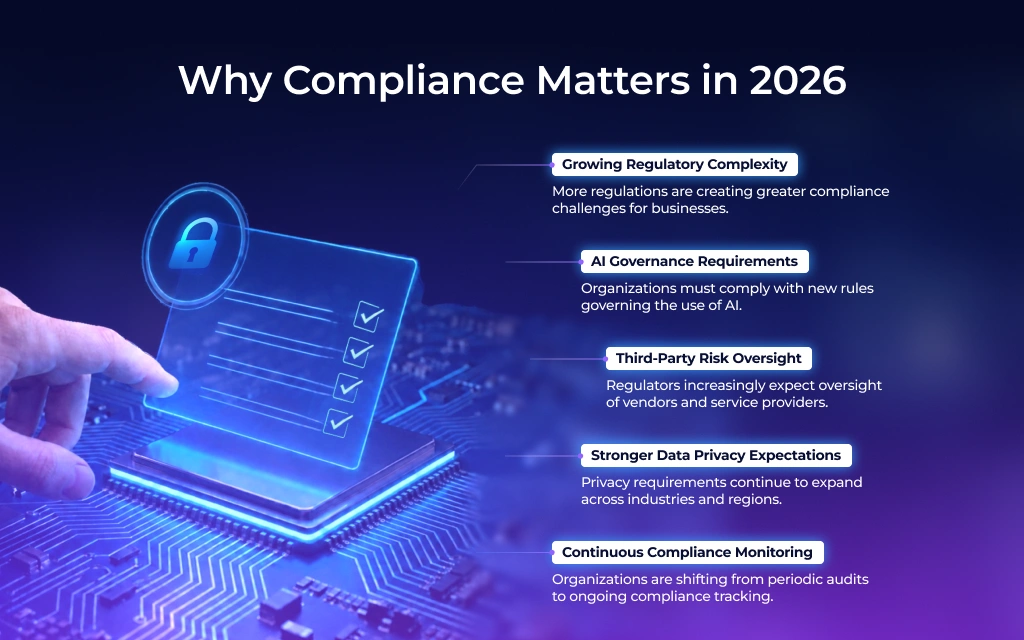
1. Regulatory Complexity Continues to Grow
Organizations today must comply with a growing number of regulations covering data privacy, cybersecurity, operational resilience, financial reporting, and industry-specific obligations. Many businesses operate across multiple jurisdictions, making compliance even more challenging.
Keeping track of evolving requirements and understanding how they apply to different business units has become a significant undertaking for compliance teams.
2. AI Creates New Compliance Obligations
The rapid adoption of artificial intelligence is creating a new category of compliance obligations. Regulations such as the EU AI Act are introducing requirements around transparency, accountability, risk management, and human oversight for AI systems.
Organizations deploying AI solutions must now consider governance and compliance requirements alongside traditional concerns such as security and privacy.
3. Third-Party Risk Is Under the Microscope
Modern businesses rely heavily on suppliers, cloud providers, software vendors, and outsourcing partners. However, regulators increasingly expect organizations to understand and manage the risks associated with these third parties.
A compliance failure within a critical vendor can create regulatory exposure, operational disruption, and reputational damage for the organization itself.
4. Data Privacy Remains a Global Priority
Privacy regulations continue to evolve around the world, with regulators placing greater emphasis on how organizations collect, store, process, and protect personal data. Customers are also becoming more aware of their privacy rights and expectations.
Organizations must maintain strong data governance practices and demonstrate that personal information is handled responsibly throughout its lifecycle.
5. Compliance Is Becoming Continuous
Traditional compliance programs often relied on manual reviews and periodic audits. In 2026, organizations are increasingly adopting automated monitoring, real-time reporting, and Governance, Risk, and Compliance (GRC) platforms to manage compliance more efficiently.
This shift helps organizations identify issues earlier, respond faster to regulatory changes, and maintain visibility across multiple compliance frameworks simultaneously.
7 Major Regulatory Compliance Frameworks Every Business Should Know
Organizations rarely operate under a single compliance requirement. A business may need to protect customer data, secure payment information, maintain accurate financial reporting, and meet industry-specific regulations simultaneously. Understanding the major compliance frameworks that shape these obligations can help organizations build a stronger and more effective compliance program.
The following frameworks are among the most widely adopted across industries and regions.
1. GDPR (General Data Protection Regulation)
GDPR is the European Union’s data privacy regulation that governs how organizations collect, process, store, and protect personal data. It applies not only to organizations located in the EU, but also to businesses worldwide that handle the personal information of EU residents.
Key benefits:
- Strengthens consumer privacy rights
- Improves transparency in data handling practices
- Establishes a consistent privacy framework across the EU
2. ISO 27001
ISO 27001 is an internationally recognized standard for information security management. It helps organizations establish an Information Security Management System (ISMS) to identify risks, implement security controls, and continuously improve their security posture.
Many organizations use ISO 27001 as the foundation for broader compliance efforts because its controls align well with multiple regulatory requirements.
Key benefits:
- Provides a structured approach to information security
- Helps reduce cybersecurity and data protection risks
- Supports compliance with multiple regulations and customer requirements
3. SOC 2
SOC 2 is a compliance framework developed by the American Institute of Certified Public Accountants (AICPA). It evaluates how organizations manage customer data based on the 5 Trust Services Criteria: security, availability, processing integrity, confidentiality, and privacy.
SOC 2 has become a common requirement for SaaS companies and cloud service providers serving enterprise customers.
Key benefits:
- Demonstrates strong data security and operational controls
- Builds customer and partner trust
- Supports enterprise sales and procurement requirements
4. HIPAA
The Health Insurance Portability and Accountability Act (HIPAA) establishes requirements for protecting healthcare information in the United States. It applies to healthcare providers, insurers, healthcare clearinghouses, and organizations that process health information on their behalf.
Organizations must implement safeguards to protect the confidentiality and security of patient data.
Key benefits:
- Protects sensitive healthcare information
- Reduces the risk of data breaches and compliance violations
- Supports trust between patients and healthcare providers
5. PCI DSS
The Payment Card Industry Data Security Standard (PCI DSS) applies to any organization that stores, processes, or transmits payment card information. The framework focuses on securing cardholder data and reducing payment-related fraud.
Although PCI DSS is not a government regulation, compliance is required by payment card brands and financial institutions.
Key benefits:
- Strengthens payment security
- Reduces fraud and data breach risk
- Helps maintain the ability to process card payments
6. SOX (Sarbanes-Oxley Act)
SOX is a U.S. regulation designed to improve corporate governance and financial reporting accuracy for publicly traded companies. It requires organizations to establish internal controls and maintain accurate records to ensure transparency and accountability.
The regulation places significant responsibility on executive leadership for the integrity of financial reporting.
Key benefits:
- Improves financial reporting accuracy
- Strengthens internal controls and governance
- Increases investor confidence and transparency
7. DORA (Digital Operational Resilience Act)
DORA is a European Union regulation focused on strengthening the operational resilience of financial institutions and their technology providers. It requires organizations to manage ICT risks, test resilience capabilities, monitor third-party providers, and report significant incidents.
As digital dependency continues to grow, DORA is becoming a key compliance requirement for organizations operating in the financial services ecosystem.
Key benefits:
- Improves operational resilience and business continuity
- Strengthens third-party risk management
- Enhances preparedness for cyber and technology-related disruptions
Regulatory Requirements by Industry
While some compliance requirements apply across multiple industries, others are highly specific to the type of business you operate. Factors such as the data you handle, the services you provide, and the regions where you operate all influence which regulations and standards apply to your organization.
Understanding your industry’s regulatory landscape is the first step toward building a targeted compliance program and avoiding unnecessary compliance gaps.
1. Healthcare
Healthcare organizations handle highly sensitive patient information and are subject to some of the strictest data protection requirements. Regulations focus on protecting patient privacy, securing medical records, and ensuring healthcare providers can respond appropriately to security incidents.
Common frameworks and regulations include HIPAA, HITECH, and GDPR when treating patients from the European Union.
Key compliance priorities:
- Patient data protection
- Access controls and encryption
- Breach notification requirements
- Third-party healthcare vendor oversight
2. Financial Services
Financial institutions operate in one of the most heavily regulated environments. Compliance requirements focus on financial integrity, customer protection, operational resilience, fraud prevention, and cybersecurity.
Common frameworks and regulations include SOX, PCI DSS, DORA, GLBA, and various regional banking regulations.
Key compliance priorities:
- Financial reporting controls
- Payment security
- Operational resilience
- Cybersecurity and fraud prevention
3. Technology and SaaS
Technology companies often manage large volumes of customer data and frequently serve clients across multiple jurisdictions. As a result, they must address privacy, cybersecurity, vendor management, and increasingly, AI governance requirements.
Common frameworks and regulations include GDPR, CCPA, ISO 27001, SOC 2, and emerging AI standards such as ISO 42001.
Key compliance priorities:
- Data privacy and protection
- Information security management
- Vendor and third-party risk management
- AI governance and transparency
4. Retail and E-Commerce
Retailers and e-commerce businesses process customer information and payment card data, making data protection and payment security critical compliance concerns. Consumer protection laws also influence how products are marketed, sold, and returned.
Common frameworks and regulations include PCI DSS, GDPR, CCPA, and consumer protection regulations.
Key compliance priorities:
- Payment card security
- Customer data protection
- Consent management
- Consumer rights and disclosures
5. Manufacturing
Manufacturers face compliance obligations related to workplace safety, environmental protection, product quality, and supply chain management. Increasingly, organizations must also demonstrate compliance across their supplier networks.
Common frameworks and regulations include workplace safety regulations, environmental standards, and industry-specific quality management requirements.
Key compliance priorities:
- Worker health and safety
- Environmental compliance
- Product quality controls
- Supply chain due diligence
6. Government and Public Sector
Government agencies and public-sector contractors are often subject to rigorous security, privacy, and operational requirements. Organizations working with government entities must demonstrate strong governance, risk management, and cybersecurity capabilities.
Common frameworks and regulations include FISMA, FedRAMP, NIST RMF, and other government-specific standards.
Key compliance priorities:
- Information security and continuous monitoring
- Data protection and privacy
- System authorization and auditing
- Secure handling of sensitive government information
The 6-Step Regulatory Compliance Program
Many organizations treat compliance as a project that begins a few weeks before an audit. In reality, compliance is an ongoing process that requires continuous attention as regulations, technologies, and business operations evolve.
A successful compliance program follows a structured approach that helps organizations identify their obligations, implement appropriate controls, and maintain compliance over time.
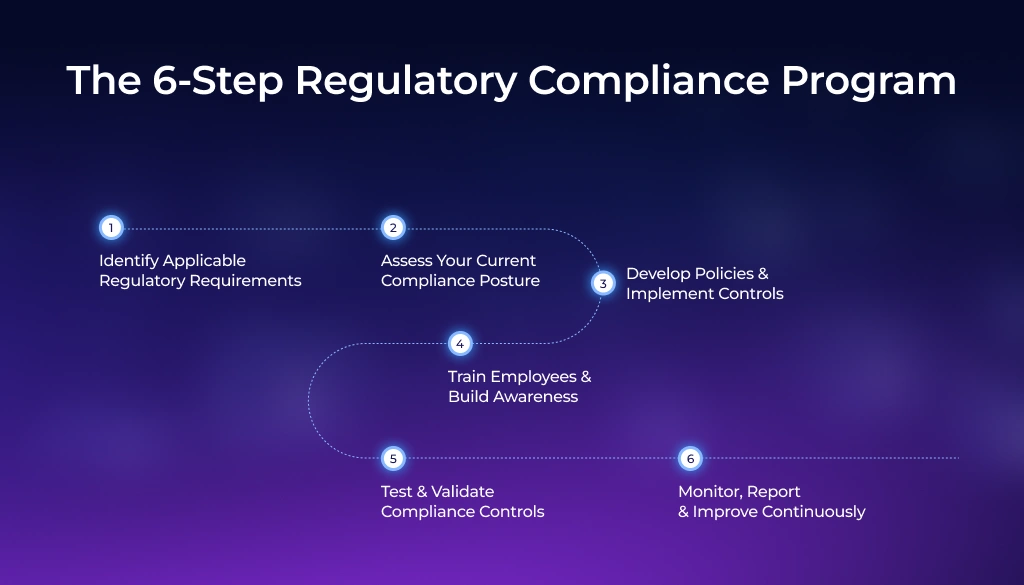
1. Identify Applicable Regulatory Requirements
The first step is understanding exactly which laws, regulations, standards, and contractual obligations apply to your organization. Requirements vary based on factors such as industry, geographic location, customer base, and the type of data you handle.
For example, a SaaS company serving European customers may need to comply with GDPR, while a healthcare technology provider may also need to meet HIPAA requirements. Identifying all applicable requirements early helps prevent compliance gaps later.
2. Assess Your Current Compliance Posture
Once requirements have been identified, organizations need to evaluate how well their existing policies, processes, and controls align with those obligations. This helps determine where gaps exist and which areas require immediate attention.
A compliance assessment provides a clear picture of current maturity and helps prioritize remediation efforts based on risk and business impact.
3. Develop Policies and Implement Controls
After identifying gaps, organizations must establish the policies, procedures, and controls needed to meet compliance requirements. These controls may be administrative, technical, or operational depending on the regulation.
The objective is to create repeatable processes that help employees follow requirements consistently while reducing the risk of violations.
4. Train Employees and Build Awareness
Compliance is not solely the responsibility of legal, compliance, or security teams. Employees across the organization play a role in protecting data, following policies, and reporting issues appropriately.
Regular training helps ensure staff understand their responsibilities and can recognize situations that may create compliance risks.
5. Test and Validate Compliance Controls
Implementing controls is only the beginning. Organizations must regularly review and test those controls to confirm they are operating as intended.
Internal audits, control testing, and compliance reviews help identify weaknesses before they become regulatory findings, customer concerns, or security incidents.
6. Monitor, Report, and Improve Continuously
Compliance is never truly finished. Regulations change, new technologies emerge, and business operations evolve. Organizations must continuously monitor their compliance status, track regulatory updates, and review the effectiveness of existing controls.
Many organizations use Governance, Risk, and Compliance (GRC) platforms to automate monitoring, evidence collection, and reporting, making it easier to manage multiple frameworks simultaneously.
Common Regulatory Compliance Challenges — and How to Solve Them
Maintaining compliance has become increasingly difficult as organizations face a growing number of regulations, security requirements, customer expectations, and reporting obligations. While every organization faces unique challenges, several issues consistently appear across industries and compliance programs.
Understanding these challenges—and how to address them—can help organizations build a more sustainable and effective compliance strategy.
1. Managing Multiple Compliance Frameworks
Many organizations must comply with several regulations and standards simultaneously. For example, a business may need to meet GDPR requirements for privacy, ISO 27001 for information security, PCI DSS for payment processing, and SOC 2 for enterprise customers.
How to solve it: Instead of managing each framework separately, establish a unified control framework that maps common controls across multiple regulations. This reduces duplication, simplifies audits, and improves efficiency.
2. Keeping Up With Regulatory Change
Compliance requirements continue to evolve as governments and regulators introduce new laws covering privacy, cybersecurity, operational resilience, ESG reporting, and artificial intelligence.
How to solve it: Create a formal process for monitoring regulatory updates, reviewing compliance impacts, and updating policies and controls regularly. Many organizations also use regulatory intelligence services or GRC platforms to track changes automatically.
3. Managing Third-Party and Vendor Risk
Organizations increasingly depend on vendors, cloud providers, and outsourcing partners. However, regulators often hold organizations accountable for compliance failures that originate within their supply chain.
How to solve it: Implement a third-party risk management program that includes vendor assessments, security reviews, contractual compliance requirements, and ongoing monitoring of critical suppliers.
4. Limited Resources and Compliance Expertise
Many organizations do not have dedicated compliance teams large enough to manage multiple frameworks, audits, and reporting obligations simultaneously. This can lead to gaps, delays, and inconsistent compliance activities.
How to solve it: Prioritize requirements based on risk, automate repetitive tasks where possible, and consider working with external compliance specialists when internal resources are limited.
5. Collecting Audit Evidence
Preparing for audits often requires gathering policies, training records, risk assessments, system logs, and control documentation from multiple departments. Manual evidence collection can become time-consuming and error-prone.
How to solve it: Centralize compliance documentation and automate evidence collection wherever possible. This improves audit readiness and reduces the administrative burden on compliance teams.
6. Addressing AI and Emerging Regulatory Requirements
New regulations focused on artificial intelligence, digital resilience, and advanced technologies are creating additional compliance obligations for many organizations. Requirements are evolving quickly, making it difficult for businesses to understand what applies to them.
How to solve it: Extend existing governance and risk management processes to include AI systems, emerging technologies, and new regulatory requirements. Organizations that prepare early will be better positioned to adapt as enforcement expands.
Benefits of a Strong Regulatory Compliance Program
Many organizations view compliance as a cost of doing business. In reality, a well-managed compliance program delivers benefits that extend far beyond avoiding fines and passing audits. It helps organizations strengthen governance, reduce risk, build trust, and create a stronger foundation for growth.
Below are some of the key benefits organizations gain from building and maintaining a strong regulatory compliance program:
1. Reduces the Risk of Fines, Lawsuits, and Business Disruption
The most obvious benefit of compliance is reducing exposure to regulatory penalties and legal action. Regulations such as GDPR, HIPAA, PCI DSS, and DORA can carry significant financial consequences when requirements are not met.
Beyond fines, compliance failures often trigger investigations, remediation costs, operational disruption, and reputational damage. A proactive compliance program helps organizations identify issues early and address them before they escalate into costly incidents.
2. Builds Customer and Stakeholder Trust
Customers, investors, and business partners increasingly want assurance that organizations can protect sensitive information and operate responsibly. Demonstrating compliance with recognized standards shows that the organization has established processes, controls, and governance mechanisms to manage risk effectively.
This trust can strengthen customer relationships, improve brand reputation, and reduce concerns during security reviews and contract negotiations.
3. Improves Market Access and Supports Business Growth
Compliance is now a requirement for doing business in many industries. Enterprise customers frequently require vendors to demonstrate compliance with frameworks such as ISO 27001, SOC 2, HIPAA, or PCI DSS before contracts can be signed.
Organizations with a mature compliance program can move through procurement processes faster, qualify for more opportunities, and compete more effectively in regulated markets.
4. Strengthens Operational Resilience
Compliance programs require organizations to document processes, assign responsibilities, test controls, and establish incident response procedures. These activities not only support regulatory requirements but also improve the organization’s ability to respond to disruptions and unexpected events.
As a result, businesses are often better prepared for cyber incidents, operational failures, regulatory changes, and other forms of disruption.
5. Improves Governance and Decision-Making
Effective compliance programs provide leadership with better visibility into regulatory obligations, operational risks, and control effectiveness. This allows executives and boards to make more informed decisions about investments, risk management, and business strategy.
Rather than reacting to compliance issues after they occur, organizations can use compliance data to identify trends, prioritize resources, and support long-term planning.
Conclusion
Regulatory requirements are no longer limited to highly regulated industries. Today, organizations of all sizes must navigate a growing number of privacy laws, cybersecurity standards, operational resilience requirements, and industry-specific regulations. As enforcement increases and customer expectations continue to rise, compliance has become a critical business function rather than an administrative obligation.
The organizations that succeed are those that treat compliance as an ongoing program—one that combines governance, risk management, employee awareness, and continuous monitoring. By understanding which regulations apply, implementing the right controls, and maintaining visibility into compliance status, businesses can reduce risk, build trust, and create a stronger foundation for growth.
Need help navigating complex regulatory requirements? Terralogic’s Governance, Risk, and Compliance (GRC) services help organizations assess compliance gaps, implement frameworks, strengthen governance, and maintain continuous compliance across regulations such as GDPR, HIPAA, PCI DSS, ISO 27001, and DORA.