

What Is GRC? A Beginner’s Guide to Governance, Risk & Compliance
Published: May 29, 2026
Last Updated: June 13, 2026
Most organizations already understand what GRC stands for. The harder question is what to actually do with it.
Many organizations are still managing compliance reactively — and the cost of that approach is measurable. IBM’s 2024 Cost of a Data Breach Report found the global average breach cost reached $4.88 million, a 10% increase from the prior year.
The gap between knowing GRC matters and knowing how to build it effectively is where most organizations get stuck. This guide is built for that gap. In this article, we’ll explain how to assess GRC maturity, choose the right framework, conduct risk assessments, and dive into how modern GRC audits work
Key Takeaways
- Most organizations are stuck between Level 1 and Level 2 GRC maturity — managing compliance reactively rather than maintaining continuous readiness, leaving them vulnerable to costly breaches averaging $4.88 million in 2024.
- There is no one-size-fits-all GRC framework — the right combination depends on three inputs: regulatory obligations (GDPR, DORA, NIS2, etc.), customer and market requirements (SOC 2, ISO 27001), and operational complexity.
- A structured 6-stage risk assessment is the foundation of every effective GRC program — from identifying regulatory requirements to continuously monitoring risks and documenting findings for audit readiness.
- Modern GRC audits go beyond annual reviews — organizations in 2026 are using continuous monitoring, automated evidence collection, and centralized GRC platforms to stay audit-ready year-round, not just at compliance deadlines
- GRC is now a strategic business function, not just a compliance checkbox — at peak maturity, it informs executive decisions on budgets, vendor selection, and product launches, with risk reporting that speaks directly to business impact at the board level.
GRC Maturity Model — Where Does an Organization Stand?
Before selecting a framework or investing in a platform, organizations need to understand their current GRC maturity level. The maturity level determines what kind of investment is actually needed — whether that is framework design, technology deployment, or a full program rebuild.
There are 4 maturity levels, and most organizations sit somewhere between Level 1 and Level 2!
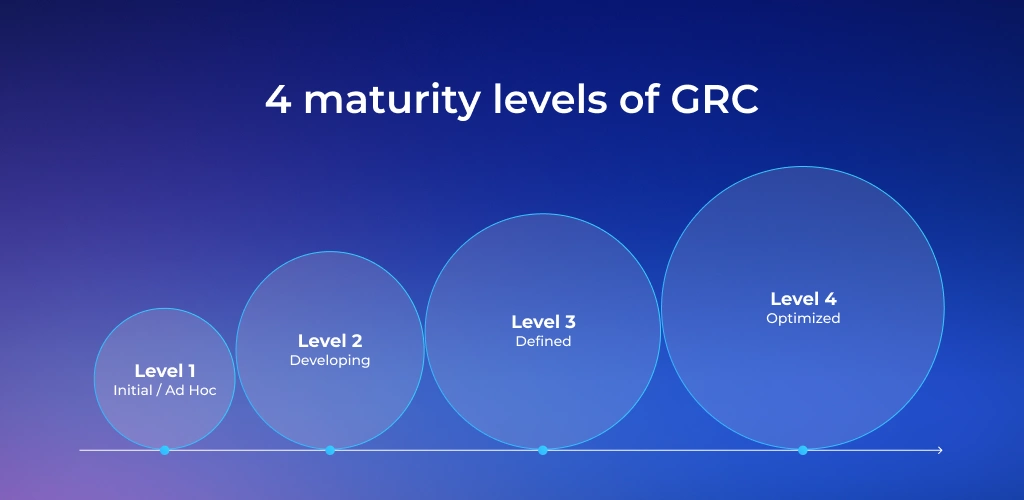
Level 1 — Initial / Ad Hoc
At this level, there is no formal GRC program. Compliance is managed reactively, meaning teams respond to audit requests or regulatory deadlines as they arrive rather than maintaining continuous readiness. Risk decisions are made inconsistently, without a shared methodology. Each compliance obligation tends to be handled separately by different teams — legal manages one regulation, IT manages another, and finance manages a third — with no shared control framework to connect them.
The most visible failure mode at this level: when an external audit request arrives, teams scramble to produce evidence that was never systematically collected.
Level 2 — Developing
Some GRC processes exist at this level, but they are not consistently documented, integrated, or applied across the organization. Compliance tends to be point-in-time; the team works hard to get audit-ready each year, then returns to day-to-day operations without maintaining the evidence or monitoring the controls that were just audited. GRC software is either absent or very basic.
According to PwC’s Global Digital Trust Insights research, most organizations currently operate at this level. They have invested some resources in governance and compliance, but have not yet connected those efforts into a functioning program.
Level 3 — Defined
At this level, a formal GRC framework is in place. Security controls are documented and mapped to specific regulatory obligations. A GRC platform has been deployed to centralize policy management, risk tracking, and audit evidence. Risk assessments are conducted on a regular schedule, and the board receives periodic compliance and risk reporting.
The key shift from Level 2 to Level 3 is that GRC becomes a managed discipline rather than a series of one-off compliance efforts.
Level 4 — Optimized
At the highest maturity level, GRC is a strategic function rather than a compliance department. Controls are monitored continuously rather than tested periodically. Risk scoring uses quantitative models that produce financial impact estimates that the board can act on. Regulatory change alerts are automated. Controls are mapped once and reused across multiple frameworks simultaneously, with no duplicated effort. GRC insights actively inform business decisions, including budget allocation, vendor selection, and product launches.
GRC Framework Selection — A Decision Guide for 2026
No single GRC framework covers every regulatory, operational, and business requirement. Most organizations operating across multiple regions, industries, or customer segments need to implement a combination of frameworks, and the right combination depends on 3 key inputs.
1. Regulatory Obligations
Regulatory obligations are the non-negotiable starting point of every GRC program. These requirements define the minimum governance, security, and compliance standards an organization must satisfy.
In 2026, several major regulations are actively shaping enterprise GRC strategies.
- NIS2 — Applies to organizations operating critical infrastructure and essential services across EU member states. Supervisory enforcement is now active across several EU countries, with formal compliance notices and remediation requirements already being issued. Financial penalties are expected to follow as enforcement continues to mature.
- DORA (Digital Operational Resilience Act) — Applies to financial entities operating in the European Union, including banks, insurance companies, and ICT service providers. DORA became fully enforceable from January 2025 and introduced stricter operational resilience, incident reporting, and third-party risk management requirements.
- EU AI Act — Introduces governance and compliance requirements for organizations developing or deploying AI systems. The regulation follows a phased enforcement model based on AI risk classification.
- GDPR — Continues to apply to organizations handling personal data belonging to EU residents. The regulation remains one of the most influential global privacy frameworks, with ongoing enforcement activity and significant penalties for non-compliance.
- PCI DSS 4.0.1 — PCI DSS v3.2.1 was officially retired on 31 March 2024. Organizations handling payment card data are now required to comply with PCI DSS v4.0.1, with all future-dated requirements becoming mandatory from 31 March 2025.
- SEC Cybersecurity Disclosure Rules — Apply to US-listed public companies. Organizations must disclose material cybersecurity incidents within 4 business days after determining the incident is material.
2. Customer & Market Requirements
Beyond legal obligations, many organizations must also satisfy customer-driven security and compliance expectations.
Enterprise buyers, especially in sectors such as financial services, healthcare, SaaS, and government contracting, often evaluate vendors against specific security frameworks before signing contracts.
- SOC 2 Type II — Has become the standard expectation for many SaaS companies selling into the US enterprise market. The framework validates that security controls are not only designed properly, but are also operating effectively over a defined audit period.
- ISO 27001 — Is increasingly required in global enterprise procurement processes, particularly across European markets. The framework helps organizations establish a structured information security management system (ISMS) and demonstrate long-term governance maturity.
- NIST CSF 2.0 — Is widely used across US government agencies, contractors, and regulated industries. Many organizations also adopt NIST CSF voluntarily because it provides a flexible structure for managing cybersecurity governance, risk management, and operational resilience.
3. Operational Complexity
Operational complexity determines how extensive the GRC compliance program needs to become.
Factors such as geographic presence, number of business units, cloud environments, third-party vendors, and sensitive data types all affect framework selection and implementation scope.
For example, a smaller SaaS company operating in a single region may begin with SOC 2 Type II alone. A multinational financial institution operating across the EU and US may need to integrate DORA, GDPR, ISO 27001, SEC disclosure rules, and additional regional requirements into one unified control structure.
As organizations mature, many adopt a control rationalization approach. Instead of maintaining separate controls for each framework, organizations map controls once and reuse them across multiple audits, regulations, and compliance obligations simultaneously.
GRC Risk Assessment — The Foundation of Every GRC Program
A GRC risk assessment is the process of identifying, evaluating, and managing risks that could affect an organization’s operations, security, compliance, or business objectives.
Without a structured risk assessment process, organizations often struggle to prioritize risks, allocate resources effectively, or maintain consistent compliance across different frameworks and business units.
Modern GRC risk management programs are no longer limited to annual assessments or spreadsheet-based reviews. In 2026, organizations are moving toward continuous risk monitoring supported by automation, centralized reporting, and real-time visibility into operational and compliance risks.
A mature GRC risk assessment process is typically built around 6 key stages:
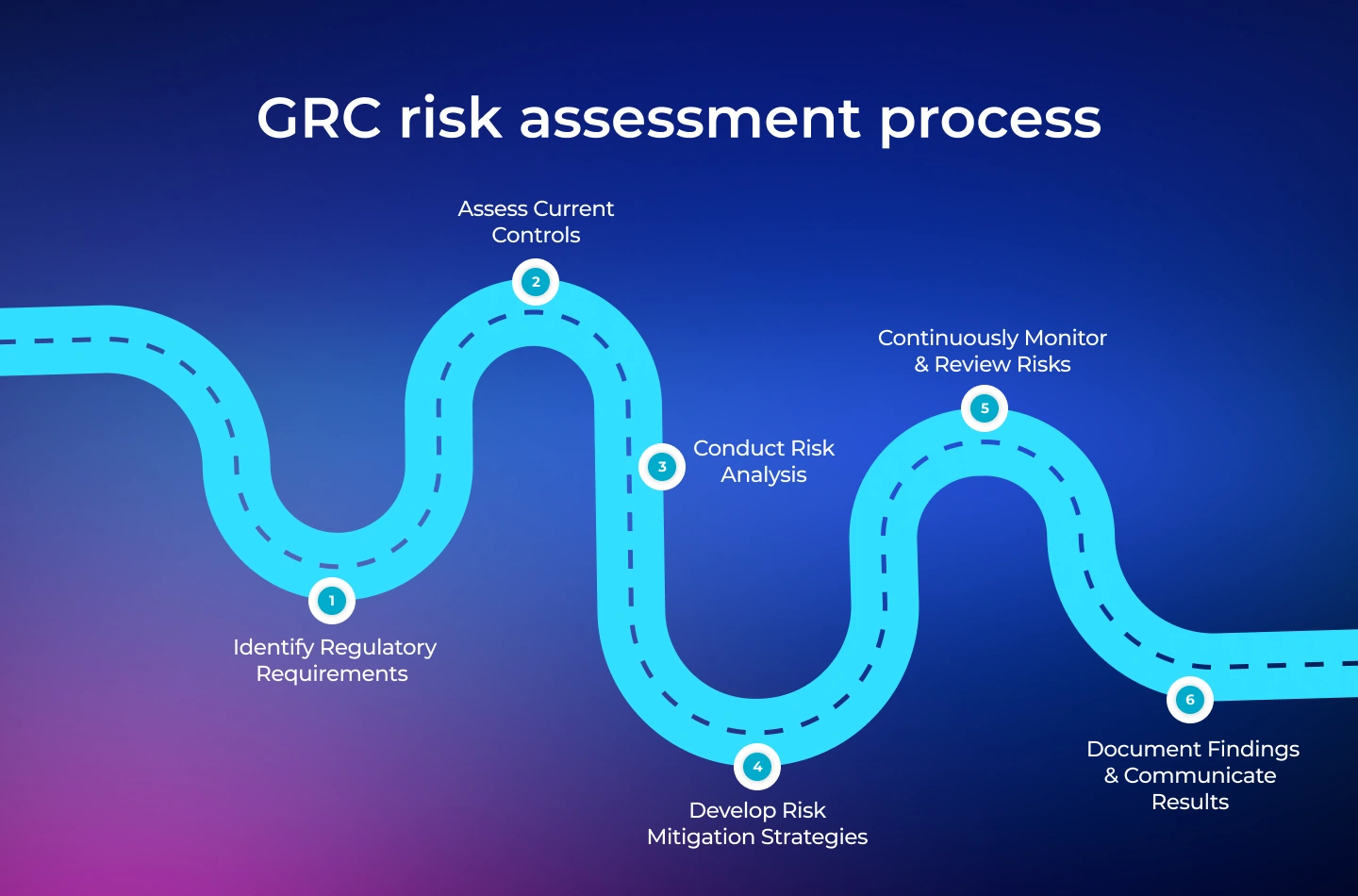
1. Identify Regulatory Requirements
The first step is identifying which regulations, security standards, and compliance requirements apply to the organization.
Different industries and regions have different requirements. For example, a healthcare provider may need to follow HIPAA, while a SaaS company selling to enterprise customers may need SOC 2 or ISO 27001.
Understanding these requirements early helps organizations avoid compliance gaps, failed audits, and unexpected security risks.
2. Assess Current Controls
After identifying compliance requirements, organizations review their current security controls, policies, and operational processes.
The goal is to understand what is already working, where gaps exist, and which areas need improvement.
This may include reviewing:
- Security policies
- Access controls
- Incident response processes
- Vendor management procedures
- Existing audit findings
Organizations often use internal reviews, control testing, and third-party audits to evaluate how effective their controls actually are.
3. Conduct Risk Analysis
Once control gaps are identified, organizations evaluate which risks could create the biggest operational, financial, or compliance impact.
Some risks are more likely to happen, while others may cause more serious business disruption if they occur. Risk analysis helps organizations prioritize which issues should be addressed first.
For example, a cloud storage misconfiguration may expose sensitive customer data, while weak vendor access controls may increase third-party security risk.
Many organizations now combine traditional risk analysis with threat intelligence, AI-driven monitoring, and continuous risk visibility tools.
4. Develop Risk Mitigation Strategies
After risks are prioritized, organizations create action plans to reduce or manage them.
Some risks can be reduced through stronger security controls or updated policies. Others may be transferred through cyber insurance or accepted if the business impact is low.
Common mitigation actions include:
- Strengthening access controls
- Improving employee security training
- Adding continuous monitoring tools
- Updating incident response procedures
- Limiting third-party access permissions
Organizations also assign owners, timelines, and responsibilities to ensure remediation efforts are completed.
5. Continuously Monitor & Review Risks
Cyber risks and compliance requirements constantly change, which means risk assessments cannot remain static.
Organizations need ongoing visibility into security risks, policy compliance, vendor exposure, and control performance.
Many mature GRC compliance programs use continuous monitoring and Key Risk Indicators (KRIs) to identify rising risks before they become larger incidents.
For example, repeated failed login attempts, delayed security patching, or overdue policy approvals may indicate growing operational risk.
6. Document Findings & Communicate Results
Every stage of the GRC risk assessment process should be properly documented.
Organizations need clear records of identified risks, mitigation plans, audit findings, policy updates, and compliance activities.
Good documentation improves audit readiness, supports regulatory reporting, and helps leadership teams make faster and more informed decisions.
In 2026, many organizations use centralized GRC software and GRC platforms to automate documentation, reporting, and risk tracking across different teams and business units.
GRC Audit Process — How Modern GRC Audits Work
A GRC audit helps organizations evaluate whether governance processes, security controls, and compliance activities are operating effectively.
Modern audits are no longer limited to annual compliance reviews. In 2026, organizations are increasingly using continuous monitoring, centralized GRC software, and automated evidence collection to improve audit readiness and reduce manual work.
A structured GRC audit process is typically built around 8 key steps:
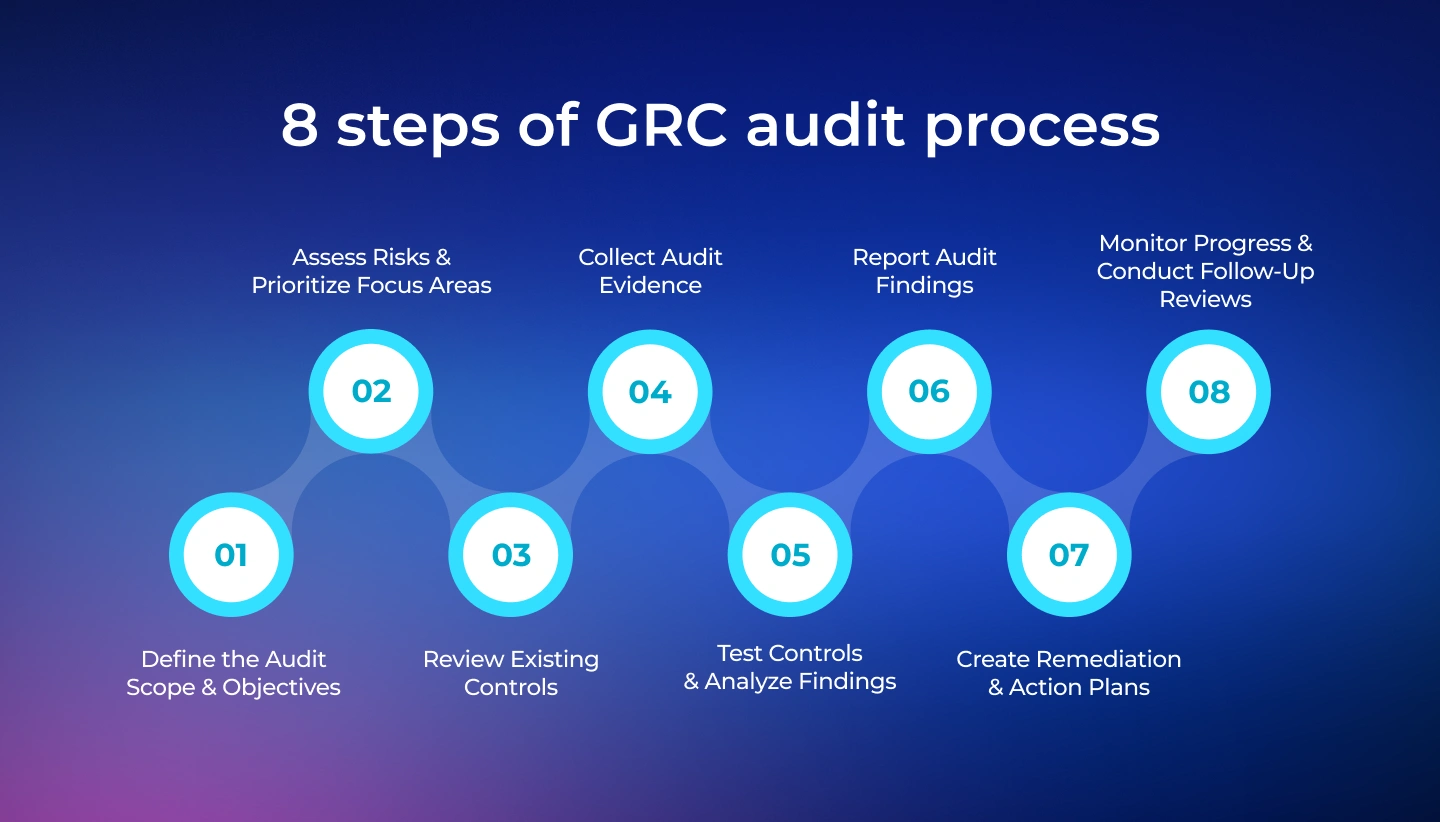
1. Define the Audit Scope & Objectives
Every audit starts by defining what will be reviewed and why. Organizations first identify which business units, systems, regulations, policies, or security controls are included in the audit scope.
This stage is important because it helps audit teams focus on the areas that create the highest operational or compliance risk. It also aligns expectations between audit teams, security leaders, compliance managers, and executive stakeholders before the audit begins.
Common audit objectives may include:
- Evaluating regulatory compliance
- Reviewing security control effectiveness
- Identifying operational risks
- Validating governance processes
- Preparing for external certification audits
2. Assess Risks & Prioritize Focus Areas
Once the scope is defined, organizations identify which risks should receive the most attention during the audit. Not every system or process carries the same level of risk, so audit teams need to prioritize the areas that could create the biggest operational, financial, or compliance impact.
This approach allows organizations to focus audit resources more effectively instead of reviewing every process with the same level of attention.
For example, organizations may prioritize cloud security, third-party vendor access, privileged accounts, or critical business applications based on operational impact and regulatory exposure.
Many organizations use risk heat maps, historical incident data, and GRC risk assessment results to guide audit priorities.
3. Review Existing Controls
After identifying key risks, auditors evaluate the controls currently used to manage them. The goal is to determine whether existing policies, procedures, and security controls are properly designed and consistently followed across the organization.
This may include reviewing:
- Security policies
- Access management controls
- Incident response procedures
- Vendor management processes
- Compliance documentation
- Monitoring and reporting workflows
4. Collect Audit Evidence
Modern GRC compliance audits rely heavily on evidence. Organizations need documentation and system records that prove security controls and governance processes are operating correctly in practice.
Organizations gather logs, policies, screenshots, system records, access reports, audit trails, and other documentation that prove controls are functioning correctly.
In many organizations, centralized GRC platforms help automate evidence collection and reduce the time spent preparing for audits.
5. Test Controls & Analyze Findings
At this stage, auditors validate whether security controls and governance processes work effectively in practice. Even if policies are documented correctly, organizations still need to verify that controls are consistently followed across day-to-day operations.
This may involve interviews, walkthroughs, control testing, sample reviews, or technical validation activities.
Any gaps, weaknesses, or failed controls are documented and analyzed based on their operational, security, and compliance impact.
6. Report Audit Findings
Once testing is completed, audit teams summarize their findings in a structured report. The purpose of the report is not only to document issues, but also to help leadership teams understand the organization’s current risk and compliance posture.
A typical audit report includes identified risks, failed controls, compliance gaps, remediation recommendations, and overall audit conclusions.
Strong reporting helps leadership teams understand which issues require immediate action and which risks may affect business operations, compliance status, or cybersecurity posture.
7. Create Remediation & Action Plans
The audit process should lead to corrective action, not just documentation. After identifying gaps or failed controls, organizations need clear remediation plans to reduce risk and improve compliance performance.
Organizations work with security, compliance, IT, and operational teams to create remediation plans that address identified issues.
This often includes assigning responsibilities, defining timelines, updating controls, and improving governance processes.
8. Monitor Progress & Conduct Follow-Up Reviews
A mature GRC program continuously tracks remediation progress after the audit is completed. Organizations need ongoing visibility into whether corrective actions were implemented successfully and whether identified risks were actually reduced over time.
Follow-up reviews help organizations verify whether corrective actions were implemented successfully and whether identified risks were reduced effectively.
Choosing GRC Consultants — What to Evaluate
As regulatory requirements become more complex, many organizations work with external GRC consultants to accelerate implementation, improve governance visibility, and strengthen compliance programs.
However, not all consulting partners provide the same level of expertise, operational support, or industry experience. Choosing the right partner can significantly affect how successful and scalable the GRC program becomes over time.
1. Multi-Framework Expertise
Modern organizations rarely operate under a single framework. A strong consulting partner should understand how different regulations and frameworks work together across multiple environments.
This may include experience with NIST CSF 2.0, ISO 27001, SOC 2, GDPR, NIS2, DORA, HIPAA, PCI DSS 4.0.1, or the EU AI Act.
Organizations should evaluate whether the consultant can build integrated control structures across multiple frameworks instead of managing each requirement separately.
2. Technology-Agnostic Recommendations
Some consulting firms are heavily tied to specific GRC software vendors or preferred platforms.
Organizations should evaluate whether the consulting partner recommends the best-fit solution for the business environment or simply pushes a single platform regardless of operational needs, budget, or technical maturity.
A strong partner should help organizations select platforms based on scalability, integration capabilities, reporting requirements, and operational complexity.
3. Ongoing Support & Managed Services
GRC is not a one-time implementation project. Regulations, risks, and operational environments continuously evolve.
Many organizations now look for consulting partners that provide ongoing support, such as continuous monitoring, regulatory change tracking, audit preparation, compliance reporting, and long-term program management.
This helps organizations maintain operational continuity instead of rebuilding processes every time new compliance requirements emerge.
4. Industry-Specific Experience
GRC requirements vary significantly between industries. Financial institutions may prioritize DORA and operational resilience requirements, while healthcare organizations focus heavily on HIPAA and patient data protection.
SaaS companies often prioritize SOC 2 and cloud governance, while critical infrastructure operators may face stricter NIS2 obligations.
Organizations should evaluate whether the consulting partner has experience managing compliance and risk requirements within their specific industry environment.
5. Executive & Board-Level Reporting Capability
One of the biggest challenges in modern GRC risk management is translating technical risks into business language.
Strong consulting partners should be able to communicate governance, compliance, and cybersecurity risks in a way that executives and board members can clearly understand.
This includes building executive dashboards, simplifying risk reporting, and helping leadership teams connect cyber risk exposure to operational and business impact.
How Terralogic Delivers GRC as a Cybersecurity Service
Terralogic provides GRC services as part of its broader cybersecurity portfolio, helping organizations improve governance visibility, manage cyber risks, and maintain regulatory compliance across evolving digital environments.
The company’s GRC approach focuses on 3 core areas: governance, risk management, and compliance.
1. Governance
Terralogic helps organizations align governance processes, security activities, and operational responsibilities with broader business objectives.
The company also focuses on establishing accountability structures that improve security oversight and governance management across teams.
2. Risk Management
Terralogic supports organizations through risk assessments, risk analysis, prioritization, root cause analysis, mitigation planning, and trend analysis.
This helps organizations identify operational and cybersecurity risks earlier while improving long-term risk visibility and response planning.
3. Compliance
Terralogic helps organizations maintain compliance with legal, regulatory, and industry requirements through assessments, audits, issue tracking, remediation support, and reporting analytics.
The company’s GRC capabilities also include enterprise risk management, third-party risk assessment, audit management, document management, and reporting & analytics.
For organizations looking to strengthen governance, reduce compliance gaps, and improve operational resilience, partnering with Terralogic can help build a more scalable and integrated GRC security strategy.
Conclusion
In 2026, GRC is no longer treated as a standalone compliance function or a one-time implementation project. Organizations are building integrated governance, risk, and compliance programs that continuously connect cybersecurity, operational resilience, regulatory compliance, and executive decision-making.
As regulatory requirements continue to expand, organizations are also facing growing pressure to improve governance visibility, strengthen audit readiness, and provide clearer risk reporting at the executive and board level.
At the same time, technologies such as continuous control monitoring, predictive risk scoring, AI-driven analytics, and automated evidence collection are changing how modern GRC programs operate.
The organizations leading in 2026 are not only responding to compliance requirements after audits occur. They are using proactive GRC risk management strategies to identify risks earlier, improve governance accountability, and strengthen long-term operational resilience.
For organizations looking to modernize governance processes, reduce compliance gaps, and improve cybersecurity visibility, partnering with Terralogic can help build a more scalable and integrated GRC security strategy.
Frequently Asked Questions (FAQs)
1. What does GRC stand for?
GRC stands for Governance, Risk, and Compliance. It is a structured approach that helps organizations manage governance processes, identify and reduce operational and cybersecurity risks, and maintain compliance with legal, regulatory, and industry requirements.
2. What is the difference between GRC software and GRC as a service?
GRC software provides tools for managing governance workflows, compliance monitoring, audit management, risk assessments, and reporting.
GRC as a service combines technology with ongoing consulting, monitoring, implementation, and operational support provided by external specialists or managed service partners.
3. Which GRC framework should my organization implement in 2026?
The right GRC framework depends on the organization’s industry, regulatory obligations, customer requirements, and operational complexity.
Many organizations combine frameworks such as ISO 27001, NIST CSF 2.0, SOC 2, PCI DSS 4.0.1, DORA, GDPR, or NIS2 based on their business environment and compliance needs.
4. How long does it take to build a GRC program?
The timeline depends on the organization’s size, regulatory complexity, existing security maturity, and implementation scope.
Smaller organizations may establish a foundational GRC program within several months, while larger enterprises managing multiple frameworks and global operations may require a phased implementation approach over a longer period.
Keep reading about
LEAVE A COMMENT
We really appreciate your interest in our ideas. Feel free to share anything that comes to your mind.


Let's Craft Brilliance
Just exploring? Let's think out loud together. We would love to hear from you. Come, let's get started!