


Only a small percentage of organizations have a mature enterprise risk management (ERM) program that successfully connects risk insights to strategic business decisions. Many organizations still manage risks through spreadsheets, disconnected processes, and department-specific assessments that rarely provide a complete picture of enterprise-wide exposure.
The challenge in 2026 is no longer recognizing the importance of risk management. Organizations are dealing with increasingly complex threats across cybersecurity, operations, regulatory compliance, third-party ecosystems, and business strategy. As these risks become more interconnected, leaders need a more structured way to understand how a single event can affect multiple parts of the organization simultaneously.
Rather than managing risks in separate departments, an enterprise risk management framework creates a unified approach for identifying, assessing, prioritizing, and monitoring risks across the entire business. The goal is not simply to reduce risk, but to help organizations make better decisions, allocate resources more effectively, and improve long-term resilience.
Whether you are building an ERM program from scratch, evaluating enterprise risk management software, or looking to mature an existing framework, understanding the right combination of governance, processes, technology, and reporting is essential.
In this guide, we’ll explain what enterprise risk management is, how leading ERM frameworks compare, the steps involved in the enterprise risk management process, how ERM software supports implementation, and how organizations can scale risk management through managed services and integrated enterprise GRC programs.
Key Takeaways
- Enterprise risk management provides a structured, organization-wide approach to identifying, assessing, managing, and monitoring risks that could affect business objectives.
- COSO ERM and ISO 31000 remain the two most widely adopted frameworks. Many mature organizations use elements of both to support governance, risk oversight, and strategic decision-making.
- One of the most common ERM failures is treating risk management as a compliance exercise rather than a strategic business capability that informs leadership decisions.
- Managed ERM services are becoming an increasingly popular model for mid-sized organizations that need specialized expertise, continuous monitoring, and enterprise-level risk management without building a large internal team.
What Is Enterprise Risk Management (ERM)?
Enterprise risk management (ERM) is a structured, organization-wide approach to identifying, assessing, managing, and monitoring risks that could affect business objectives. Unlike traditional risk management, which often focuses on individual departments or specific risk categories, ERM provides a unified view of risk across the entire organization.
The primary goal of an enterprise risk management framework is to connect risk management with business strategy. Rather than treating risk as a compliance requirement or audit activity, ERM helps leadership understand how potential threats and opportunities can influence growth, operations, financial performance, and long-term resilience.
Traditional Risk Management vs. ERM
Traditional risk management is often managed in silos. IT teams focus on cybersecurity risks, finance teams manage financial risks, legal teams oversee regulatory compliance, and operational teams address process-related issues. While each team may manage its risks effectively, the organization often lacks a complete view of how these risks interact.
ERM brings these perspectives together through a common methodology, centralized oversight, and consistent reporting. This allows leadership teams to evaluate risks across the business and make more informed decisions based on overall organizational exposure.
Types of Risks Covered by ERM
A mature ERM framework typically manages multiple categories of risk across the organization, including:
- Operational risks
- Financial risks
- Strategic risks
- Compliance and regulatory risks
- Cybersecurity and technology risks
- Third-party and supply chain risks
- Environmental, Social, and Governance (ESG) risks
ERM Framework Selection
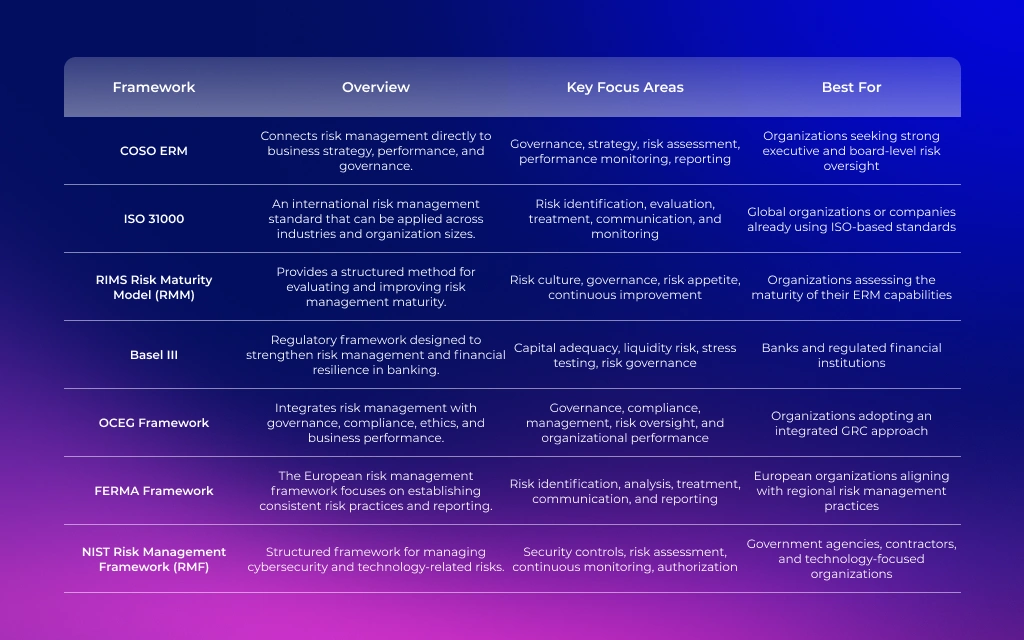
Choosing the right enterprise risk management framework is one of the most important decisions when building an ERM program. A framework provides the structure, governance model, and methodology that organizations use to identify, assess, manage, and monitor risks across the business.
There is no single framework that fits every organization. The best choice depends on factors such as industry requirements, regulatory obligations, organizational maturity, and business objectives. While some frameworks focus on strategic decision-making and governance, others emphasize operational risk management, compliance, or risk maturity assessment.
The ERM Process — 5 Steps to Implementation
An effective enterprise risk management process is not a one-time exercise. It is a continuous cycle that helps organizations identify emerging risks, evaluate their potential impact, implement appropriate responses, and monitor changes over time.
While the specific methodology may vary across industries, most mature enterprise risk management frameworks follow 5 core steps that create a consistent approach to risk management across the organization.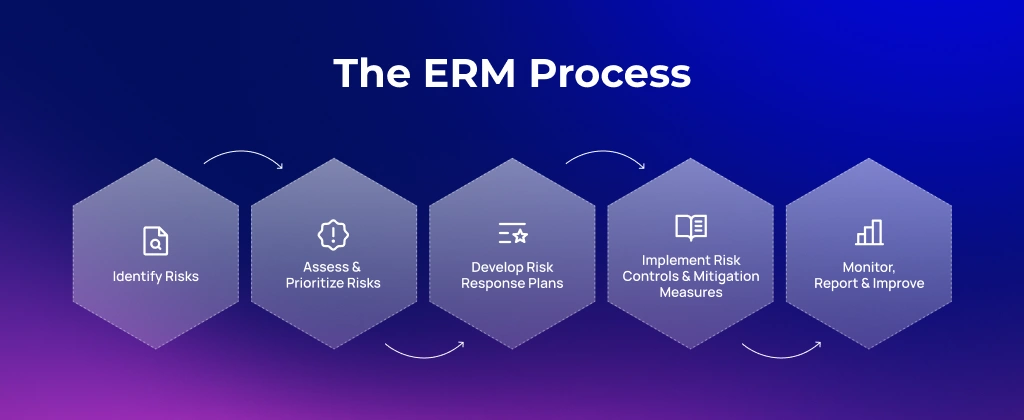
1. Identify Risks
The first step is identifying the events, conditions, or trends that could affect business objectives. These risks may originate from internal operations, technology systems, third-party relationships, regulatory changes, financial pressures, or broader market conditions.
Organizations should look beyond current issues and consider emerging risks that may affect future growth or strategic initiatives. The goal is to create a comprehensive view of potential threats and opportunities across the enterprise.
Common risk categories include:
- Operational risks
- Financial risks
- Strategic risks
- Compliance risks
- Cybersecurity and technology risks
- Third-party and supply chain risks
- ESG and reputational risks
2. Assess & Prioritize Risks
Once risks are identified, organizations evaluate how likely each risk is to occur and the level of impact it could have on business objectives.
Many organizations use a combination of qualitative and quantitative analysis to assess risk severity. Factors such as financial impact, operational disruption, regulatory consequences, reputational damage, and the effectiveness of existing controls are often considered during this stage.
After assessment, risks are prioritized so leadership teams can focus resources on the issues that present the greatest exposure. Risk heat maps and scoring models are commonly used to visualize and compare risks across the organization.
3. Develop Risk Response Plans
Not every risk should be managed in the same way. Once priorities are established, organizations determine the most appropriate response strategy for each risk.
In most ERM frameworks, risk responses generally fall into 4 categories:
- Mitigate — Reduce the likelihood or impact of the risk
- Transfer — Shift part of the risk to a third party, such as through insurance or contractual agreements
- Avoid — Eliminate the activity creating the risk
- Accept — Acknowledge and monitor the risk when the potential impact is within the organization’s risk tolerance.
4. Implement Risk Controls & Mitigation Measures
After response plans are approved, organizations implement the policies, controls, processes, and governance mechanisms needed to manage identified risks.
Examples may include strengthening cybersecurity controls, updating operational procedures, introducing vendor management requirements, improving employee training, or implementing new monitoring technologies.
Successful implementation requires collaboration across business units. Risk management becomes far more effective when ownership is clearly assigned and accountability is built into daily operations.
5. Monitor, Report & Improve
The final step focuses on measuring the effectiveness of risk management activities and identifying changes in the risk landscape.
Organizations continuously monitor key risks, review control performance, track mitigation progress, and evaluate whether risk responses remain effective. Emerging threats, regulatory changes, business expansion, and technology adoption may all require adjustments to the ERM strategy.
Many organizations use Key Risk Indicators (KRIs), executive dashboards, and regular reporting cycles to provide leadership with ongoing visibility into enterprise risk exposure.
ERM is most effective when it becomes part of strategic decision-making rather than a periodic compliance exercise. Continuous monitoring and regular review help organizations adapt faster, improve resilience, and maintain alignment between risk management and business objectives.
Implementation Tip: Start with a pilot program in a single business unit or risk category before rolling out ERM across the entire organization. Attempting a full enterprise-wide implementation from day one is one of the most common reasons ERM initiatives lose momentum.
Enterprise Risk Management Services — The Managed Model
Building and maintaining an effective enterprise risk management program requires more than a framework or software platform. Organizations need governance structures, risk assessment processes, reporting mechanisms, and ongoing oversight to ensure the program continues to deliver value over time.
For many organizations, developing these capabilities entirely in-house can be resource-intensive. This is why managed enterprise risk management services have become an increasingly popular option, particularly for mid-sized organizations facing growing regulatory requirements and operational complexity.
What Is ERM as a Service (ERMaaS)?
ERM as a Service (ERMaaS) is a delivery model where a specialist partner provides the expertise, processes, technology support, and ongoing program management needed to operate an ERM program.
Rather than building a dedicated internal risk function from scratch, organizations gain access to experienced risk professionals, established methodologies, and proven implementation approaches. This allows risk management capabilities to mature more quickly while reducing the operational burden on internal teams.
When Does a Managed ERM Model Make Sense?
A managed ERM model is often a strong fit for organizations that need more sophisticated risk management capabilities but lack the resources to build a large internal risk team.
This approach is commonly adopted by:
- Organizations operating under multiple regulatory and compliance requirements
- Fast-growing companies whose risk exposure is increasing faster than their internal capabilities
- Businesses preparing for audits, certifications, or regulatory reviews
- Organizations recovering from compliance findings or operational incidents
- Companies seeking greater board-level visibility into enterprise risks
In these situations, external expertise can accelerate program maturity while helping organizations establish more consistent governance and reporting practices.
What Is Typically Included?
While services vary by provider, most enterprise risk management companies support organizations across both strategic planning and day-to-day program operations.
Common capabilities include:
- ERM framework design and implementation
- Risk appetite and risk tolerance definition
- Enterprise risk register development
- Risk assessment methodology design
- Risk scoring and prioritization models
- Platform selection and implementation support
- Key Risk Indicator (KRI) monitoring
- Regulatory change monitoring and reporting
- Executive and board-level reporting
ERM Metrics — Measuring the Effectiveness of Your Risk Program
An enterprise risk management program is only valuable if organizations can measure whether it is reducing risk and supporting business objectives. Without meaningful metrics, leadership teams often struggle to determine whether risk management activities are improving resilience or simply generating reports.
One of the most common mistakes is tracking large volumes of data without clear business relevance. Mature ERM programs focus on metrics that help executives understand changing risk exposure, mitigation effectiveness, control performance, and the organization’s ability to achieve strategic objectives.
Rather than measuring everything, organizations should prioritize a small set of metrics that provide actionable insights and support better decision-making.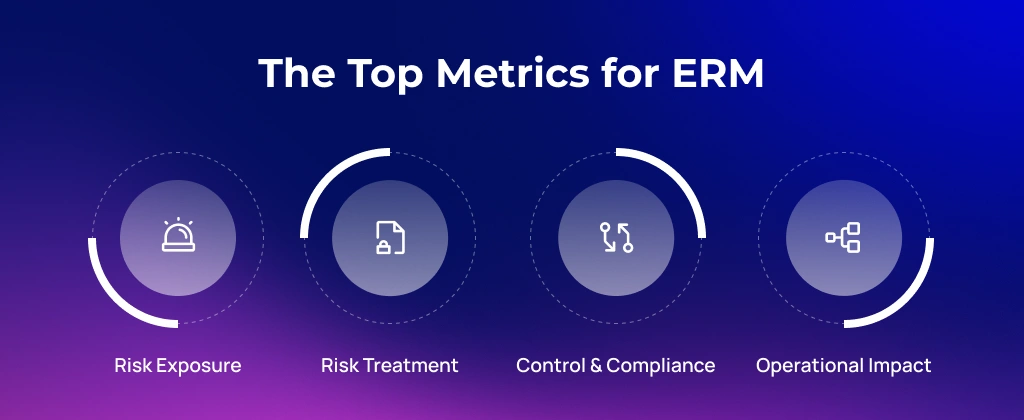
1. Risk Exposure Metrics
These metrics help organizations understand their overall risk profile and identify areas requiring immediate attention.
Common examples include:
- Total risks in the enterprise risk register
- Number of high-risk or critical risks
- Risk posture score
- Risk concentration by business unit or risk category
- Risk appetite adherence rate
These metrics provide leadership with a clear view of where the organization’s greatest exposures exist and whether risks remain within acceptable tolerance levels.
2. Risk Treatment Metrics
Risk management is not only about identifying risks but also about reducing them effectively. Risk treatment metrics measure how efficiently the organization responds to identified risks.
Examples include:
- Percentage of risks with active mitigation plans
- Average time to risk treatment
- Percentage of overdue remediation actions
- Risk mitigation completion rate
- Risk realization rate (identified risks that become actual incidents)
These metrics help evaluate whether risk response activities are keeping pace with the organization’s risk environment.
3. Control & Compliance Metrics
An effective enterprise risk management framework relies on strong governance and control effectiveness. These metrics help organizations evaluate whether controls are operating as intended and supporting compliance objectives.
Common metrics include:
- Control effectiveness rate
- Compliance exception rate
- Number of audit findings
- Percentage of controls tested on schedule
- Policy compliance rate
Monitoring these indicators helps organizations identify weaknesses before they develop into larger operational, regulatory, or security issues.
4. Operational Impact Metrics
These metrics focus on the business impact of risk events and provide a direct connection between risk management activities and organizational performance.
Organizations often track:
- Cost of risk incidents
- Operational disruption frequency
- Financial losses from risk events
- Third-party risk incidents
- Security or compliance incident rates
By measuring business impact, organizations can better justify investments in risk management and demonstrate the value of ERM initiatives.
ERM and GRC — How They Connect
Enterprise risk management (ERM) and GRC are closely related, but they serve different purposes. ERM focuses on identifying, assessing, and managing risks that could affect business objectives, while GRC provides the broader structure for governance, risk management, and compliance across the organization.
In a mature enterprise GRC program, ERM acts as the risk management pillar that supports decision-making, risk visibility, and business resilience. Governance establishes accountability and oversight, compliance ensures regulatory requirements are met, and ERM provides a consistent process for evaluating and managing risk across the enterprise.
When ERM and GRC operate separately, organizations often face duplicated assessments, fragmented reporting, and inconsistent risk management practices. Integrating them creates a single source of truth for risk, controls, and compliance activities, improving visibility and reducing operational complexity.
The goal is not simply better compliance. An integrated approach helps organizations strengthen enterprise risk governance, improve enterprise risk mitigation, and provide leadership with a clearer understanding of how risk affects strategic objectives.
Conclusion
In 2026, enterprise risk management is no longer viewed as an annual audit exercise or a standalone compliance initiative. As organizations face increasing regulatory requirements, cybersecurity threats, operational disruptions, and third-party risks, ERM has become a strategic capability that supports better decision-making across the business.
Building a mature ERM program requires more than implementing a framework or purchasing software. Organizations need a clear understanding of their risk exposure, a structured enterprise risk management framework, consistent risk assessment processes, effective governance, and ongoing monitoring to keep pace with changing business conditions.
The most successful organizations follow a clear path: assess current maturity, select the right framework, establish a repeatable risk management process, implement supporting technology, and continuously monitor and improve the program over time.
For organizations looking to strengthen risk visibility, improve governance, and build a more resilient business, partnering with Terralogic can help accelerate ERM maturity through structured risk management, governance alignment, and compliance support.