


Many organizations have risk registers, compliance programs, security controls, and audit processes. Yet when a major disruption occurs, leaders often discover that risks were being managed in silos, with no coordinated view of how those risks could affect the business as a whole.
This is the challenge that an enterprise risk management (ERM) program is designed to solve. Rather than treating risks as isolated issues managed by individual departments, an ERM program provides a structured approach for identifying, assessing, prioritizing, and responding to risks across the entire organization.
In 2026, building a mature ERM program is becoming increasingly important. Organizations face growing regulatory requirements, evolving cyber threats, AI-related risks, supply chain disruptions, and greater board accountability for risk oversight. Having an ERM framework on paper is no longer enough—organizations need an operational program that turns risk management into an ongoing business capability.
In this guide, we’ll explain what an enterprise risk management program is, explore the frameworks that support it, walk through the step-by-step implementation process, review ERM maturity levels, and share best practices for building a more resilient and risk-aware organization.
Key Takeaways
- An enterprise risk management program is the operational capability that enables organizations to identify, assess, respond to, and monitor risks across the business.
- An ERM framework provides the methodology, while an ERM program puts that methodology into practice through governance, processes, people, and reporting.
- The most widely used ERM frameworks include COSO ERM, ISO 31000, NIST CSF, and the RIMS Risk Maturity Model.
- Building an ERM program requires clear governance, defined risk appetite, enterprise-wide risk assessments, control ownership, and continuous monitoring.
- Organizations with mature ERM programs are generally better positioned to improve resilience, support strategic decision-making, and respond to emerging risks.
What Is an Enterprise Risk Management Program?
An Enterprise Risk Management (ERM) program is a structured approach that helps organizations identify, assess, manage, and monitor risks across the entire business. Rather than addressing risks one department at a time, an ERM program provides a coordinated view of risks that could affect the organization’s objectives, operations, finances, reputation, or compliance obligations.
An effective ERM program brings together people, processes, governance, and reporting into a single system for managing risk. It helps leaders understand where the greatest risks exist, prioritize resources, and make more informed business decisions.
Think of an ERM framework as the blueprint and the ERM program as the working system built from that blueprint. The framework provides the methodology, while the ERM program is how risk management operates in practice across the organization on a day-to-day basis.
Why Only 32% of Organizations Have a Mature ERM Program — and Why It Matters in 2026
Many organizations have risk registers, compliance programs, and periodic risk assessments. However, according to KPMG research, only about 32% of organizations consider their risk management capabilities to be mature. This suggests that while many businesses have implemented ERM initiatives, relatively few have fully integrated risk management into strategic decision-making and daily operations.
The gap matters because the risk environment in 2026 is becoming more complex, interconnected, and fast-moving. Organizations that rely on outdated or fragmented approaches to risk management may struggle to respond effectively when disruptions occur.
Below are some of the main reasons many ERM programs fail to reach maturity:
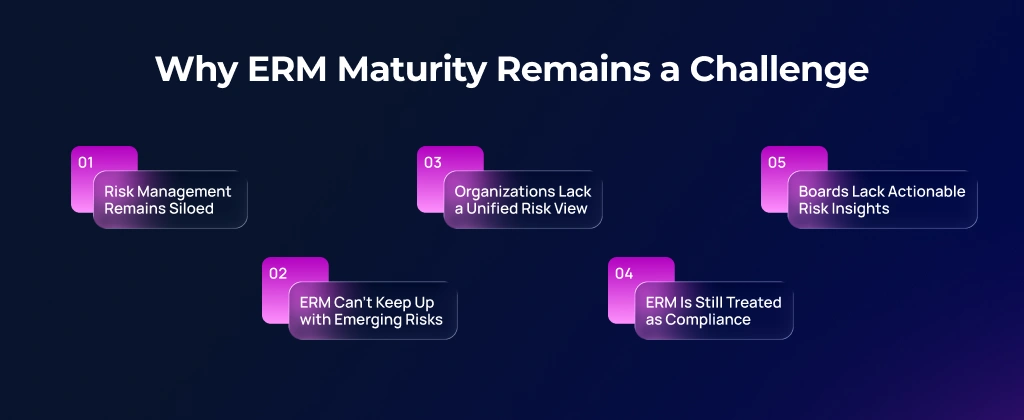
1. Risk Management Remains Siloed
In many organizations, different departments manage risks independently. IT handles cybersecurity risks, legal teams manage compliance risks, finance oversees financial risks, and operations focus on business continuity.
Without a centralized view, leadership may struggle to understand how risks are connected or how a single event could affect multiple parts of the business at once.
2. ERM Can’t Keep Up with Emerging Risks
Many ERM programs still rely on annual assessments or quarterly reporting cycles. However, risks related to AI, cybersecurity, geopolitics, supply chains, and regulatory change can emerge and escalate within days or even hours.
Organizations need more continuous monitoring and faster decision-making processes to keep pace with today’s risk environment.
3. Organizations Lack a Unified Risk View
Risk information is frequently stored in separate spreadsheets, reports, and systems maintained by different teams. This makes it difficult to gain a consistent enterprise-wide view of risk exposure.
Without reliable and consolidated risk data, organizations may struggle to prioritize resources and respond effectively to emerging threats.
4. ERM Is Still Treated as Compliance
Many organizations build ERM programs primarily to satisfy audit, regulatory, or reporting requirements. While compliance remains important, mature ERM programs go further by supporting strategic planning, investment decisions, business transformation initiatives, and operational resilience efforts.
When risk management is disconnected from business decisions, its value becomes limited.
5. Boards Lack Actionable Risk Insights
Boards and executive teams are increasingly expected to oversee cybersecurity, operational resilience, third-party risk, AI governance, and regulatory compliance. However, many organizations still struggle to provide leadership with timely, actionable risk information.
As accountability expectations continue to increase, mature ERM programs are becoming essential for effective governance and informed decision-making.
In 2026, organizations are not simply being asked to identify risks. They are expected to understand how risks interact, respond more quickly to change, and use risk insights to support better business decisions. This is why building a mature ERM program has become a strategic priority rather than a compliance exercise.
The 4 Core Frameworks Every ERM Program Builds On
An enterprise risk management program needs a framework to provide structure and consistency. Frameworks help organizations identify risks, assess their impact, define responsibilities, and establish a repeatable process for managing risk across the business.
There is no single framework that works for every organization. Some focus on governance and strategy, while others emphasize operational risk, cybersecurity, or program maturity. The most effective ERM programs often combine multiple frameworks based on their business needs and risk profile.
1. COSO ERM
COSO ERM is one of the most widely adopted enterprise risk management frameworks, particularly among large organizations and publicly traded companies. Rather than treating risk management as a separate activity, COSO helps organizations integrate risk considerations into strategy, performance management, and business decision-making.
How it works:
COSO ERM is built around 5 interconnected components:
- Governance and Culture – Establishes oversight responsibilities, accountability, and a risk-aware culture across the organization.
- Strategy and Objective-Setting – Aligns risk management with business objectives and strategic planning.
- Performance – Identifies, assesses, prioritizes, and responds to risks that could affect organizational goals.
- Review and Revision – Evaluates how effectively risks are being managed and adjusts processes as business conditions change.
- Information, Communication, and Reporting – Ensures risk information reaches decision-makers in a timely and consistent manner.
Why it works: COSO is effective because it connects risk management directly to business strategy. Instead of focusing only on compliance or operational risks, it helps leadership evaluate how uncertainty could affect organizational objectives. This makes it particularly useful for organizations that want stronger board oversight and more risk-informed decision-making.
2. ISO 31000
ISO 31000 is a globally recognized risk management framework designed to help organizations manage uncertainty in a structured but flexible way. Unlike more prescriptive frameworks, ISO 31000 can be adapted to organizations of any size, industry, or geographic location.
How it works:
ISO 31000 follows a continuous risk management cycle:
- Establish Context – Define the internal and external factors that influence the organization’s objectives.
- Identify Risks – Determine events or conditions that could affect business outcomes.
- Analyze and Evaluate Risks – Assess the likelihood and potential impact of each risk and prioritize them accordingly.
- Treat Risks – Select and implement strategies to avoid, reduce, transfer, or accept risks.
- Monitor and Review – Continuously evaluate risks and update responses as circumstances change.
Why it works: ISO 31000 is widely used because it is flexible and easy to adapt. Organizations can apply it across multiple business units, regions, and risk categories without significantly changing their existing operating models. This makes it particularly valuable for organizations seeking a consistent enterprise-wide approach to risk management.
3. NIST Cybersecurity Framework (CSF)
The NIST Cybersecurity Framework (NIST CSF) is a risk management framework designed to help organizations identify, manage, and reduce cybersecurity risks. While it is not a complete enterprise risk management framework, it is commonly used alongside ERM programs because cyber risk has become one of the most significant enterprise risks organizations face today.
How it works:
NIST CSF organizes cybersecurity activities into 6 core functions:
- Govern – Establish cybersecurity governance, policies, roles, responsibilities, and oversight.
- Identify – Understand critical assets, systems, data, and cybersecurity risks.
- Protect – Implement safeguards to prevent or minimize the impact of cyber incidents.
- Detect – Monitor systems and activities to identify threats and security events quickly.
- Respond – Take action to contain incidents and minimize business disruption.
- Recover – Restore operations and strengthen resilience after an incident.
Why it works: NIST CSF provides a practical and structured approach to cybersecurity risk management. It helps organizations understand their current security posture, identify gaps, and prioritize improvements based on business risk. Because cybersecurity increasingly affects operations, compliance, reputation, and financial performance, NIST CSF is often used as the cybersecurity layer within a broader ERM program.
4. RIMS Risk Maturity Model (RMM)
Unlike the other frameworks, the RIMS Risk Maturity Model is not designed to tell organizations how to manage risk. Instead, it helps organizations evaluate how mature and effective their existing ERM program is.
Organizations often use RIMS after an ERM program has been operating for some time to identify strengths, weaknesses, and opportunities for improvement.
How it works:
The model evaluates an organization’s capabilities across several key areas of enterprise risk management, including:
- ERM-Based Approach – How consistently risk management principles are applied across the organization.
- Risk Appetite Management – Whether risk tolerance is clearly defined and used in decision-making.
- Root Cause Discipline – The ability to identify and address the underlying causes of risk events.
- Uncovering Risks – How effectively emerging and interconnected risks are identified.
- Performance Management – The extent to which risk management supports business objectives and performance.
- Business Resiliency and Sustainability – The organization’s ability to respond to and recover from disruptions.
Organizations are then assessed across multiple maturity levels, ranging from ad hoc and reactive programs to highly integrated and optimized ERM capabilities.
Why it works: Many organizations struggle to determine whether their ERM program is actually improving over time. The RIMS Risk Maturity Model provides a structured way to measure progress, benchmark performance, and prioritize future improvements. It helps leadership move beyond simply having an ERM program and focus on making that program more effective and valuable to the business.
How to Build an Enterprise Risk Management Program: 7-Step Process
Building an enterprise risk management program requires more than creating a risk register or purchasing GRC software. Successful ERM programs combine governance, processes, people, and technology to create a structured approach for managing risk across the organization.
The following 7-step process provides a practical roadmap for building and maintaining an effective ERM program:
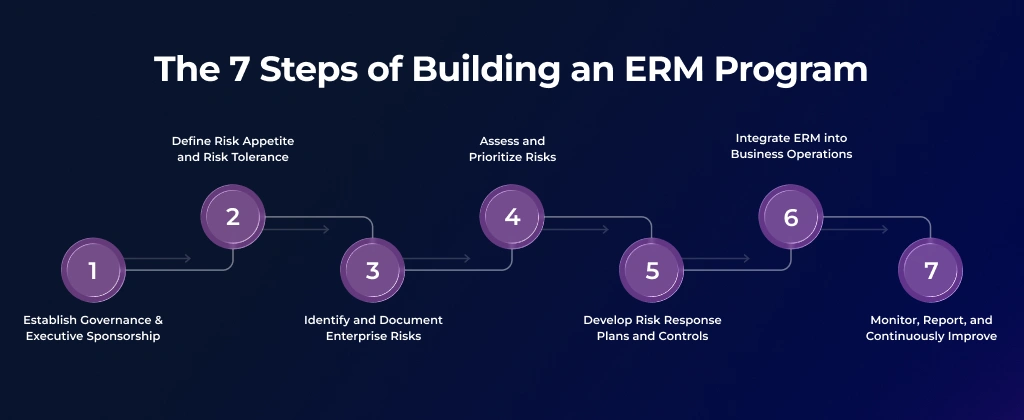
1. Establish Governance and Executive Sponsorship
Every successful ERM program starts with clear leadership and accountability. Organizations should define who is responsible for risk management, establish reporting structures, and ensure executive and board-level support.
Common governance structures include a Chief Risk Officer (CRO), a risk committee, and designated risk owners across different business functions.
Example: A manufacturing company establishes a risk committee consisting of the CEO, CFO, CIO, and operations leaders to review enterprise risks quarterly and report key findings to the board.
2. Define Risk Appetite and Risk Tolerance
Organizations must determine how much risk they are willing to accept in pursuit of their business objectives.
A risk appetite statement helps leadership establish boundaries for decision-making, while risk tolerance thresholds define acceptable levels of exposure for different risk categories such as financial, operational, cybersecurity, and compliance risks.
Example: A bank may accept moderate market risk to support growth objectives but maintain very low tolerance for regulatory compliance violations.
3. Identify and Document Enterprise Risks
The next step is to identify risks that could affect the organization’s ability to achieve its objectives.
This process typically involves workshops, interviews, risk assessments, historical incident reviews, and input from business stakeholders. Risks are then documented in a centralized risk register and categorized according to a defined risk taxonomy.
Example: During a risk workshop, a retail company identifies supply chain disruption, ransomware attacks, labor shortages, and changing consumer demand as key enterprise risks.
4. Assess and Prioritize Risks
Once risks have been identified, organizations need to evaluate their likelihood and potential impact.
Risk scoring models, heat maps, and prioritization matrices help determine which risks require immediate attention and which can be monitored over time.
Example: A healthcare organization determines that a patient data breach has both a high likelihood and high impact, making it a top-priority risk requiring immediate mitigation.
5. Develop Risk Response Plans and Controls
For each significant risk, organizations should determine an appropriate response strategy.
Common approaches include avoiding the risk, reducing its likelihood, transferring the risk through insurance or contracts, or accepting the risk when it falls within established tolerance levels.
Example: To reduce cybersecurity risk, an organization implements multi-factor authentication, endpoint protection, and employee security awareness training.
- Integrate ERM into Business Operations
ERM should not operate as a standalone activity. Risk considerations should be incorporated into strategic planning, budgeting, project management, procurement, mergers and acquisitions, and other key business processes.
Organizations with mature ERM programs use risk information to support everyday decision-making rather than reviewing risks only during annual assessments.
Example: Before expanding into a new market, leadership evaluates regulatory risks, geopolitical risks, and operational challenges as part of the investment approval process.
7. Monitor, Report, and Continuously Improve
Risk management is an ongoing process. Organizations should regularly review risk registers, monitor key risk indicators (KRIs), evaluate control effectiveness, and provide risk reports to management and the board.
As business conditions change, the ERM program should evolve to address new risks and emerging threats.
Example: A company tracks KRIs such as phishing attack attempts, vendor incidents, and regulatory findings through monthly risk dashboards reviewed by executives and the board.
Conclusion
An enterprise risk management program provides a structured way to identify, assess, prioritize, and respond to risks across the organization. Rather than managing risks in separate departments, ERM helps create a unified view of risk that supports better decision-making, stronger governance, and improved organizational resilience.
As the risk landscape becomes more complex, organizations need more than periodic assessments and compliance checklists. A mature ERM program helps leaders understand emerging risks, align risk management with business objectives, and respond more effectively to disruption.
Whether you’re building an ERM program from scratch or improving an existing one, success depends on establishing clear governance, defining risk appetite, implementing consistent processes, and continuously monitoring risks as the business evolves.
Need help building or maturing your ERM program? Terralogic helps organizations strengthen governance, implement risk management frameworks, improve risk visibility, and build scalable GRC programs that support long-term resilience and regulatory compliance.