


Business leaders are facing more interconnected risks than ever before. A cyberattack can disrupt operations, trigger regulatory investigations, damage customer trust, and impact financial performance simultaneously. Yet many organizations still manage these risks through separate teams, disconnected processes, and siloed reporting structures.
This fragmented approach makes it difficult for leadership to understand the organization’s true risk exposure. Without a common methodology and governance structure, risks are often assessed inconsistently, priorities become unclear, and critical issues may go unnoticed until they affect business performance.
An enterprise risk management framework provides the structure needed to manage risk across the entire organization. It establishes consistent processes for identifying, assessing, responding to, and monitoring risks while creating clear accountability and visibility at the executive and board levels. Most importantly, it helps organizations connect risk management to strategic decision-making rather than treating it as a compliance exercise.
As regulatory expectations increase, cyber threats evolve, and organizations adopt emerging technologies such as AI, building a mature ERM framework has become a business priority. Organizations are no longer asking whether they need enterprise risk management, but which framework best fits their environment and how to implement it effectively.
In this guide, we’ll explain what an enterprise risk management framework is, compare leading frameworks such as COSO ERM, ISO 31000, and NIST RMF. Then explore their core components, and walk through a practical step-by-step approach for building and maintaining a successful enterprise risk management program.
What Is an Enterprise Risk Management Framework?
An enterprise risk management framework is a structured approach that helps organizations identify, assess, respond to, and monitor risks that could affect their strategic objectives. Rather than focusing on a single department or risk category, an ERM framework establishes a consistent process for managing risk throughout the organization.
Traditional risk management is often handled in silos. Finance teams manage financial risks, IT teams focus on cybersecurity threats, and compliance teams oversee regulatory requirements. While these functions may operate effectively on their own, organizations can struggle to understand how risks interact and influence one another.
The enterprise risk management framework helps organizations:
- Identify risks earlier and more consistently
- Improve decision-making through better risk visibility
- Align risk management with business objectives
- Clarify roles and responsibilities across teams
- Provide executives and boards with meaningful risk insights
Most importantly, an ERM framework helps organizations move from reactive risk management to proactive risk governance. Instead of responding to issues after they occur, leadership teams can evaluate potential risks during planning, investment, and operational decisions.
The 6 Major Enterprise Risk Management Frameworks Compared
There is no single enterprise risk management framework that fits every organization. Different frameworks were developed to solve different challenges, from strategic governance and operational risk management to cybersecurity oversight and financial regulation.
Some frameworks provide broad risk management principles that can be applied across any industry, while others focus on specific areas such as technology governance, banking regulation, or risk maturity assessment. Understanding the strengths and intended use cases of each framework can help organizations select the right foundation for their enterprise risk management program.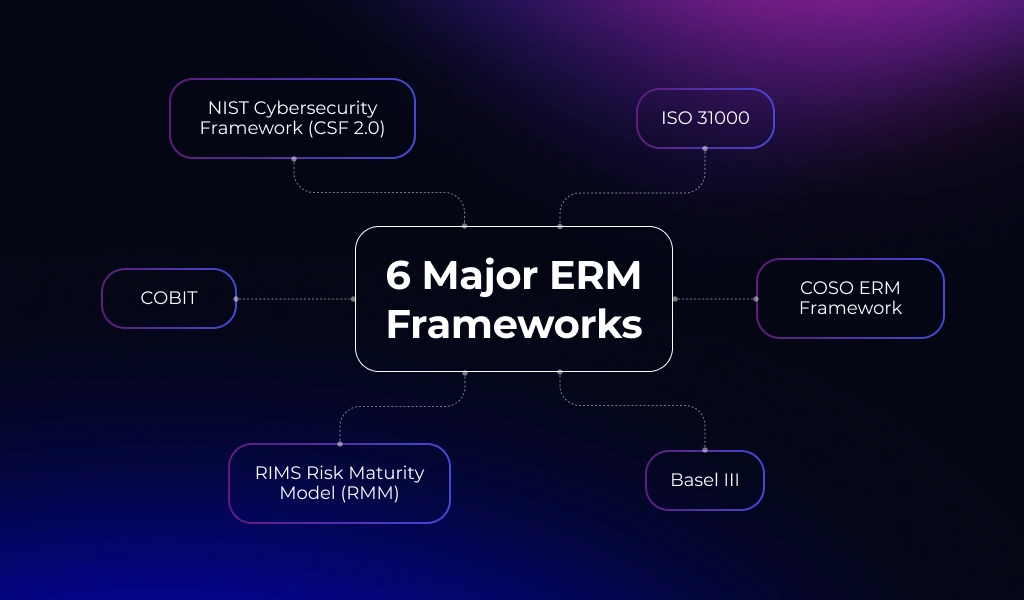
1. COSO ERM Framework
The COSO ERM Framework is one of the most widely adopted approaches to enterprise risk management. Developed by the Committee of Sponsoring Organizations (COSO), it helps organizations integrate risk considerations into strategy, governance, and performance management rather than treating risk as a separate compliance activity.
COSO is commonly used by large enterprises, public companies, and regulated organizations that require strong board oversight and structured governance. Its greatest strength is linking risk management directly to business objectives, allowing leaders to make decisions with a clearer understanding of potential risks and opportunities.
2. ISO 31000
ISO 31000 is an international standard that provides principles and guidelines for managing risk across an organization. Unlike more prescriptive frameworks, it focuses on creating a risk-aware culture and embedding risk management into everyday decision-making processes.
Organizations often choose ISO 31000 because it can be applied across different industries, business sizes, and regulatory environments. Its flexibility makes it particularly useful for global organizations that need a consistent approach to risk management across multiple regions.
3. NIST Cybersecurity Framework (CSF 2.0)
The NIST Cybersecurity Framework (CSF 2.0) helps organizations identify, assess, and manage cybersecurity risks. The framework is organized around 6 core functions—Govern, Identify, Protect, Detect, Respond, and Recover—which provide a structured approach to improving cyber resilience.
Although originally developed for critical infrastructure, NIST CSF is now widely adopted across both public and private sectors. Organizations often use it alongside broader ERM frameworks to strengthen cyber risk management and align security activities with business objectives.
4. COBIT
COBIT (Control Objectives for Information and Related Technologies) is a framework focused on IT governance and risk management. It helps organizations ensure that technology investments, processes, and controls support business goals while maintaining appropriate oversight and accountability.
COBIT is particularly valuable for organizations that rely heavily on technology or operate in highly regulated environments. Its detailed governance model helps leaders measure IT performance, manage technology risks, and improve alignment between business and IT functions.
5. Basel III
Basel III is a regulatory framework designed to strengthen risk management and financial stability within the banking sector. It establishes requirements for capital adequacy, liquidity management, and stress testing to help financial institutions withstand economic and operational disruptions.
Because it is specifically designed for banks and financial institutions, Basel III is less applicable to organizations outside the financial sector. However, it remains one of the most influential examples of industry-specific risk governance and regulatory oversight.
6. RIMS Risk Maturity Model (RMM)
The RIMS Risk Maturity Model (RMM) is a benchmarking framework used to evaluate how mature an organization’s risk management capabilities are. Rather than prescribing specific controls, it measures how effectively risk management is embedded into governance, culture, decision-making, and reporting processes.
Organizations often use RMM to identify gaps in their current ERM program and create a roadmap for improvement. It is particularly useful for organizations seeking to move from reactive risk management toward a more mature and strategic approach.
5 Core Components of the COSO ERM Framework
The COSO ERM Framework is organized around 5 interconnected components that help organizations integrate risk management into governance, strategy, and day-to-day operations. Together, these components create a structured approach for identifying risks, making informed decisions, and improving organizational resilience.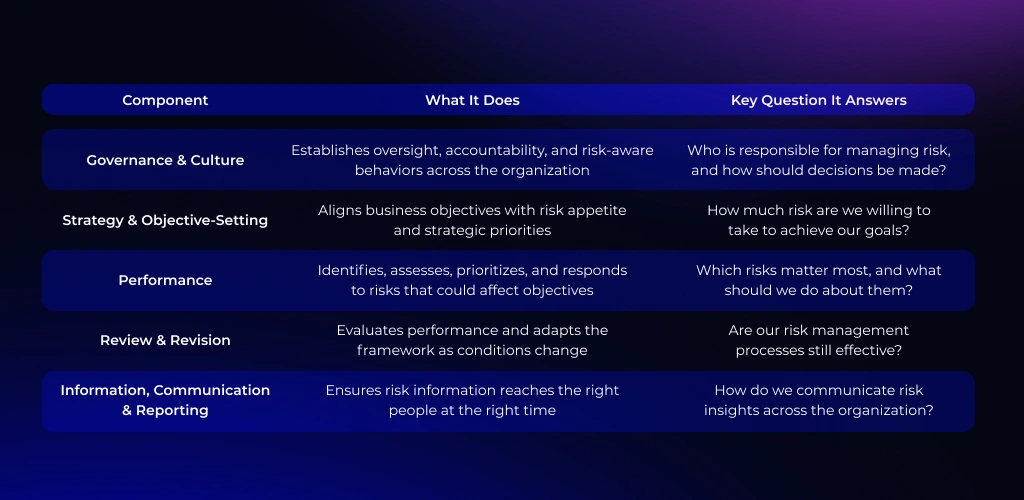
1. Governance & Culture
Governance and culture form the foundation of the enterprise risk management framework. This component focuses on leadership oversight, accountability, organizational structure, and the behaviors that influence how employees think about and respond to risk.
A strong governance model ensures risk responsibilities are clearly defined. In contrast, a healthy risk culture encourages employees to identify issues, escalate concerns, and make decisions that align with organizational values and objectives.
2. Strategy & Objective-Setting
Risk management is most effective when it is incorporated into strategic planning rather than treated as a separate activity. This component helps organizations evaluate business objectives, assess potential risks, and establish an appropriate risk-appetite framework before major decisions are made.
By considering risk during planning, organizations can pursue growth opportunities with greater confidence while ensuring risk exposure remains within acceptable limits.
3. Performance
The performance component focuses on identifying, assessing, prioritizing, and responding to risks that could affect business objectives. Organizations evaluate both the likelihood and potential impact of risks before determining the most appropriate response strategy.
This process helps leadership focus resources on the risks that matter most. Instead of reacting to every issue equally, organizations can prioritize mitigation efforts based on potential business impact and strategic importance.
4. Review & Revision
Business environments continuously change due to new regulations, market conditions, technology adoption, and emerging threats. The review and revision component helps organizations evaluate whether their current risk management approach remains effective under changing conditions.
Regular reviews allow leadership teams to identify gaps, improve processes, update controls, and refine risk management practices. This continuous improvement approach helps ensure the ERM program remains aligned with organizational objectives over time.
5. Information, Communication & Reporting
Effective risk management depends on timely and accurate information. This component focuses on collecting relevant risk data, communicating insights to stakeholders, and providing meaningful reporting to management and the board.
Organizations need consistent reporting processes so decision-makers can understand current risk exposure, monitor emerging threats, and evaluate the effectiveness of mitigation efforts. Clear communication helps transform risk information into actionable business decisions.
Types of Risk Covered in an Enterprise Risk Management Framework
An enterprise risk management framework helps organizations identify, assess, and manage risks across multiple areas of the business. Rather than focusing on a single department or function, ERM provides a structured approach for evaluating risks that could affect strategic objectives, operations, financial performance, regulatory compliance, and long-term resilience.
While every organization faces unique challenges, most enterprise risk management programs are designed to address several common categories of risk. Understanding these risk types helps leadership teams develop a more complete view of organizational exposure and prioritize resources where they can have the greatest impact.
The most common categories of risk covered by an ERM framework include:
1. Strategic Risk
Strategic risks are threats that could prevent an organization from achieving its long-term goals and business objectives. These risks often arise from market shifts, changing customer demands, competitive pressures, mergers and acquisitions, or disruptive technologies.
For example, a business that fails to adapt to emerging technologies or changing consumer behavior may lose market share and growth opportunities. Managing strategic risk helps leadership evaluate both opportunities and potential challenges before making major business decisions.
2. Operational Risk
Operational risks stem from internal processes, people, systems, and day-to-day business activities. When these areas fail to perform as expected, organizations may experience service disruptions, reduced productivity, financial losses, or customer dissatisfaction.
Common examples include supply chain disruptions, process failures, equipment breakdowns, staffing shortages, and human error. Effective operational risk management helps organizations improve reliability, efficiency, and business continuity.
3. Financial Risk
Financial risks affect an organization’s ability to maintain profitability, manage cash flow, and achieve financial objectives. These risks may result from inflation, interest rate fluctuations, foreign exchange volatility, market instability, or credit exposure.
Organizations use financial risk management to understand potential financial impacts, strengthen forecasting, and make more informed investment and budgeting decisions.
4. Cybersecurity & Technology Risk
Cybersecurity and technology risks have become a critical focus of modern enterprise risk assessment programs. As organizations rely more heavily on digital systems, technology failures can quickly create operational, financial, and reputational consequences.
This category includes cyberattacks, ransomware, data breaches, cloud security issues, software vulnerabilities, and system outages. Because cyber risks can affect multiple parts of the business simultaneously, they are often a top priority for executives and boards.
5. Compliance & Regulatory Risk
Compliance risks arise when organizations fail to meet legal, regulatory, contractual, or industry requirements. These failures can lead to financial penalties, legal action, operational restrictions, and damage to customer trust.
Examples include violations of privacy regulations, financial reporting requirements, industry standards, or sector-specific compliance obligations. Strong risk management governance helps organizations stay aligned with changing regulatory expectations and reduce the likelihood of non-compliance.
6. ESG & Emerging Risk
Environmental, Social, and Governance (ESG) risks are becoming increasingly important within modern ERM programs. Investors, regulators, customers, and employees are placing greater emphasis on sustainability, ethical business practices, and corporate accountability.
Organizations must also address emerging risks such as artificial intelligence, climate-related events, geopolitical uncertainty, and third-party dependencies. For example, AI-related risks may include biased outputs, inaccurate decisions, lack of transparency, or evolving regulatory requirements that affect how AI systems are developed and used.
Key Benefits of Implementing an Enterprise Risk Management Framework
An enterprise risk management framework helps organizations move beyond reactive risk management by creating a structured approach to identifying, evaluating, and managing risks across the business. When integrated into daily operations and strategic planning, ERM provides benefits that extend far beyond compliance.
1. Better Strategic Decision-Making
ERM helps leaders understand how risks may affect business objectives before important decisions are made. This allows organizations to evaluate opportunities, investments, and growth initiatives with a clearer understanding of potential risks and rewards.
2. Improved Risk Visibility
An ERM framework provides a centralized view of risks across departments, business units, and functions. Instead of managing risks in isolation, leadership teams gain a clearer understanding of the organization’s overall risk exposure and emerging threats.
3. Stronger Governance & Accountability
By defining clear roles, responsibilities, and reporting structures, ERM improves oversight throughout the organization. Employees, managers, executives, and boards all have greater clarity around how risks should be identified, escalated, and managed.
4. Increased Regulatory & Audit Readiness
A structured ERM program helps organizations maintain documented processes, controls, and risk assessments that support compliance requirements. This reduces audit preparation efforts and helps demonstrate effective risk management to regulators, customers, and stakeholders.
5. Greater Organizational Resilience
Organizations with mature ERM programs are better prepared to respond to cyberattacks, operational disruptions, regulatory changes, and market uncertainty. By identifying vulnerabilities early and developing response plans in advance, ERM helps businesses adapt faster and recover more effectively when challenges arise.
Common Enterprise Risk Management Challenges (and How to Overcome Them)
Implementing an enterprise risk management framework is not simply a matter of selecting a model such as COSO ERM or ISO 31000. Many organizations struggle to turn framework requirements into consistent day-to-day practices that support decision-making across the business.
The most successful ERM programs recognize these challenges early and establish processes, governance structures, and technologies that help overcome them.
1. Limited Executive & Board Buy-In
One of the most common reasons ERM initiatives fail is that leadership views risk management as a compliance requirement rather than a strategic business function. Without active support from executives and board members, risk management activities often become disconnected from business planning and investment decisions.
How to overcome it: Focus reporting on business impact rather than technical risk details. Present risks in terms of financial exposure, operational disruption, strategic objectives, and organizational resilience to help leadership understand why risk management matters.
2. Siloed Risk Management Across Departments
Many organizations manage risks independently within different functions such as finance, operations, cybersecurity, compliance, and legal teams. This fragmented approach can create inconsistent assessments, duplicated efforts, and limited visibility into enterprise-wide risk exposure.
How to overcome it: Establish a centralized risk management process with common risk definitions, assessment criteria, and reporting standards. A shared risk register and governance structure can help create a more consistent view of risk across the organization.
3. Difficulty Measuring and Prioritizing Risks
Organizations often rely heavily on subjective assessments when evaluating risks. Without consistent scoring criteria or measurable indicators, it becomes difficult to compare risks objectively and determine where resources should be allocated.
How to overcome it: Develop standardized risk scoring models that consider factors such as likelihood, business impact, velocity, and existing controls. Combining qualitative assessments with measurable risk indicators can improve prioritization and decision-making.
4. Managing Multiple Frameworks and Regulatory Requirements
Organizations operating across different industries or regions frequently face overlapping requirements from frameworks, regulations, and customer expectations. Managing these obligations separately can increase complexity and create unnecessary duplication.
How to overcome it: Use a unified GRC framework or integrated control structure that maps requirements across multiple standards. Many organizations use ISO 31000 as an overarching risk management model while aligning governance and cybersecurity requirements with frameworks such as COSO ERM and NIST.
5. Maintaining Continuous Monitoring
Risk management is not a one-time assessment. New threats, business changes, regulatory updates, and emerging technologies can quickly change an organization’s risk profile. Keeping risk registers, controls, and reporting current often requires significant time and effort.
How to overcome it: Implement regular review cycles, define Key Risk Indicators (KRIs), and use automation where possible. Modern risk management platforms can help organizations monitor risk exposure, track remediation activities, and provide ongoing visibility into changes across the business.
How to Build an Enterprise Risk Management Framework: 6-Step Process
Building an enterprise risk management framework requires more than creating a risk register or conducting occasional assessments. A successful framework establishes clear governance, consistent processes, and meaningful reporting that support decision-making across the organization.
While implementation approaches vary by industry and organizational maturity, most successful ERM programs follow 6 core steps.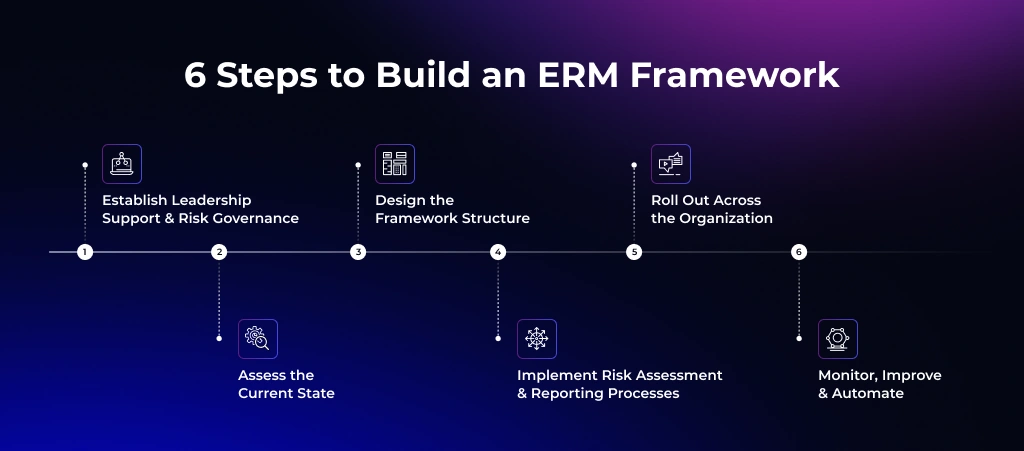
1. Establish Leadership Support & Risk Governance
Every successful ERM initiative begins with executive sponsorship. Leadership teams must agree on the purpose of the program, define accountability, and establish how risk management supports business objectives.
This stage often includes defining governance structures, assigning risk ownership, and establishing a risk appetite framework that guides decision-making across the organization.
2. Assess the Current State
Before designing a new framework, organizations need to understand their existing risk management practices. This includes reviewing current policies, controls, reporting processes, assessments, and governance activities.
The goal is to identify strengths, gaps, inconsistencies, and opportunities for improvement. Understanding the current state helps organizations build on existing capabilities rather than starting from scratch.
3. Design the Framework Structure
The next step is creating a consistent framework that can be applied across the enterprise. This includes defining risk categories, assessment methodologies, reporting requirements, escalation procedures, and risk ownership responsibilities.
A well-designed framework should be easy to understand, scalable across departments, and flexible enough to adapt as business needs evolve.
4. Implement Risk Assessment & Reporting Processes
Once the framework is established, organizations can begin identifying, assessing, and prioritizing risks using a standardized methodology. Consistent assessment criteria help ensure risks are evaluated and reported in the same way across the organization.
At this stage, organizations also establish reporting processes that provide management and boards with meaningful insights into risk exposure, mitigation progress, and emerging threats.
5. Roll Out Across the Organization
ERM becomes effective only when it is embedded into daily operations and business decision-making. Organizations should communicate expectations clearly, provide training where necessary, and ensure employees understand their responsibilities within the framework.
Risk management should be integrated into planning, budgeting, project management, procurement, and other business processes rather than operating as a standalone activity.
6. Monitor, Improve & Automate
An enterprise risk management program must evolve as the organization changes. New regulations, emerging threats, technology adoption, and market conditions can all affect the organization’s risk profile.
Regular reviews, performance metrics, and ongoing monitoring help ensure the framework remains effective. As programs mature, many organizations implement technology solutions to automate assessments, reporting, workflow management, and risk monitoring, improving both efficiency and visibility.
Conclusion
An enterprise risk management framework provides the structure organizations need to identify, assess, and manage risks in a consistent and strategic way. Rather than treating risks as isolated events within individual departments, ERM creates a unified view of risk across the enterprise, helping leadership make better-informed decisions and allocate resources more effectively.
As organizations face growing regulatory requirements, cybersecurity threats, operational complexity, and economic uncertainty, risk management can no longer be viewed as a periodic compliance exercise. Modern ERM frameworks help connect governance, strategy, performance, and risk oversight into a single operating model that supports long-term business resilience.
Whether organizations adopt COSO ERM, ISO 31000, NIST RMF, or a combination of frameworks, success ultimately depends on establishing clear governance, consistent processes, meaningful reporting, and a culture that integrates risk awareness into everyday decision-making.
If your organization is evaluating its current risk management maturity or looking to build a more structured ERM program, consulting with Terralogic can help you assess gaps, strengthen governance, and develop a framework aligned with your business objectives and regulatory requirements.