

Designing Scalable ML Model Architectures: Neural Components, Training Workflows & Inference
Published: June 27, 2026
Last Updated: June 29, 2026

You trained a machine learning model that achieves 94% accuracy on your laptop, but when deployed to production, it collapses under real traffic. Predictions lag, memory explodes, and stakeholders want answers.
The uncomfortable truth: 87% of machine learning models never make it to production. The gap isn’t model accuracy; it’s architecture. While most tutorials stop at the Jupyter notebook, production systems must serve thousands of users and retrain on terabytes of data without breaking.
The Three Pillars of Production ML Architecture
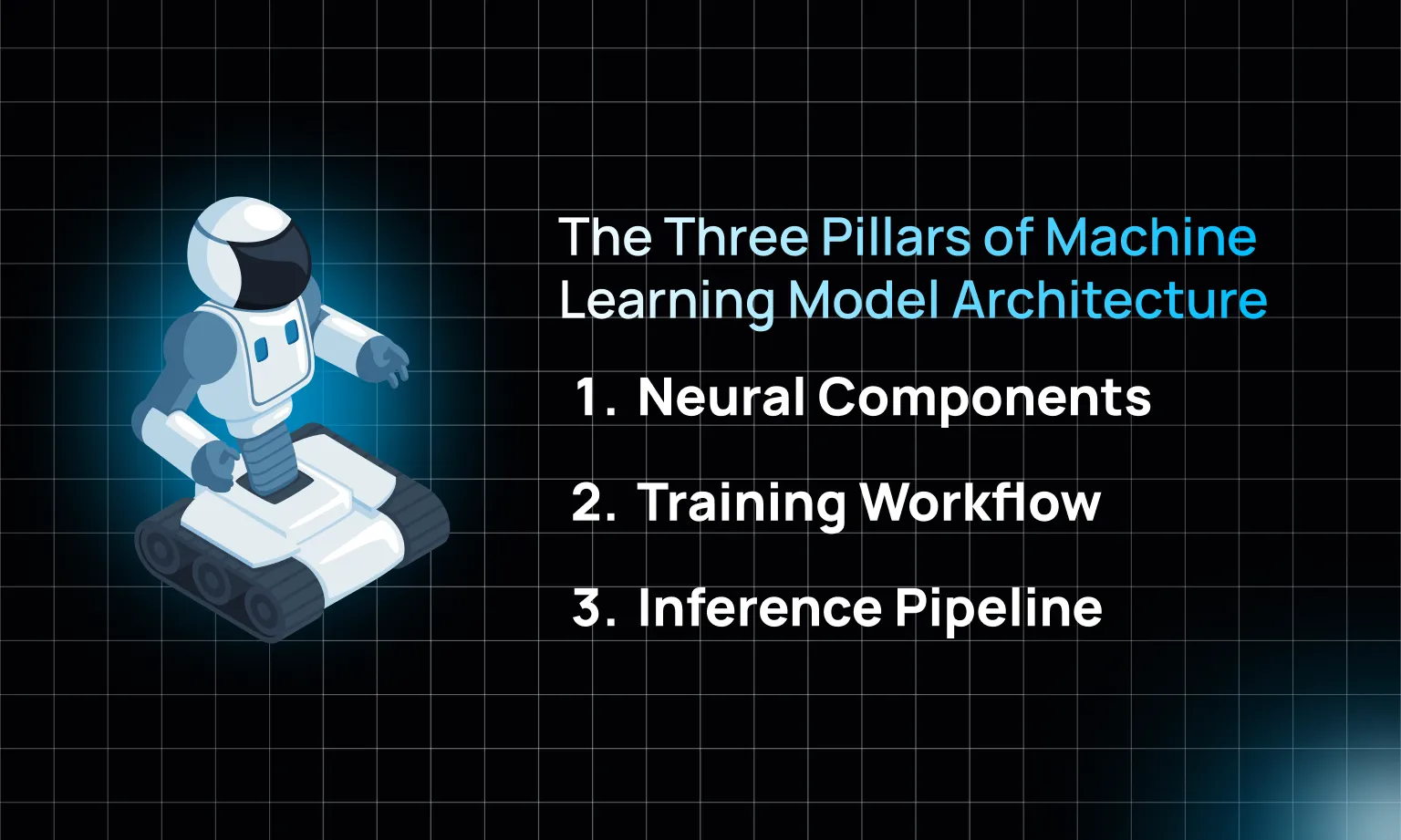
A production-grade machine learning system relies on three interconnected architectures. If any single pillar fails to scale, the entire deployment collapses under production traffic.
- Neural Components: The computational graph—including layer topologies, weight matrices, and non-linear activation functions that process data.
- Training Workflow: The pipeline responsible for model evolution, spanning data ingestion, experiment tracking, hyperparameter optimization, and version control.
- Inference Pipeline: The live serving infrastructure that manages real-time or batch preprocessing, runtime optimizations, and data drift monitoring.
1. Neural Network Components: Engineering for Scalability
Architectural choices directly dictate training wall-clock time, memory footprint, and server deployment costs. Understanding how your network scales under load is vital when establishing professional enterprise AI frameworks.
The Functional Layers
- Input Layer: Dictates how raw features, high-dimensional embeddings, and sparse vectors enter the computational graph. Poor input structuring guarantees downstream convergence failure.
- Hidden Layers: The structural choice between going deep (hierarchical feature abstraction) versus wide (diverse pattern matching).
- Output Layer: Must mathematically match the objective functions: softmax for multi-class classification, sigmoid for binary problems, and linear for regression tasks.
The Rule of Three: For 80% of enterprise AI network schemas, start with exactly 3 hidden layers. Only scale complexity when validation metric plateaus cannot be resolved via data quality improvements.
Core Mathematical Mechanics
- Weights and Biases: The primary learnable parameter arrays. Scaling means managing the memory footprint of these matrices during parallel backpropagation.
- Activation Functions: Gatekeepers of non-linearity. Use ReLU (Rectified Linear Unit) for hidden layers due to computational efficiency and sparsity. Reserve bounded functions like sigmoid strictly for final outputs.
- Backpropagation: The gradient-based error feedback loop. Understanding gradient flow is critical for diagnosing vanishing or exploding gradients when scaling networks deep.
Common Topology Patterns
- Sequential Layout: Layers stacked linearly. Ideal for standard tabular and tabular-adjacent business logic.
- Skip Connections (ResNets): Alternate pathways that bypass layers, allowing gradients to flow backwards unimpeded. Essential for networks exceeding 10 layers.
- Attention Mechanisms (Transformers): Dynamic weighting systems that capture global context across sequential or spatial structures, used when long-range relationships matter more than local proximity.
2. Data Preprocessing: The Pipeline Foundation
The primary cause of production ML failure is training-serving skew, occurring when the preprocessing logic used during training differs from the live inference runtime pipeline.
Raw Data Ingestion –> Cleaning –> Feature Engineering –> Preprocessing –> Model Training –> Live Predictions
Essential Feature Engineering Techniques
| Technique | Production Purpose | Enterprise Application |
|---|---|---|
| StandardScaler / MinMaxScaler | Normalizes feature scales to the center mean or bound values within a 0-1 range. | Prevents high-magnitude numerical features from dominating gradient descent updates. |
| One-Hot Encoding | Transforms low-cardinality categorical sets into sparse binary vectors. | Best for static categories (e.g., Country, Industry) where unique values remain low. |
| Learned Embeddings | Converts high-cardinality data strings into dense, lower-dimensional continuous vectors. | Crucial for User IDs, Product SKUs, or NLP features to prevent memory explosion. |
| Imputation (Mean/Mode) | Resolves missing data without dropping rows by using statistical fills or specific indicators. | Guarantees inference calls do not fail when facing incomplete real-world telemetry. |
Preprocessing at Scale
- Batch vs. Streaming: Choose batch workflows for high-throughput operations. Implement streaming via real-time message brokers when features must reflect sub-second user behavior. Learn more about data management in our guide to Data Lakes and AI Integration.
- Data Versioning: Use tools like DVC or Delta Lake to version datasets alongside source code. If model performance drops, you must be able to trace the root cause back to exact data state mutations.
- Feature Caching: Store pre-computed, transformed features in low-latency stores. This guarantees that both the offline training loop and the live inference pipeline query identical mathematical representations.
3. The ML Development Lifecycle: Training Sequences
Production machine learning is a highly cyclical software engineering discipline. Success requires moving away from ad-hoc notebook executions toward reproducible, structured pipelines.
Step 1: Define Key Business Metrics
Establish concrete KPIs (e.g., conversion lift, click-through optimization, or sub-50ms latency caps) before writing model code. Technical accuracy means nothing if system latency hurts your conversion rates.
Step 2: Establish a Simple Baseline
Deploy a basic linear model or shallow decision tree first. This validates data pipeline integrity and sets a benchmark that your deep learning architecture must definitively beat.
Step 3: Iterate Graph Architecture Systematically
Modify exactly one architectural or hyperparameter variable at a time. Tracking individual delta shifts prevents chasing ghost optimization gains and isolating code defects becomes straightforward.
Step 4: Implement Absolute Version Control
Commit code, model weights, feature store configurations, hyperparameter configs, and random seeds to your registry to achieve 100% execution reproducibility across the organization.
Scalable Project Layout
To isolate execution concerns, production codebases should be structured cleanly by architectural responsibility:
ml-project/
├── data/          # Data ingestion pipelines & validation rules
├── features/      # Feature engineering scripts & preprocessing logic
├── models/        # Pure neural network architecture definitions
├── training/      # Custom training loops & loss functions
├── inference/     # Production serving logic & serialization layers
└── configs/       # YAML/JSON hyperparameter and environment manifests
4. Inference Pipelines: Serving Predictions at Scale
Serving models efficiently requires selecting an appropriate operational mode based on budget profiles and maximum acceptable latency constraints.
Choosing Your Inference Topology
- Batch Inference: Processes large datasets in bulk asynchronous runs. Ideal for high-throughput, non-urgent tasks like computing weekly recommendation arrays.
- Real-Time Inference: Serves predictions on-demand via low-latency stateless endpoints (REST or gRPC APIs). Mandatory for transactional operations like instantaneous credit card fraud detection.
Production Optimization Strategies
- Model Quantization: Converts float32 weights into specialized 8-bit integers (INT8). This reduces the absolute disk footprint by up to 4x and accelerates compute cycles by 2-4x, typically incurring less than a 1% degradation in top-line accuracy.
- Dynamic Request Batching: Pools individual incoming inference requests at the API layer to process them concurrently within a single hardware pass. This maximizes tensor core utilization during highly concurrent traffic spikes.
- Prediction Caching: Deploy a fast caching layer in front of the inference engine to store common inputs and their respective outputs. Caching eliminates 50% to 70% of redundant operational calls for repetitive query footprints.
Deployment Guardrail: Wrap models within Docker containers and serve them using specialized engines like Triton Inference Server or TorchServe. These frameworks handle memory allocations, model version hot-swapping, and telemetry exporting out of the box.
Frequently Asked Questions
1. Can I use the exact same architecture for both Batch and Real-Time inference?
Mathematically, yes—the frozen computational graph and weight matrices remain identical. However, the execution pipelines diverge significantly. Real-time inference pipelines prioritize low latency using techniques like model quantization and hardware acceleration. Batch systems optimize for high throughput, relying on massive dynamic request batching to saturate large clusters.
2. Why does model accuracy drop immediately after production deployment?
This behavior points to model drift or data drift, which is fundamentally a data pipeline failure rather than a neural network flaw. If your training features represent historical patterns but production traffic exhibits fresh trends, your feature engineering rules are out of date. This highlights why maintaining versioned datasets and real-time monitoring alerts is critical.
3. Is there a structural sweet spot for hidden layers in enterprise models?
For 80% of standard enterprise AI network schemas, the standard design pattern is a baseline of 3 hidden layers. Expanding wider exponentially increases operational memory usage during matrix operations, while going deeper introduces risk profiles like vanishing gradients that require complex skip connections to resolve.
4. When should an engineering team migrate to a distributed training workflow?
Migrate to distributed execution topologies exclusively when single-node processing limits engineering velocity. Specifically, when the computational graph size surpasses the physical memory capacity of a single high-tier enterprise GPU (e.g., 80GB+ VRAM) or when total wall-clock execution times for a single experiment exceed a 24-hour window.
5. What is the most cost-effective method to scale request capacity?
Avoid immediately throwing expensive GPU instances at the infrastructure layer. First, establish a prediction cache using an in-memory data store to instantly intercept repetitive queries without involving the model. Second, apply model quantization techniques to shrink the model footprint, allowing it to run efficiently on cheaper, horizontally scaled CPU instances.
Ready to Deploy Scalable, Production-Grade AI Architecture?
Transitioning an ML prototype from a laptop to a high-availability production cloud environment requires specialized expertise across infrastructure engineering and neural design.
Keep reading about
LEAVE A COMMENT
We really appreciate your interest in our ideas. Feel free to share anything that comes to your mind.



Let's Craft Brilliance
Just exploring? Let's think out loud together. We would love to hear from you. Come, let's get started!