

AI for Network Engineers: Why Critical Thinking Is Still Your Most Important Tool
Published: August 5, 2026
Last Updated: August 5, 2026

Let’s be honest. If you are a network engineer and you have not used ChatGPT or Copilot to generate a config or troubleshoot a routing issue at least once, you are probably in the minority. AI for network engineers has made its way into the daily workflow of NetOps teams across the industry, and for good reason. They are fast, they are reasonably accurate on syntax, and they save time on repetitive tasks.
But here is what the glossy AI capability articles are not telling you: the biggest risk in modern network engineering is not AI getting something wrong. It is engineers not checking whether AI got something wrong before hitting Enter on a live device.
AI for network engineersis most useful as an accelerator, not an authority. It can generate syntax, suggest troubleshooting paths, and surface relevant documentation in seconds. What it cannot do is see your live network, read your active customer SLAs, or know the specific line-card limitations of the hardware in your rack right now.
That distinction, between what AI can do and what it actually knows, is where configurations go wrong and outages happen.
How AI Has Changed Network Engineering Workflows
The shift has been fast. A few years ago, a network engineer troubleshooting a BGP session issue would go to vendor documentation, search through protocol RFCs, or open a TAC case. Today, the same engineer is likely to paste the error output into ChatGPT and start from the generated response.
This is not inherently bad. AI in network engineering has made certain workflows genuinely faster. Syntax generation for IOS-XR configurations that would have taken twenty minutes to look up now takes two. Troubleshooting paths for common OSPF adjacency failures or MPLS label-switching issues are surfaced in seconds. For engineers working in time-pressured maintenance windows, that speed has real operational value.
The problem is what happens next.
Across experience levels, from junior engineers to experienced architects, there is a growing pattern of treating LLM outputs as a first-and-final answer rather than a starting point.
Configurations get copied directly from the AI response into a terminal session on a production device, sometimes without a second read, let alone a lab test.
On a carrier-grade network running IOS-XR with active BGP sessions carrying customer traffic and MPLS paths supporting production SLAs, a single flawed configuration line can have a blast radius that no one in the room is prepared for.
The Risks of AI in Network Operations That Nobody Talks About
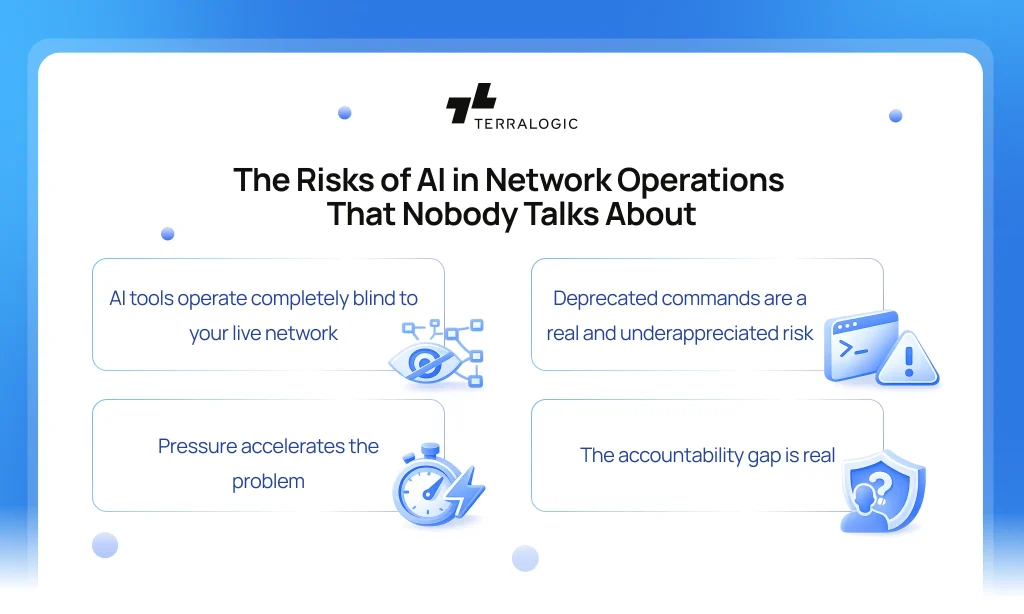
Most of the industry literature on AI in network engineering focuses on capability: what these tools can do, how fast they are, what they will be able to do next. The field-level conversation about human behavioural risks when engineers rely on AI under pressure is almost entirely missing.
Here is what that actually looks like in practice.
AI tools operate completely blind to your live network. An LLM generating a Cisco IOS-XR configuration has no access to your current routing tables, no knowledge of the BGP community strings your team has built over years, and no awareness of the specific hardware release running on that line card. It is generating the most statistically likely correct answer based on training data. In many cases that answer is fine. In some cases, it is not, and the delta between “fine” and “not fine” on a live carrier network is an outage.
Deprecated commands are a real and underappreciated risk. IOS-XR evolves across releases. A command that was valid syntax in one version may be deprecated, modified, or behave differently in the version running on your production device. An LLM trained on aggregated documentation does not always get this right, and it does not always flag the uncertainty either. It will often generate deprecated syntax with the same confidence it generates current syntax.
Pressure accelerates the problem. During a live fault or a tight maintenance window, the instinct is to move fast. AI tools feed that instinct. They produce output immediately, the output looks correct, and the cognitive load of a time-pressured engineer makes thorough validation feel like friction. This is precisely when validation matters most, and when it is most likely to be skipped.
The accountability gap is real. When a configuration causes an outage, the LLM that generated it is not in the post-mortem. The engineer who applied it is. This is not a technicality. It reflects a genuine responsibility that cannot be delegated to a generative AI tool, regardless of how confident the output looks.
How to Validate AI-Generated Network Configurations: The CVA Framework
What follows is a practical framework developed from real field experience in carrier-grade network environments. It is not a theory. It came from watching what goes wrong when engineers use AI tools without a structured validation step, and building a repeatable process to prevent it.
The framework has three steps: Context, Validate, Accountability.
Context: Read the Environment Before You Read the Config
Before evaluating a single line of AI-generated syntax, evaluate whether the AI actually understood your environment when it generated the output.
Did you give it the full picture? Does it know this is an IOS-XR core router and not an enterprise access switch? Does it account for the existing BGP community strings on this device? Does it reflect the specific MPLS label-distribution behaviour that is unique to your network topology?
LLMs can only work with what you give them. If your prompt was vague, the output will fill in the gaps with generic assumptions. On a carrier-grade network, generic assumptions are dangerous. Before treating any AI output as relevant to your specific situation, ask whether the AI actually had enough context to generate a relevant answer. If it did not, the output needs to be treated accordingly.
Validate: Cross-Reference Before You Apply
Once the context check is done, the output still needs independent verification before it goes anywhere near a production device.
Cross-reference the generated configuration against the official vendor documentation for your specific IOS-XR release. Check the hardware release notes for the line card in question. If the output references a protocol behaviour, verify it against the relevant RFC. If there is any doubt, run it through a simulation environment first. Tools like CML (Cisco Modelling Labs) or EVE-NG exist specifically for this purpose. They are not optional extras for cautious engineers. They are the standard process for validating LLM outputs in NetOps before applying to live devices.
Network configuration validation is not about distrusting AI. It is about understanding that the consequences of an error in this environment are not a failed unit test or a broken build. They are a live outage affecting real customers with real SLAs.
Accountability: Own Every Line You Apply
This is the non-negotiable part.
If you cannot explain what a command does, it does not go live. Not because the AI might be wrong, though it might be, but because you as the engineer are the one responsible for the outcome of every configuration change applied to a device in your network. That responsibility does not transfer when you use an AI tool to help generate the config.
An LLM cannot be paged at 2am when the BGP session drops. It cannot explain the change to a customer whose traffic is down. It cannot sit in the post-mortem and own the decision. You can. Every line of code applied to a production device must be fully understood and owned by the engineer applying it. That standard does not change because the source was an AI assistant rather than a colleague or a vendor document.
Integrating AI Tools Into NetOps Safely
None of this means AI for BGP and MPLS troubleshooting is not useful. It is. The point is to use it at the right stage of the workflow and with the right validation steps built in.
Used well, generative AI for network configurations is an excellent starting point. It is fast at syntax generation, useful for surfacing troubleshooting hypotheses, and helpful for navigating large bodies of documentation quickly. These are real productivity gains for network engineers, and dismissing them in the name of caution is not the answer.
The CVA Framework is not about slowing down. It is about inserting the right checks at the right points so that the speed AI provides does not come at the cost of the precision that live, carrier-grade networks demand. Context, Validate, Accountability. In that order, every time.
When engineering teams integrate this into their standard operating procedures and troubleshooting checklists, the result is not a slower workflow. It is fewer configuration-induced anomalies during maintenance windows, less time in post-mortems, and more confidence applying changes under pressure because the validation step is already built into the process.
The Skill That Does Not Deprecate
AI-driven network management is going to keep advancing. The tools will get faster, the outputs will get more accurate, and the integration with live network telemetry will deepen. Some of what engineers do manually today will be automated within a few years.
But the critical thinking that sits between an AI output and a live production device is not going anywhere. The ability to evaluate context, cross-reference outputs, and own the decision is not a skill that AI replaces. It is the skill that makes AI safe to use in environments where the cost of being wrong is an outage.
AI will not replace network engineers. But engineers who apply AI outputs without understanding them will eventually find themselves in a post-mortem explaining a decision they cannot fully account for.
The CVA Framework is a small thing to add to your workflow. The outage it prevents is not small at all.
FAQs
What is the role of AI for network engineers today?
AI helps network engineers to speed up tasks like generating syntax, troubleshooting, and documentation lookup. Using AI generative tools like ChatGPT and Copilot reduces manual effort, but they primarily lack visibility into live networks, hardware, and SLAs. Hence, it must be mandated to generate AI-generated output before production.
What are the risks of AI in network operations?
The biggest risks of AI in network operations come when you deploy unverified configurations. On carrier-grade networks running Cisco IOS-XR, BGP, or MPLS, a single incorrect command can trigger BGP session drops, MPLS path failures, routing table corruption, or complete loss of customer traffic, sometimes across multiple sites simultaneously. Here, AI can assist, but the engineering team will remain accountable.
How to validate AI generated network configurations?
To validate AI generated network configurations, you can simply follow the CVA Framework. It offers a simple process:
- Provide environment-specific details to understand the context.
- Validate using AI Generated Code using vendor documentation, RFCs, and network simulation tools like CML.
- Understand every command before deployment.
This approach strengthens network configuration validation and reduces production risks.
Can AI tools handle Cisco IOS-XR Configuration safely?
AI can generate Cisco IOS-XR Configuration safely but here’s a twist. Since it doesn’t know your hardware, software version, or routing policies, every configuration must be reviewed and validated before deployment.
What is the CVA Framework?
The CVA Framework stands for Context, Validate, Accountability. Built from real-world Network Troubleshooting Workflows, it helps teams use AI safely by combining proper context, independent validation, and engineer accountability.
Disclaimer
This blog is based on field observations from Network Engineering projects involving Cisco IOS-XR, BGP, OSPF, and MPLS environments. This blog includes the practical experience of Terralogic’s network engineering team and is intended for informational purposes only.
Keep reading about
LEAVE A COMMENT
We really appreciate your interest in our ideas. Feel free to share anything that comes to your mind.


Let's Craft Brilliance
Just exploring? Let's think out loud together. We would love to hear from you. Come, let's get started!