


For years, compliance teams have operated in a largely reactive environment. Regulations change, audits are scheduled, evidence is collected, reports are prepared, and remediation begins after a gap is identified. While this approach has helped organizations meet regulatory requirements, it is becoming increasingly difficult to sustain.
The compliance landscape in 2026 is far more complex than it was just a few years ago. Organizations must navigate evolving cybersecurity regulations, stricter data privacy laws, AI governance requirements, third-party risk obligations, and growing expectations from regulators, customers, and boards. At the same time, compliance teams are expected to do more with limited resources and tighter budgets.
Artificial intelligence is emerging as a practical solution to this challenge. Rather than replacing compliance professionals, AI helps them process large volumes of data, identify patterns, automate repetitive tasks, and surface potential risks much earlier than traditional methods. Activities that once required weeks of manual effort—such as evidence collection, control testing, policy reviews, and regulatory mapping—can now be performed continuously and at scale.
This shift is reshaping Governance, Risk, and Compliance (GRC). Organizations are moving away from periodic, audit-driven compliance programs toward continuous compliance models that provide real-time visibility into risks, controls, and regulatory obligations. AI-powered monitoring, predictive risk analysis, and automated workflows are becoming key capabilities for modern compliance teams.
However, adopting AI also introduces new responsibilities. Organizations must address concerns such as model bias, data privacy, explainability, AI governance, and compliance with emerging regulations such as the EU AI Act. As AI becomes more deeply embedded in business operations, governing AI systems is becoming just as important as using AI to support compliance activities.
In this guide, we’ll explore how AI is transforming compliance and GRC in 2026, the most valuable use cases emerging today, the risks organizations must manage, and the frameworks that can help ensure AI adoption remains trustworthy, transparent, and compliant.
Key Takeaways
- AI is transforming compliance from a periodic activity into a continuous process. Organizations can monitor controls, collect evidence, and identify compliance issues in near real time rather than relying solely on annual audits and manual reviews.
- The biggest impact of AI is automation at scale. Compliance teams are using AI to streamline evidence collection, regulatory mapping, policy reviews, control testing, and reporting activities that traditionally consumed significant time and resources.
- AI is becoming a core component of modern GRC programs. Organizations are increasingly integrating AI into governance, risk management, third-party risk management, and compliance operations to improve visibility and decision-making.
- Agentic AI is introducing a new model for compliance operations. AI systems can now support remediation workflows, prioritize compliance tasks, and assist with risk analysis while operating within defined governance controls.
- AI creates new compliance risks that organizations must manage. Model drift, algorithmic bias, data privacy concerns, lack of explainability, and AI washing are emerging as key governance challenges.
- AI governance is becoming a regulatory requirement. Frameworks such as ISO/IEC 42001, the NIST AI Risk Management Framework (AI RMF), and the EU AI Act are establishing expectations for responsible AI development and use.
- Human oversight remains essential. AI can accelerate compliance activities, but accountability for regulatory compliance, risk decisions, and governance outcomes remains with people.
- Organizations that combine AI with strong governance will gain the greatest value. The goal is not simply to automate compliance tasks, but to build a more proactive, resilient, and risk-aware compliance program.
AI in Compliance: What It Actually Means in 2026
AI is rapidly becoming part of modern compliance programs, but the term AI compliance means more than simply automating compliance tasks.
In 2026, AI compliance has 2 equally important dimensions. The first is using AI to improve compliance operations, such as monitoring regulatory changes, collecting audit evidence, reviewing policies, assessing risks, and identifying potential compliance issues. The second is ensuring that AI systems themselves are governed responsibly and comply with emerging regulations, industry standards, and organizational policies.
As organizations adopt AI across business functions, compliance teams are increasingly responsible for both. They must leverage AI to improve efficiency while also managing the risks that AI introduces. This has transformed AI compliance from a technology initiative into a core Governance, Risk, and Compliance (GRC) discipline.
1. AI Is Transforming How Compliance Works
Compliance teams are dealing with growing volumes of regulations, controls, audit evidence, and risk data. AI helps automate many of these activities, allowing teams to move beyond manual reviews and periodic assessments.
Common use cases include:
- Monitoring regulatory changes
- Mapping regulations to internal controls
- Reviewing policies and procedures
- Collecting audit evidence
- Detecting compliance anomalies
- Generating compliance reports
Instead of relying solely on annual audits, organizations can continuously monitor compliance activities and identify issues much earlier.
2. Governing AI Is Now a Compliance Requirement
As AI becomes embedded in business operations, organizations must ensure these systems are transparent, accountable, and compliant with emerging regulations.
Compliance teams now need to answer questions such as:
- How is the AI system making decisions?
- Is the model producing biased outcomes?
- How is training data managed and protected?
- Who is accountable for AI-driven decisions?
- Does the system comply with frameworks such as the EU AI Act or ISO/IEC 42001?
This is why AI governance has become a major focus for compliance programs in 2026. Organizations are no longer just using AI for compliance—they are also building compliance programs for AI.
3. From Reactive Compliance to Continuous Compliance
Perhaps the biggest change is how compliance is managed. Traditional compliance programs rely on periodic reviews, manual evidence collection, and point-in-time assessments. AI enables organizations to monitor controls continuously, analyze large volumes of data in real time, and identify emerging risks before they become compliance failures.
As a result, compliance is shifting from an audit-driven activity to a continuous, risk-based process that supports stronger governance, faster decision-making, and improved organizational resilience.
5 Ways AI Is Reshaping Compliance Work Right Now
AI is changing how compliance teams operate by reducing manual effort, improving visibility, and helping organizations respond more quickly to emerging risks. Rather than replacing compliance professionals, AI is enabling them to focus more on analysis, judgment, and strategic decision-making.
Here are 5 areas where AI is delivering the biggest impact today:
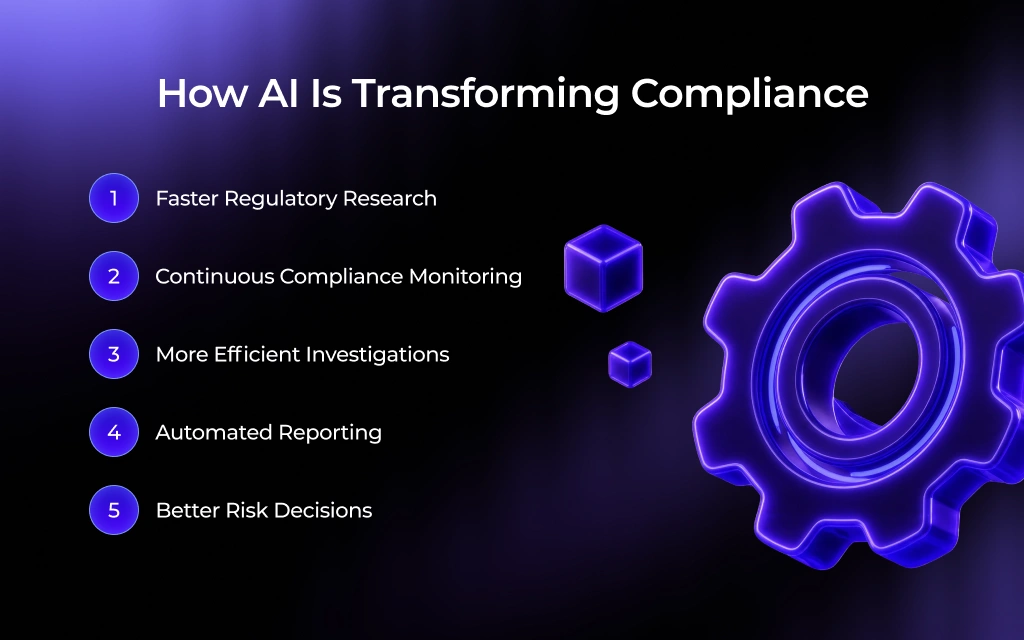
1. Faster Regulatory Research
One of the most time-consuming parts of compliance work is keeping up with regulatory changes. Compliance teams must review new regulations, enforcement actions, industry guidance, and internal policies to determine what applies to the organization.
AI can analyze large volumes of regulatory information in minutes and surface the sections most relevant to a specific business, industry, or compliance requirement.
Instead of manually reviewing hundreds of pages of documentation, compliance professionals can focus on understanding the business impact and determining what actions need to be taken.
Example: A compliance officer can use AI to summarize updates to the EU AI Act and identify which internal policies may require revision.
2. Continuous Compliance Monitoring
Traditional compliance monitoring often relies on periodic reviews, audits, or manual testing. Problems may go unnoticed for weeks or months until they are discovered during an assessment.
AI enables continuous monitoring by analyzing transactions, user activities, communications, and control data in real time. This helps organizations identify unusual behavior and potential compliance violations much earlier.
Rather than waiting for an annual audit, compliance teams can detect issues as they emerge.
Example: An AI system may flag unusual employee access to sensitive data or identify transactions that deviate from established compliance rules.
3. More Efficient Investigations
Investigations often require compliance teams to review emails, documents, chat messages, contracts, and other records to understand what happened and whether a violation occurred.
AI can quickly search large datasets, identify relevant information, and highlight patterns that might otherwise be overlooked.
This reduces the time required for investigations and allows teams to focus on evaluating evidence rather than searching for it.
Example: During a whistleblower investigation, AI can analyze thousands of communications and surface conversations relevant to the reported issue.
4. Automated Reporting
Compliance teams spend significant time preparing audit evidence, documenting controls, maintaining records, and creating reports for management and regulators.
Many of these activities follow predictable processes that can be partially automated using AI.
By reducing manual administrative work, organizations can improve reporting accuracy and free compliance professionals to focus on higher-value activities.
Example: AI can automatically collect evidence from multiple systems and generate draft audit reports based on predefined templates.
5. Better Risk Decisions
Compliance decisions are only as good as the information available. AI can help compliance teams analyze data from multiple sources, identify emerging risks, and prioritize issues based on potential impact.
This provides leadership with better visibility into compliance risks and supports more informed decision-making.
The goal is not to let AI make compliance decisions independently. Instead, AI provides insights that help compliance professionals make better decisions faster.
Example: AI can identify business units with recurring policy violations and recommend areas that require additional controls or training.
Agentic Compliance: The 2026 Shift from Reactive to Autonomous
Agentic compliance refers to the use of AI agents that can perform compliance-related tasks autonomously within predefined governance rules. Unlike traditional AI tools that primarily analyze information or generate recommendations, AI agents can take action—such as collecting evidence, assigning remediation tasks, escalating issues, tracking control failures, and coordinating compliance workflows across systems.
This represents a significant shift in how compliance programs operate. Traditionally, compliance has been reactive: teams review controls periodically, identify issues during audits, and manually coordinate remediation efforts. As regulations become more complex and compliance data continues to grow, this approach is becoming increasingly difficult to sustain.
AI agents enable a more proactive model. Instead of waiting for an audit to uncover a problem, they can continuously monitor controls, identify potential compliance issues in real time, and initiate predefined response workflows automatically. For example, an AI agent might detect a policy violation, create a remediation ticket, assign an owner, and track progress until the issue is resolved.
The goal is not to replace compliance professionals. Human oversight remains essential for regulatory interpretation, governance decisions, and high-risk actions. Rather, agentic compliance automates routine operational work, allowing compliance teams to spend less time on administrative tasks and more time on risk management, governance, and strategic decision-making.
As organizations move toward continuous compliance, agentic AI is emerging as the next evolution of modern GRC programs—helping teams respond faster, improve consistency, and scale compliance operations more effectively.
The Risks: What Can Go Wrong When AI Runs Compliance?
AI can help compliance teams work faster, automate repetitive tasks, and identify risks more efficiently. However, AI is not inherently compliant. Without proper governance and oversight, organizations may introduce new compliance risks while trying to improve existing processes.
Below are 3 common AI compliance risks:
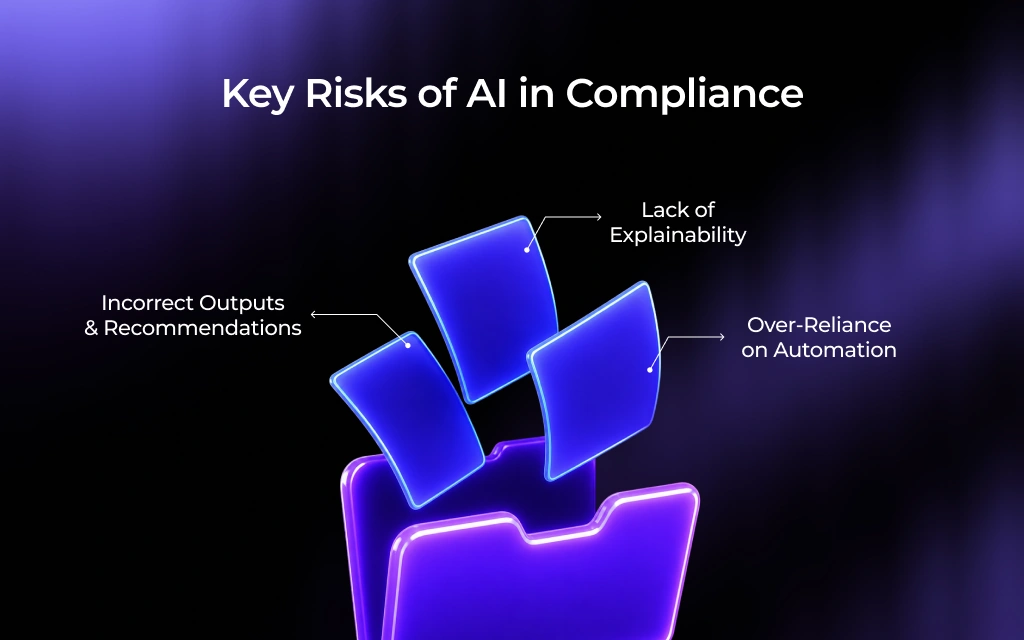
1. Incorrect Outputs and Recommendations
AI models can generate answers that appear accurate but are actually incomplete, outdated, or entirely incorrect. This is particularly risky when AI is used to interpret regulations, summarize policies, or answer compliance-related questions.
Example: An AI assistant summarizes a new regulatory requirement and incorrectly states that a quarterly review is sufficient when the regulation actually requires monthly monitoring.
Why it matters: Compliance teams may make decisions based on inaccurate information, resulting in audit findings, regulatory violations, or ineffective controls.
2. Lack of Explainability
Some AI systems can identify risks or generate recommendations without clearly showing how they reached those conclusions. This lack of transparency can create challenges during audits, investigations, or regulatory reviews.
Example: An AI tool flags a vendor as high-risk, but the compliance team cannot explain which factors contributed to the score when asked by management or auditors.
Why it matters: Regulators increasingly expect organizations to demonstrate accountability and explain how important compliance decisions are made.
3. Over-Reliance on Automation
AI can automate many compliance activities, but it cannot replace professional judgment. Compliance decisions often require business context, ethical considerations, and regulatory interpretation that AI cannot fully understand.
Example: An AI system automatically closes low-risk compliance alerts. Over time, employees begin trusting the system completely, causing a genuine compliance issue to be overlooked because nobody reviewed the alert manually.
Why it matters: AI should support decision-making, not replace it. Accountability for compliance outcomes always remains with the organization and its leadership.
Governing the AI That Governs Compliance: Frameworks That Apply
As organizations increasingly rely on AI for compliance activities, governance becomes just as important as automation. An AI system that reviews policies, monitors controls, or assesses risks can influence important business and regulatory decisions. Without proper oversight, errors, bias, or poor decision-making can create significant compliance and legal consequences.
The goal of AI governance is not simply to control AI. It is to ensure AI systems remain transparent, accountable, reliable, and aligned with organizational and regulatory requirements.
What Needs to Be Governed?
Before selecting a framework, organizations need to understand what AI governance is designed to achieve. The challenge is not simply ensuring that AI systems function correctly, but ensuring they operate in a way that is trustworthy, accountable, and aligned with both business objectives and regulatory expectations.
As AI becomes more involved in compliance activities, organizations must establish controls around several key areas:
- Accountability: Clearly define who is responsible for AI-driven decisions and outcomes.
- Transparency: Ensure AI recommendations and outputs can be explained and understood.
- Data Governance: Manage how training data is collected, stored, and used.
- Risk Management: Identify and mitigate risks such as bias, inaccurate outputs, and model failures.
- Human Oversight: Maintain appropriate human review for high-impact decisions.
Key Frameworks Supporting AI Compliance
While governance principles provide the “what,” organizations also need practical guidance on “how” to implement them. This is where AI governance frameworks play an important role. They provide structured approaches for managing AI risks, defining responsibilities, documenting controls, and demonstrating compliance to regulators and stakeholders.
Several frameworks have emerged as leading references for organizations adopting AI at scale:
- ISO/IEC 42001 provides a management system standard for governing AI throughout its lifecycle. Similar to how ISO 27001 supports information security management, ISO 42001 helps organizations establish policies, responsibilities, controls, and continuous improvement processes for AI systems.
- The NIST AI Risk Management Framework (AI RMF) provides practical guidance for identifying, assessing, and managing AI-related risks. It is widely used to help organizations build trustworthy AI systems while balancing innovation, risk, and regulatory expectations.
- The EU AI Act introduces legal obligations for organizations developing or deploying AI systems within the European market. Depending on the risk level of the AI application, organizations may need to meet requirements related to transparency, documentation, human oversight, testing, and ongoing monitoring.
How to Adopt AI in Compliance Without Losing Control: A Practical Approach
Many organizations recognize the potential of AI in compliance but struggle with where to start. The challenge is not whether AI can improve compliance processes—it can. The challenge is implementing AI in a way that improves efficiency without introducing new risks.
A successful AI compliance program starts with governance and gradually expands as confidence and maturity increase.
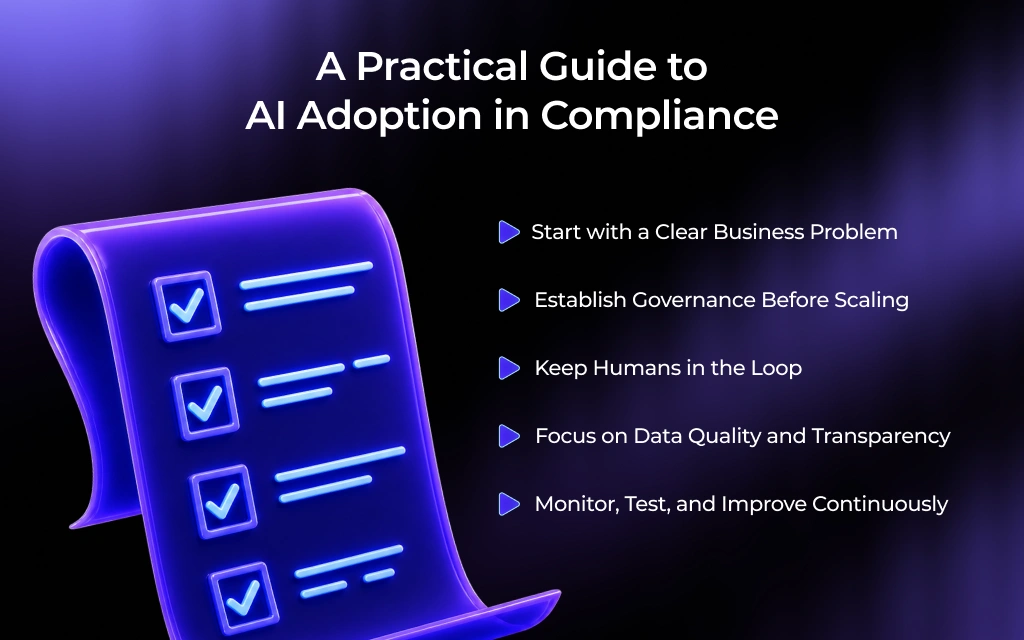
1. Start with a Clear Business Problem
Organizations should avoid adopting AI simply because it is available. Instead, focus on specific compliance activities that are repetitive, time-consuming, and difficult to scale manually.
Common starting points include:
- Regulatory monitoring
- Evidence collection
- Policy reviews
- Third-party due diligence
- Compliance reporting
These processes often require significant manual effort but follow predictable workflows, making them suitable for AI-assisted automation. Starting with a well-defined use case also makes it easier to measure outcomes, identify risks, and demonstrate value before expanding AI adoption to other areas.
2. Establish Governance Before Scaling
One of the biggest mistakes organizations make is deploying AI tools before defining how they will be governed. As AI becomes involved in compliance activities, organizations need clear accountability for how these systems are used and monitored.
Key questions include:
- Who owns the AI system?
- Who reviews AI-generated outputs?
- What level of human approval is required?
- How will AI-related risks be assessed and reported?
Without clear ownership and oversight, it becomes difficult to determine responsibility when an AI system produces inaccurate outputs or contributes to a compliance failure. Governance should be established before AI becomes embedded in critical compliance processes.
3. Keep Humans in the Loop
AI can analyze information and automate workflows, but it cannot replace professional judgment. Compliance decisions often require context, interpretation, and an understanding of regulatory intent that AI systems may not fully capture.
Human oversight remains essential for:
- Regulatory interpretation
- Risk acceptance decisions
- Exception approvals
- High-impact investigations
- Policy changes
The most effective organizations use AI to support decision-making rather than make decisions independently. AI can help identify issues and provide recommendations, but accountability should always remain with people.
4. Focus on Data Quality and Transparency
The quality of AI outputs depends heavily on the quality of the data being used. Incomplete records, outdated policies, inconsistent documentation, or poor data governance can lead to inaccurate recommendations and unreliable results.
Organizations should establish controls around:
- Data quality
- Data access
- Model inputs
- Documentation
- Auditability
Transparency is equally important. Compliance teams should be able to understand how an AI system reached a conclusion and what information influenced the result. If an organization cannot explain an AI-generated recommendation during an audit or regulatory review, it may struggle to defend its compliance decisions.
5. Monitor, Test, and Improve Continuously
AI implementation is not a one-time project. Regulations evolve, business processes change, and AI models can become less reliable over time if they are not regularly evaluated.
Organizations should regularly:
- Review AI performance
- Test outputs for accuracy
- Monitor for model drift
- Reassess AI-related risks
- Update governance controls
Continuous monitoring helps ensure AI remains aligned with current regulatory requirements and business objectives. It also allows organizations to identify issues early before they affect compliance outcomes or regulatory reporting.
Conclusion
Artificial intelligence is rapidly changing how compliance programs operate. What was once a largely manual function built around periodic reviews, audits, and evidence collection is evolving into a more continuous, data-driven discipline supported by AI.
Organizations are already using AI to monitor regulatory changes, automate routine compliance tasks, improve investigations, and identify risks faster than traditional approaches allow. At the same time, the growing use of AI creates new responsibilities around governance, transparency, accountability, and regulatory compliance.
The organizations that will gain the most value from AI are not necessarily those adopting the most advanced technologies. They are the ones building strong governance foundations, maintaining human oversight, and implementing AI in a controlled and measurable way.
As AI adoption accelerates and regulations continue to evolve, compliance teams will play a critical role in ensuring that innovation and accountability move forward together. The future of compliance is not fully automated—it is AI-enabled, human-governed, and continuously improving.
Need help building an AI governance strategy or integrating AI into your compliance and GRC program? Terralogic helps organizations assess AI-related risks, establish governance frameworks, align with emerging regulations, and implement AI responsibly across compliance operations.