

Why Businesses Fail with AI Applications (and How to Get It Right)
December 15, 2025
It starts the same way every time. A company pours hundreds of thousands into AI, launches a promising pilot, and within months, it is collecting dust.
This story is common. Gartner recently reported that 85% of AI projects fail to deliver expected business value. McKinsey found that only 8% of companies have scaled AI beyond the pilot stage successfully.
Think about that for a second. Companies pour money into AI, see promising early results, and then hit a wall that burns their investment into expensive shelfware.
But here’s what nobody’s talking about: AI application failures aren’t technology problems. They’re strategy problems disguised as technology challenges.
The businesses succeeding with AI in 2025 aren’t necessarily the ones with the best engineers or biggest budgets. They’re the ones who figured out that implementing AI is fundamentally different from implementing traditional software.
Let’s see exactly why AI projects fail in business and, more importantly, how to avoid becoming another cautionary tale.
6 Common Causes of AI Application Failure
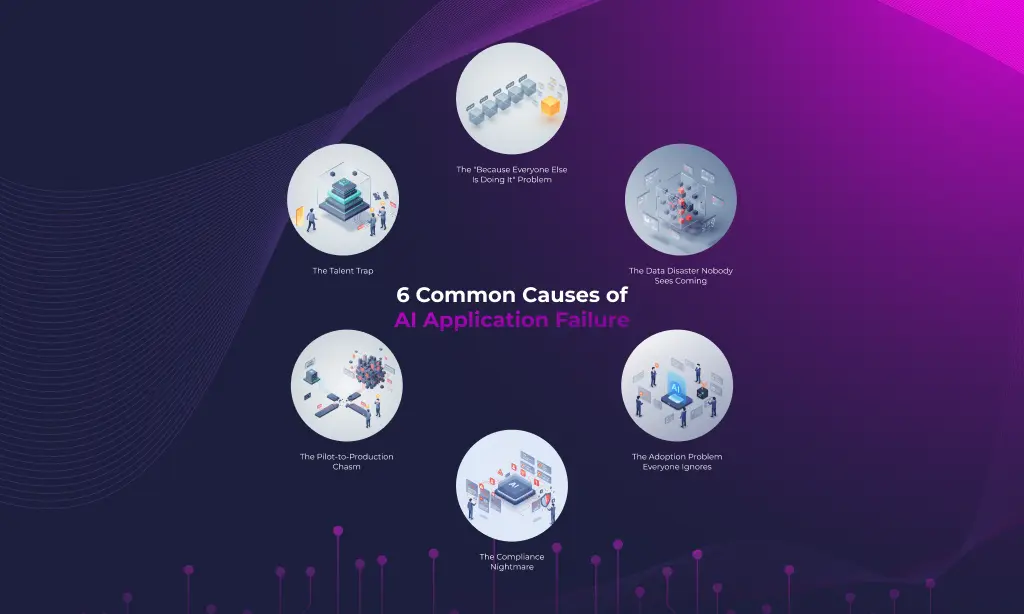
Let’s cut through the noise and talk about the real challenges in implementing AI applications that we see repeatedly:
Let’s dive straight to the real challenges in implementing AI applications failures that happen repeatedly
- The “Because Everyone Else Is Doing It” Problem
Many companies build AI chatbots because their competitors are doing it. That’s not a strategy; that’s FOMO with a budget.
Successful AI implementation strategies start with business problems, not technology solutions. Are you losing customers because response times are slow? Quantify it. Are manual processes creating bottlenecks? Measure them. Without clear business goals tied to specific metrics, you’re just buying expensive toys.
- The Data Disaster Nobody Sees Coming
The most common mistakes in enterprise AI adoption; they don’t have AI-ready data.
Your data is scattered across systems that don’t talk to each other. It’s inconsistent, like one word spelled in multiple ways. It’s incomplete (missing crucial fields). It’s outdated or was last updated in 2019. And it’s often just plain wrong.
- The Talent Trap
You hired a data scientist from a big tech company. They built an incredible model. Then they left for another opportunity, and nobody on your team understands how it works or how to maintain it.
This is one of the reasons why AI applications fail in enterprises that nobody wants to admit. The dependency on specialized talent without building internal capability creates unsustainable systems. And the entire project crumbles down like a house of cards.
- The Pilot-to-Production Chasm
Your AI proof-of-concept worked beautifully with 1,000 clean records in a controlled environment. Now you need it to handle 10 million messy records, integrate with your legacy ERP system, and perform consistently 24/7. And it’s a big trouble to handle.
Most AI pilots are experiments that never account for real-world complexity. When you try to move to production, you discover that your beautiful demo doesn’t handle edge cases, can’t maintain performance at scale, and breaks when integrated with existing systems.
- The Adoption Problem Everyone Ignores
You built the AI tool. Your users hate it, don’t trust it, or simply ignore it and keep doing things the old way.
When management isn’t ready to adopt an AI tool, then failure is a byproduct. Your sales team doesn’t trust the AI lead scoring, customer service reps prefer their own over AI’s, and analysts think it is some black box. So, always work on technology adoption.
- The Compliance Nightmare
Your AI is in production, and the legal team is sending you emails regarding GDPR violations; the security team found more cracks.
Common pitfalls in AI adoption for businesses include treating AI like traditional software when it actually requires entirely new approaches to security, privacy, and regulatory compliance.
What Successful AI Leaders Do Differently
They Obsess Over Business Outcomes, Not Technology
The best AI project success factors start with ruthless clarity on what success looks like in business terms.
- They Design for Humans, Not Just Algorithms
Successful AI implementations focus as much on user experience and building trust as they do on accuracy.
For example, when you build an AI assistant for your support team that shows its reasoning and admits uncertainty, this makes it easy for agents to override when needed. This results in an easy adoption across the company. Why? Because it was designed to augment humans, not replace them.
- They Build Infrastructure Before Applications
Companies with long vision always invest in data quality, governance frameworks, and integration capabilities before building AI models. This results in a strong foundation that determines whether AI will scale or stall in the near term.
- They Think in Phases, Not Projects
Successful AI implementation strategies treat AI as a journey, not a destination. It all starts with a focused use case that delivers quick wins. Learn from it. Build capability. Then expand. Companies that try to boil the ocean (funds) on their first AI initiative almost always fail.
- They Partner Strategically
All companies don’t have all the expertise at their disposal. To get AI right, leaders know where they have to invest and need any help. You don’t need to become an AI company to benefit from AI. You need to be smart enough to know what to build, what to buy, and who to partner with for design, development, and maintenance.
Practical Steps to Get AI Right in 2025
Here’s your playbook for how to ensure successful AI implementation:
Define Success in metrics and sense.
Before writing code, answer: What specific business metric improves? By how much? What’s that worth? If you can’t quantify the value, you’re not ready to build.
Start Small, Win Big
Pick high-impact, low-risk use cases for your first AI implementation. Customer service chatbots are before autonomous decision-making systems. Invoice processing before strategic forecasting.
Quick wins fuel momentum, build capability, and boost organizational confidence.
Invest in Your People
Train your team not only on how to use AI tools but to think with AI. The companies succeeding with AI are building AI literacy across their organization, not just in IT, allowing them to scale easily.
Make Security and Compliance Non-Negotiable
Create a solid foundation for privacy, security, and auditability in your AI from the start. Retrofitting compliance is exponentially harder and more expensive than designing for it up front.
Plan for Maintenance, Not Just Launch
AI models need fine-tuning over time as patterns change. Your initial implementation is just the beginning; you need more budget for ongoing monitoring, retraining, and refinement.
The Role of Trusted AI Partners
Here’s what I’ve learned watching hundreds of AI implementations: the companies that try to figure everything out alone are the ones most likely to fail.
Why Does Going Solo Fail?
To build production-grade AI, one requires expertise in machine learning, data engineering, UX design, security, compliance, and change management. Few companies have all these skills in-house.
Many businesses spend years and millions trying to build AI capabilities from scratch, only to end up with systems that don’t deliver business value.
What the Right Partner Provides
Strategic partners help you avoid AI application design mistakes companies make by bringing:
- Strategy clarity: helping you identify where AI creates the most value
- Design expertise: building AI that people actually want to use
- Technical depth: implementing AI that works reliably at scale
- Ongoing support: maintaining and improving AI as your business evolves
The businesses winning with AI aren’t trying to become AI experts. They’re focusing on their core business while partnering with experts who handle the complexity of designing, building, and maintaining AI solutions.
Conclusion
The gap between AI hype and AI results comes down to one thing: execution.
The technology works. The business value is real. But overcoming challenges in AI adoption requires more than just tools or hiring data scientists. It was all about strategic thinking, how AI creates value, and how to execute and prioritize business outcomes.
The ones getting AI right are pulling ahead, while others are stuck in pilot purgatory or dealing with failed implementations.
The question isn’t whether AI will transform your industry; it’s whether you’ll be leading that transformation or not. Partner with experts who design, build, and maintain AI solutions tailored for your business growth.
FAQ
Why do most AI projects fail?
Most AI projects fail due to a lack of clarity and business objectives, poor data quality, inadequate change management, and scaling without proper infrastructure. What you need is a strategic implementation of AI in your business.
What percentage of AI initiatives actually succeed?
Only 15-20% of AI projects actually succeed. Around 10% can scale successfully beyond the pilot stage.
How long does it take to see ROI from AI applications?
A well-designed AI application can generate ROI within 6-12 months. The key is starting with high-impact use cases rather than trying to solve everything at once.
What’s the biggest mistake companies make when implementing AI?
The biggest mistake is adopting AI because competitors are doing it, rather than starting with clear business problems and measurable outcomes. Technology should follow strategy, not drive it.
The biggest mistake companies make when implementing AI is the FOMO. Many businesses jump in because their competitors are doing it. But without clarity, projects are bound to fail.
Do I need to hire AI specialists to succeed with AI?
Yes, at the initial stage, you should hire an AI specialist to build all capabilities. This allows you to implement an AI solution in your business faster.
Keep reading about
LEAVE A COMMENT
We really appreciate your interest in our ideas. Feel free to share anything that comes to your mind.



Our 16 years of achievements includes:
-
10M+
lines of codes
-
2400+
projects completed
-
900+
satisfied clients
-
16+
countries served