
Cyber threats are not limited to sophisticated hackers breaking into corporate networks. They also include compromised employee accounts, unpatched software, malicious insiders, and weaknesses in third-party services that organizations rely on to operate.
What makes these threats difficult to manage is that they rarely occur in isolation. A phishing email can expose an employee’s credentials. Those credentials can give an attacker access to a remote system. From there, the attacker may move across the network, steal sensitive data, or deploy ransomware.
The consequences extend beyond IT disruption. A successful attack can interrupt business operations, expose customer information, create regulatory obligations, and damage relationships with customers and partners.
For business leaders, the challenge is not simply knowing which cyber threats exist. It is understanding how they could affect the organization, where security controls may fail, and whether the business can detect and contain an attack before the damage spreads.
This guide explains the major types of cyber threats, examines important developments shaping the 2026 threat landscape, and outlines practical measures organizations can use to reduce their exposure.
What is a cyber threat?
A cyber threat is any circumstance, event, actor, or technique with the potential to exploit a weakness and cause harm to a computer system, network, application, or organization.
Cyber threats can originate from external attackers, malicious software, criminal groups, nation-state actors, or individuals with legitimate access to organizational systems. Their objectives vary. Some seek financial gain through ransomware or fraud, while others aim to steal sensitive information, disrupt operations, or maintain unauthorized access.
A cyber threat is not necessarily an active attack. It describes the potential for harm. An attack occurs when a threat is carried out against a target.
Why cyber threats matter in 2026
The way attackers gain access to business systems is changing, and organizations can no longer focus on a single type of threat. Software vulnerabilities are giving attackers more opportunities to enter corporate networks, ransomware continues to disrupt business operations, and AI is making social engineering attacks harder to recognize.
These developments create challenges at different stages of an attack. A vulnerability can provide the initial entry point. Stolen credentials or weak access controls can help attackers move further into the environment. Ransomware and data theft can then turn a security incident into a business crisis.
For security leaders, this means reviewing more than just the tools used to prevent attacks. They need to understand where their systems are exposed, how attackers could gain and expand access, and whether their teams can detect suspicious activity before it causes significant damage.
3 developments in particular are shaping the cyber threat landscape in 2026:
1. Vulnerability exploitation is a major way attackers gain access
Attackers often look for weaknesses in business systems that allow them to gain unauthorized access. These weaknesses may exist in outdated software, internet-facing applications, remote-access services, or systems with insecure configurations.
Once attackers find an exploitable vulnerability, they may use it to access a system, steal sensitive information, install malware, or establish a foothold in the organization’s network.
For businesses, identifying vulnerabilities is only the first step. Security teams also need to understand which weaknesses are exposed, how they could be exploited, and whether the affected systems support critical business operations.
Regular vulnerability assessments help identify security gaps, but the findings must be prioritized and addressed promptly. Otherwise, known weaknesses can remain available for attackers to exploit.
2. Ransomware continues to threaten business operations
Ransomware remains a significant threat because it can disrupt business operations while putting sensitive information at risk.
Modern ransomware attacks often go beyond encrypting files and demanding payment. Attackers may also steal sensitive data before encrypting systems. If the organization refuses to pay, they may threaten to publish or sell the stolen information. This is commonly known as double extortion.
The impact can extend across several areas of the business:
- Operational disruption: Critical systems and services may become unavailable, affecting daily operations.
- Data exposure: Customer, employee, or confidential business information may be stolen.
- Financial losses: Organizations may face recovery costs, incident response expenses, legal fees, and lost revenue.
- Compliance consequences: A data breach may trigger regulatory reporting requirements, contractual obligations, or legal action.
Maintaining reliable backups is essential for recovering encrypted systems, but backups alone are not enough. If attackers have already stolen sensitive information, restoring systems will not prevent its exposure. Organizations also need controls to detect suspicious activity, restrict unauthorized access, and limit the amount of data attackers can reach.
3. AI is making existing attacks more convincing
AI is changing how attackers prepare and carry out cyber attacks. They can use it to create more convincing phishing messages, gather information about potential targets, and support impersonation attempts.
In 2026, AI is also helping attackers improve existing techniques rather than simply introducing entirely new types of threats.
For example, an attacker can use AI to write a phishing email that sounds like a legitimate business request. They may also use generated audio or video to impersonate an executive and request an urgent payment.
This makes it harder for employees to identify suspicious messages based on spelling mistakes or unusual wording alone.
Businesses should therefore strengthen identity verification, access controls, and security monitoring. Employees still need security awareness training, but they should not be expected to identify every AI-generated threat on their own.
The major types of cyber threats organizations face
There is no single way to categorize every cyber threat. Some categories describe the attacker’s objective, while others describe the method used to gain access or compromise an environment.
The following 7 categories represent major cybersecurity threats organizations should understand in 2026.

1. Ransomware
Ransomware is a type of malware that prevents an organization from accessing its systems or data, commonly by encrypting files. Attackers then demand payment in exchange for a decryption key or other promises.
Modern ransomware attacks frequently involve double extortion. Attackers steal sensitive information before encrypting systems, then threaten to publish or sell the data if the organization refuses to pay.
How it typically works:
- Attackers gain initial access through stolen credentials, exploited vulnerabilities, phishing, or compromised remote-access services.
- They establish persistence and attempt to expand their access.
- They identify valuable systems, sensitive data, and backup infrastructure.
- They exfiltrate information and deploy ransomware.
- They demand payment, often threatening both continued disruption and data disclosure.
Cyber threat example: An attacker compromises an employee account, moves into the organization’s internal network, and gains access to shared storage. The attacker then encrypts business-critical files and threatens to release customer information copied before the encryption began.
Business impact: Ransomware can interrupt production, delay customer services, affect revenue, and create substantial recovery costs. Data theft can also lead to regulatory scrutiny and reputational damage.
What organizations should prioritize:
- Maintain tested and isolated backups.
- Apply security patches to exposed systems.
- Enforce MFA and least-privilege access.
- Segment networks to limit lateral movement.
- Monitor endpoints, identities, and network activity.
- Establish and test incident response and recovery procedures.
2. Phishing and social engineering
Phishing is a form of social engineering in which attackers use deceptive messages, websites, or communications to persuade individuals to reveal information, transfer money, or perform an action that benefits the attacker.
Although email remains a common delivery channel, social engineering also occurs through text messages, phone calls, collaboration platforms, and impersonation of trusted individuals.
How it typically works:
- An attacker impersonates a trusted person, organization, or service.
- The target receives a message containing an urgent request, misleading information, or a malicious link.
- The target is persuaded to disclose credentials, open a malicious attachment, approve an authentication request, or transfer funds.
- The attacker uses the resulting access or information to continue the attack.
Cyber threat example: An employee receives an email that appears to come from the finance director requesting an urgent payment to a new supplier account. The message uses familiar business language and references a legitimate transaction, making it difficult to identify as fraudulent.
Business impact: Successful phishing can lead to account compromise, business email compromise, financial fraud, malware infections, and unauthorized access to corporate systems.
What organizations should prioritize:
- Conduct regular security awareness training.
- Use email security controls to identify malicious links and attachments.
- Require MFA for business-critical accounts.
- Establish independent verification procedures for financial requests and changes to payment details.
- Provide clear reporting channels for suspicious communications.
Training should reflect how social engineering actually occurs. Employees need to recognize suspicious requests across email, messaging applications, and voice calls, not just poorly written phishing emails.
3. Credential-based and identity attacks
Credential-based attacks target the information used to verify a user’s identity, such as passwords, authentication tokens, and session cookies.
Attackers may obtain credentials through phishing, malware, data breaches, password reuse, or brute-force attempts. They can then use legitimate access mechanisms to enter systems without immediately triggering traditional malware alerts.
Common techniques include:
- Credential stuffing: Using username and password combinations exposed in previous breaches to access other services.
- Password spraying: Trying a small number of commonly used passwords against many accounts.
- Brute-force attacks: Repeatedly attempting password combinations until access is gained.
- Session hijacking: Stealing or abusing an authenticated session to act as a legitimate user.
- MFA fatigue: Repeatedly sending authentication requests to pressure a user into approving one.
Cyber threat example: An attacker obtains an employee’s password through a phishing campaign. The employee reuses that password across multiple services, allowing the attacker to access a corporate account and explore connected applications.
Business impact: Compromised identities can provide access to email, cloud platforms, financial systems, customer data, and privileged administrative functions. Because attackers may use valid credentials, their activity can resemble normal user behavior.
What organizations should prioritize:
- Enforce MFA, prioritizing privileged and remote-access accounts.
- Apply least-privilege access principles.
- Use strong authentication methods, including phishing-resistant MFA where appropriate.
- Monitor unusual login locations, devices, and access patterns.
- Review privileged accounts and remove unnecessary access.
- Revoke compromised credentials, sessions, and tokens promptly.
Identity security should be treated as a continuous process. Granting access once and assuming it remains appropriate creates opportunities for attackers to exploit accounts that have become overprivileged or poorly monitored.
4. Vulnerability exploitation
Vulnerability exploitation occurs when attackers take advantage of weaknesses in software, hardware, applications, or system configurations to gain unauthorized access or perform malicious actions.
These weaknesses may include outdated software, insecure configurations, missing security updates, or flaws in application code.
Not every vulnerability is actively exploited. However, weaknesses in internet-facing systems and widely used technologies can become attractive targets, particularly when exploit techniques are publicly available.
How it typically works:
- Attackers identify an exposed system or application.
- They determine whether it contains a known or unknown vulnerability.
- They use an exploit to bypass security controls, execute code, or gain unauthorized access.
- They use the initial foothold to steal information, move laterally, or deploy additional malware.
Cyber threat example: An organization operates an internet-facing application using an outdated software component. An attacker identifies a known vulnerability in that component and exploits it to execute unauthorized commands on the server.
Business impact: Successful exploitation can expose sensitive data, compromise applications, disrupt services, and provide a path into other parts of the corporate network.
What organizations should prioritize:
- Maintain an accurate inventory of assets and software.
- Conduct regular vulnerability assessments.
- Prioritize remediation based on exploitability, exposure, and business criticality.
- Apply security updates within risk-based timeframes.
- Conduct penetration testing to validate whether weaknesses can be exploited.
- Monitor exposed systems for suspicious activity.
The 2026 DBIR finding that vulnerability exploitation accounted for 31% of breaches reinforces the need to connect vulnerability identification with timely remediation. A list of vulnerabilities is not a security outcome unless the organization can demonstrate that meaningful exposure is being reduced.
5. AI-enabled cyber threats
AI-enabled cyber threats involve the use of artificial intelligence to support, accelerate, or improve malicious activities.
AI can help attackers create convincing messages, automate parts of reconnaissance, generate malicious code, and adapt social engineering attempts to specific targets.
One important development is the use of deepfake audio and video to impersonate executives, employees, or business partners. These techniques can make fraudulent requests appear more credible, particularly when they are combined with information gathered from public sources.
How it typically works:
- An attacker gathers information about an organization or individual.
- AI tools help generate convincing messages, impersonation content, or supporting material.
- The attacker uses the content to manipulate employees, obtain information, or initiate unauthorized transactions.
- If successful, the attacker uses the resulting access or financial transfer to achieve their objective.
Cyber threat example: An employee receives a voice call that appears to come from a senior executive requesting an urgent transfer. The request sounds familiar and credible, but the voice has been artificially generated or manipulated.
Business impact: AI-assisted social engineering can increase the volume and credibility of impersonation attempts. It can also make it harder for employees to distinguish legitimate requests from fraudulent ones.
What organizations should prioritize:
- Introduce independent verification for sensitive financial and administrative requests.
- Establish clear approval processes for payments and changes to account details.
- Train employees to recognize voice, video, and messaging-based impersonation.
- Define acceptable use policies for generative AI tools.
- Monitor for unauthorized access to sensitive information and corporate AI environments.
AI should be treated as a force multiplier for existing cyber threats, not as a reason to focus exclusively on futuristic attack scenarios. Many of the most effective defenses remain fundamental controls around identity, access, verification, and monitoring.
6. Insider threats
Insider threats originate from individuals who have legitimate access to an organization’s systems, applications, or information.
They may involve malicious actions, such as intentionally stealing confidential data, or negligent behavior, such as exposing sensitive information through insecure practices.
Insider threats can be difficult to identify because the individuals involved may already have authorized access to the systems they misuse.
Common forms include:
- Malicious insiders: Employees or contractors who intentionally steal, disclose, or damage organizational information.
- Negligent insiders: Individuals who unintentionally expose data through mistakes or unsafe behavior.
- Compromised insiders: Legitimate accounts taken over by external attackers.
Cyber threat example: An employee preparing to leave the organization copies confidential customer information to a personal storage account without authorization.
Business impact: Insider incidents can expose intellectual property, customer records, financial information, and other sensitive assets. They may also create legal, contractual, and compliance consequences.
What organizations should prioritize:
- Apply role-based access controls and least privilege.
- Review access rights when employees change roles or leave.
- Monitor unusual data access, downloads, and transfers.
- Establish clear data handling policies.
- Maintain processes for reporting and investigating suspicious activity.
Organizations should not treat insider threats exclusively as an employee misconduct issue. Poor access governance, excessive permissions, and inadequate monitoring can create the conditions for both intentional and accidental incidents.
7. Supply-chain and third-party cyber threats
Supply-chain cyber threats occur when attackers compromise an organization through a supplier, service provider, contractor, software dependency, or other external party connected to its environment.
The risk grows as organizations depend on external platforms and providers to manage business processes, store information, and access internal systems.
A third party may have access to sensitive data, privileged accounts, remote-access services, or software components used across multiple organizations. If that relationship is compromised, the impact can extend beyond the original victim.
How it typically works:
- Attackers identify a supplier, service provider, or software component connected to a target organization.
- They compromise the third party or exploit a weakness in the relationship.
- They use trusted connections, credentials, software updates, or integrations to reach the target environment.
- They access data, disrupt services, or move into connected systems.
Cyber threat example: An attacker compromises a technology provider that has remote access to a customer’s environment. The attacker then abuses that access to reach systems that would otherwise be difficult to access directly.
Business impact: Supply-chain incidents can affect multiple organizations at once. They may disrupt critical services, expose customer information, and create uncertainty about which systems or business partners have been affected.
What organizations should prioritize:
- Maintain an inventory of critical suppliers and external dependencies.
- Assess third-party security before granting access.
- Restrict vendor access to the systems and information required for their work.
- Review and monitor external accounts and integrations.
- Include third-party incidents in incident response plans.
- Reassess supplier risk throughout the relationship, not only during onboarding.
A supplier’s security posture can become part of the organization’s own risk exposure. Third-party risk management therefore needs to extend beyond contract reviews and annual questionnaires.
How cyber threats are evolving in 2026: The AI factor
Artificial intelligence is changing the economics and execution of cyber attacks. It can reduce the effort required to create convincing social engineering content, support reconnaissance, and automate parts of an attack.
However, AI should not be viewed as a completely separate threat landscape. Many AI-enabled attacks still rely on familiar techniques such as phishing, credential theft, impersonation, and exploitation.
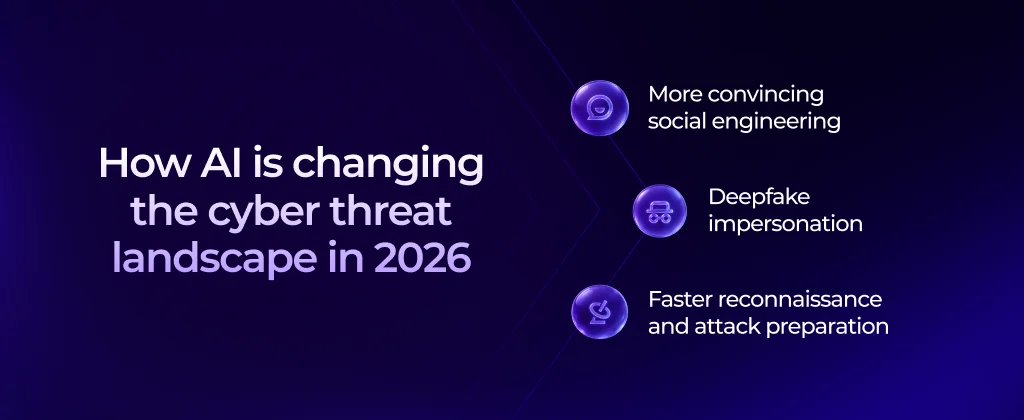
1. More convincing social engineering
Traditional phishing campaigns often relied on generic messages sent to large numbers of people. AI can help attackers produce more personalized content, adapt messages to different audiences, and imitate the communication styles of individuals or organizations.
This makes it harder for employees to rely on obvious warning signs, such as spelling mistakes or unnatural wording.
2. Deepfake impersonation
AI-generated or manipulated audio and video can be used to impersonate executives, suppliers, or other trusted individuals.
For example, a finance employee may receive a video call that appears to show a senior executive requesting an urgent payment. If the organization relies on the caller’s identity alone, the request may bypass normal scrutiny.
The appropriate response is not to expect employees to identify every deepfake. Organizations should establish verification procedures that apply regardless of how convincing a request appears.
3. Faster reconnaissance and attack preparation
AI tools can assist attackers in gathering information, analyzing public-facing systems, and preparing targeted campaigns.
This can make it easier to scale activities that previously required more time and manual effort.
At the same time, the 2026 Verizon DBIR emphasizes that AI is strengthening existing attack techniques. The report identifies 15 techniques being bolstered by generative AI, reinforcing the need to improve defenses against established attack methods.
From threat awareness to continuous detection
Knowing the types of cyber threats is important, but it does not tell an organization whether its security controls are working or whether an attacker has already gained access.
Preventive measures such as firewalls, access controls, and vulnerability management help reduce the chances of an attack succeeding. However, no single control can prevent every threat. Attackers may still find ways to bypass security measures or exploit weaknesses that have not yet been identified.
This is why organizations need continuous security monitoring. By tracking activity across users, devices, networks, and applications, security teams can identify unusual behavior, investigate potential threats, and respond before an incident causes further damage.
Why detection and response matter
When an attacker gains access to a business environment, the damage often depends on how long they remain undetected and what they can access during that time.
For example, an attacker with compromised employee credentials may initially access only one account. If the activity goes unnoticed, they may use that access to reach other systems, collect sensitive information, or disrupt business operations.
Early detection gives security teams an opportunity to investigate suspicious activity, understand which systems may be affected, and contain the threat before it spreads.
Effective cybersecurity therefore requires more than preventing attacks. Organizations must also be prepared to identify and respond to threats that get past their preventive controls.
What an effective detection and response process involves
An effective approach combines several activities:
- Security monitoring: Tracking activity across systems, networks, applications, and user accounts to identify unusual behavior.
- Threat detection: Recognizing suspicious activities that may indicate an attempted or successful attack.
- Investigation: Examining alerts to determine whether a real threat exists, how it entered the environment, and which systems may be affected.
- Incident response: Containing the threat, removing unauthorized access, and restoring affected systems.
- Continuous improvement: Reviewing security incidents and adjusting monitoring rules, security controls, and response procedures to address identified gaps.
These activities require the right expertise, tools, and resources. Organizations with limited internal security teams may find it difficult to monitor their environments and respond to threats around the clock.
Managed Detection and Response (MDR) can help address this challenge by providing ongoing security monitoring, threat investigation, and incident response support.
How Terralogic helps organizations manage cyber threats
Managing cyber threats requires more than deploying individual security tools. Organizations need to understand their exposure, identify weaknesses, strengthen controls, and establish the ability to detect and respond to suspicious activity.
Terralogic supports enterprise cybersecurity through services covering managed detection and response, threat and vulnerability management, governance, risk and compliance, data protection and privacy, and security implementation.
For organizations seeking to improve their detection and response capabilities, Terralogic’s Managed Detection and Response service supports security operations through monitoring, threat detection, and incident response.
The objective is to help organizations improve visibility into their environments, investigate potential threats, and respond to security incidents with a structured approach.
Effective threat management also requires coordination between prevention and response. Vulnerability management helps reduce exploitable weaknesses, while detection and response capabilities help identify suspicious activity that preventive controls may not stop.
This combination allows security teams to make more informed decisions about risk, prioritize security improvements, and strengthen the organization’s overall security posture.
Talk to Terralogic’s cybersecurity experts to explore how your organization can assess its exposure and strengthen its threat detection and response capabilities.
Conclusion
Cyber threats are becoming more interconnected. Attackers can combine stolen credentials, software vulnerabilities, social engineering, and ransomware to compromise systems and disrupt business operations.
The developments highlighted in 2026 reporting reinforce the need to reassess how organizations manage security exposure. Vulnerability exploitation remains a major entry point, ransomware continues to cause significant disruption, and AI is making established attack techniques more scalable and convincing.
For business leaders, the priority should be to build a security program that connects prevention, detection, response, and recovery.
Knowing the types of cyber threats is only the starting point. Organizations need to understand which threats are relevant to their environment, where their controls may fail, and how quickly they can respond when an incident occurs.
Is your current security strategy prepared to address these challenges? Talk with Terralogic’s cybersecurity experts to assess your organization’s security needs and explore how to strengthen its detection and response capabilities.
Frequently asked questions (FAQs)
1. What is a cyber threat?
A cyber threat is any actor, event, or technique with the potential to exploit a weakness and cause harm to a system, network, application, or organization. Examples include ransomware, phishing, credential theft, malicious insiders, and supply-chain attacks.
2. What are the most common types of cyber threats in 2026?
Major cyber threat categories include ransomware, phishing and social engineering, credential-based attacks, vulnerability exploitation, AI-enabled threats, insider threats, and supply-chain attacks. These categories can overlap within a single incident.
3. What is the difference between a cyber threat, a vulnerability, and a risk?
A vulnerability is a weakness in a system or security control. A threat is an actor, event, or technique that could exploit that weakness. Risk describes the likelihood and potential business impact if the threat successfully exploits the vulnerability.
4. How is AI changing cyber threats in 2026?
AI is helping attackers scale and improve existing techniques, including phishing, social engineering, reconnaissance, and impersonation. Verizon’s 2026 DBIR reports that generative AI is bolstering 15 different attack techniques. Organizations should strengthen identity controls, verification procedures, monitoring, and employee awareness to address these developments.
5. How can businesses protect themselves against cyber threats?
Businesses should adopt a layered security approach that includes vulnerability management, strong identity and access controls, endpoint and network protection, third-party risk management, employee awareness, continuous monitoring, and tested incident response procedures.
6. Why is threat detection important if an organization already has preventive security controls?
Preventive controls reduce the likelihood of successful attacks, but no control can guarantee that every threat will be blocked. Threat detection helps identify suspicious activity that passes through preventive defenses, while incident response helps contain the threat and limit its impact.
7. What is the difference between a cyber threat and a cyber attack?
A cyber threat represents the potential for harm from an attacker, event, or technique. A cyber attack is the actual execution of malicious activity against a system, network, or organization. A threat may exist without an attack taking place.