
Finding vulnerabilities does not necessarily tell an organization how exposed it is to a cyberattack.
A vulnerability scan may identify an outdated application, a missing security patch, or an exposed service. These findings indicate where weaknesses may exist, but they do not always explain whether an attacker can exploit them, what systems could be reached, or how much damage could result.
Understanding this distinction is essential when building an effective security testing program. Vulnerability assessment and penetration testing (VAPT) are often discussed together, but they serve different purposes. A vulnerability assessment helps organizations identify and prioritize potential weaknesses across their IT environments. Penetration testing goes further by investigating whether those weaknesses can be exploited and what an attacker could achieve.
Neither activity provides a complete picture on its own. Relying only on vulnerability scanning may leave exploitable weaknesses undiscovered, while relying only on periodic penetration testing may leave organizations without sufficient visibility into newly emerging vulnerabilities.
This article examines how vulnerability assessments and penetration tests differ in scope, methodology, and outcomes. It also explores their respective limitations, relevant PCI DSS requirements, and practical considerations for deciding when to use each. More importantly, it explains how organizations can combine both activities to build a more consistent and risk-informed security testing program.
Vulnerability assessment vs penetration testing: Understanding the difference
The fundamental difference between vulnerability assessment and penetration testing lies in the questions they are designed to answer.
A vulnerability assessment focuses on identifying potential security weaknesses. It examines systems, networks, and applications for known vulnerabilities, missing patches, outdated software, exposed services, and security misconfigurations. Most assessments use automated scanning tools to cover a broad range of assets efficiently.
Penetration testing takes a more adversarial approach. A qualified tester uses controlled attack techniques to investigate weaknesses and determine whether they can be exploited. The objective is to understand how an attacker might gain access, move between systems, or reach sensitive information.
How vulnerability assessment and penetration testing differ in practice
Consider an organization running an outdated web server.
A vulnerability assessment may detect the software version, match it against a known vulnerability, and assign a severity score based on its potential impact. This gives the security team a reason to investigate and remediate the issue.
A penetration tester examines the same weakness in its actual environment. They may discover that a compensating security control prevents exploitation. Alternatively, they may find that the vulnerability can be combined with weak network segmentation to reach an internal database.
The difference is important when assessing risk. A vulnerability’s severity score describes its potential technical impact, but the actual risk to an organization also depends on the affected asset, its exposure, and the security controls surrounding it.
How vulnerability assessment and penetration testing work together
Vulnerability assessment and penetration testing should not be treated as competing options or as interchangeable services.
A vulnerability assessment provides broad visibility into known weaknesses. Penetration testing provides deeper validation of selected weaknesses and examines how they may be combined into attack paths.
The two activities can be used together, but they do not always have to follow a fixed sequence. An organization may conduct routine vulnerability scanning as part of its vulnerability management program and commission a penetration test independently to assess a critical application or network segment.
Their roles can be summarized as follows:
- Vulnerability assessment: What security weaknesses are present, and which ones should be prioritized?
- Penetration testing: Can selected weaknesses be exploited, and what could an attacker achieve?
A mature security program needs both perspectives. One helps organizations understand where weaknesses exist; the other helps determine how those weaknesses could affect the business.
What is a vulnerability assessment?
A vulnerability assessment is a systematic process for identifying, evaluating, and prioritizing security weaknesses across an organization’s IT environment.
It typically uses automated tools to examine systems, networks, applications, and infrastructure against known vulnerability databases, such as Common Vulnerabilities and Exposures (CVE) records and vendor security advisories.
The purpose is to give security teams visibility into weaknesses that could expose their systems to attack. This includes more than critical software vulnerabilities. Missing patches, outdated components, exposed services, and insecure configurations can all create opportunities for attackers.
How does a vulnerability assessment work?
A vulnerability assessment generally involves 5 stages.
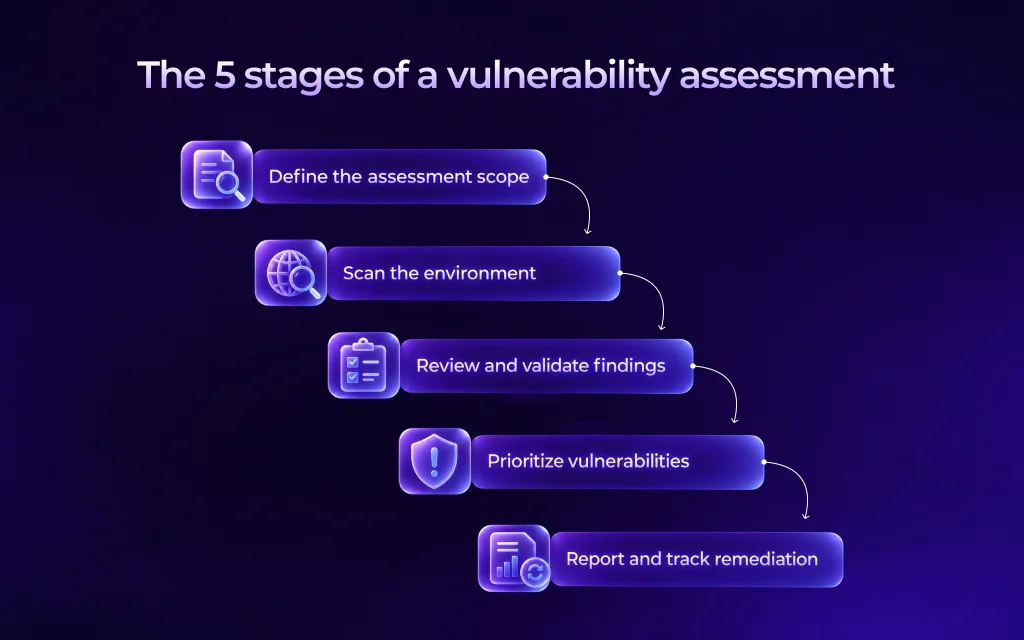
- Define the assessment scope. Identify the systems, networks, applications, and infrastructure that need to be examined. An accurate asset inventory helps prevent important systems from being overlooked.
- Scan the environment. Use vulnerability scanning tools to examine the selected assets for known vulnerabilities, outdated software, missing patches, exposed services, and configuration weaknesses.
- Review and validate findings. Examine the scan results to identify false positives, understand affected assets, and determine whether the findings require further investigation.
- Prioritize vulnerabilities. Evaluate findings using severity scores, such as the Common Vulnerability Scoring System (CVSS), alongside factors such as asset criticality, exposure, and potential business impact.
- Report and track remediation. Document the findings, recommend corrective actions, and track whether identified weaknesses have been addressed.
What does a vulnerability assessment identify?
A vulnerability assessment can reveal several categories of technical weaknesses:
- Known software vulnerabilities: Security flaws associated with operating systems, applications, libraries, and other software components.
- Missing security patches: Updates that have not been applied, potentially leaving systems exposed to publicly known vulnerabilities.
- Security misconfigurations: Insecure settings, unnecessary services, exposed ports, or configurations that increase the attack surface.
- Outdated components: Software versions that may no longer receive security updates or contain known vulnerabilities.
- Exposed services: Network services or systems that are accessible from locations where they may not be intended to be available.
How should organizations interpret vulnerability assessment results?
The output is typically a vulnerability assessment report containing affected assets, identified vulnerabilities, severity ratings, and remediation recommendations.
Many scanning tools use CVSS to communicate the technical severity of a vulnerability. However, a CVSS score should not be treated as a complete measure of business risk.
For example, a critical vulnerability on an isolated test server may present a different level of business risk from a medium-severity vulnerability on an internet-facing payment application. The latter may deserve greater attention because of the system’s exposure and the sensitivity of the data it handles.
Security teams should therefore consider several factors when prioritizing findings:
- Vulnerability severity and available exploitation information
- Whether the affected system is exposed to the internet
- The importance of the asset to business operations
- The sensitivity of the data it stores or processes
- Existing security controls that may reduce or increase exposure
How often should organizations conduct vulnerability assessments?
Vulnerability assessments should be performed regularly because an organization’s attack surface changes over time.
New software is deployed, infrastructure is modified, vulnerabilities are disclosed, and configurations change. A scan conducted several months ago may no longer reflect the current security posture.
Many organizations use monthly or continuous scanning for internal assets, depending on their environment and risk profile. External scanning should follow applicable compliance requirements.
For organizations subject to PCI DSS, external vulnerability scans must be performed at least quarterly by an Approved Scanning Vendor (ASV). Internal vulnerability scanning is also required at the applicable frequency under the standard.
The key consideration is consistency. Vulnerability scanning should be part of an ongoing vulnerability management process, not an isolated activity performed only before an audit.
What is penetration testing?
Penetration testing is a controlled security assessment in which qualified testers simulate real-world attack techniques to identify and exploit security weaknesses.
Unlike a vulnerability assessment, which primarily identifies potential weaknesses, penetration testing investigates how those weaknesses behave when actively tested.
The objective is to determine whether an attacker could use a vulnerability to gain unauthorized access, compromise sensitive information, move laterally across a network, or disrupt business operations.
This distinction matters because individual vulnerabilities do not always represent the full extent of an organization’s exposure. Attackers often combine multiple weaknesses to achieve an objective. A penetration test examines these relationships rather than treating every finding in isolation.
How does penetration testing work?
A penetration test follows an agreed scope and methodology. The exact activities depend on the systems being tested, the assessment objectives, and the rules of engagement.
A typical engagement includes 6 stages:
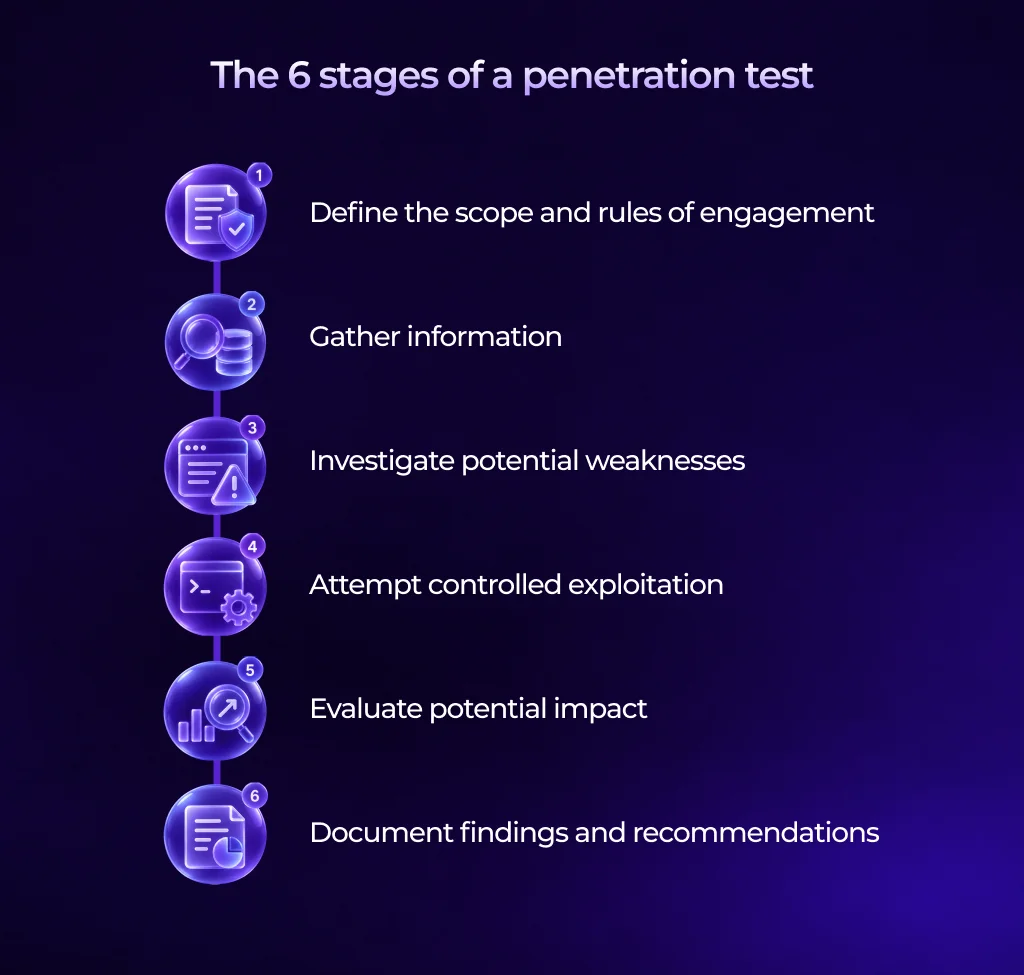
- Define the scope and rules of engagement. Agree on the systems to be tested, permitted techniques, testing windows, and operational restrictions.
- Gather information. Identify exposed services, technologies, potential entry points, and relevant details about the target environment.
- Investigate potential weaknesses. Examine the environment for vulnerabilities, misconfigurations, weak authentication, and other security gaps.
- Attempt controlled exploitation. Use appropriate techniques to determine whether identified weaknesses can be exploited within the agreed scope.
- Evaluate potential impact. Assess what access an attacker could gain, what information could be exposed, and whether other systems could be reached.
- Document findings and recommendations. Provide evidence of successful exploitation, explain the attack paths, and recommend remediation measures.
What does penetration testing reveal?
A penetration test provides evidence of how security weaknesses could affect an organization’s environment.
Consider the outdated web server identified in the earlier vulnerability assessment example.
During penetration testing, a qualified tester may discover that the server is accessible from the internet and that an exploitable weakness allows access to the underlying system. Further investigation may reveal that internal network segmentation is insufficient, allowing the tester to reach a database that should not be accessible from the web server.
The original vulnerability was only one part of the problem. The combination of the software weakness and inadequate segmentation created a more serious attack path.
A penetration testing report can document:
- The vulnerabilities successfully exploited
- Evidence of exploitation and the access obtained
- Attack paths connecting multiple weaknesses
- Affected systems and potential business impact
- Recommended remediation actions
- Retesting results, where included in the engagement
This information helps security teams understand not only which weaknesses need attention, but also how those weaknesses could affect the organization.
Common types of penetration testing
The scope of a penetration test depends on the assets and attack scenarios an organization wants to evaluate.
1. External penetration testing
External penetration testing examines internet-facing systems, services, and applications. It helps identify potential entry points that an attacker outside the organization could target.
This may include exposed network services, publicly accessible applications, and weaknesses in external infrastructure.
2. Internal penetration testing
Internal penetration testing simulates an attacker operating within the internal network. This could represent someone using compromised credentials, accessing an internal device, or exploiting an existing foothold.
The assessment helps determine whether an attacker could move between network segments, access restricted systems, or reach sensitive information.
3. Network penetration testing
Network penetration testing evaluates network infrastructure, exposed services, configurations, and segmentation controls. It focuses on identifying weaknesses that could allow unauthorized access or movement across the network.
4. Web application penetration testing
Web application penetration testing examines application security, including authentication, authorization, input validation, session management, and business logic.
This is particularly relevant for applications that process customer information, financial transactions, or other sensitive data.
These testing types are not mutually exclusive. An organization may combine several scopes to evaluate how an attacker could move from an external entry point toward critical internal assets.
Vulnerability assessment vs penetration testing: A side-by-side comparison
Although vulnerability assessment and penetration testing share the goal of improving an organization’s security posture, they differ in how they identify risks, validate weaknesses, and support remediation.
Understanding these differences helps security teams determine what each activity can deliver and where its limitations lie. The comparison below highlights the key distinctions across assessment objectives, testing methods, scope, frequency, and reporting outputs. It also shows why the two approaches serve complementary roles rather than replace one another.
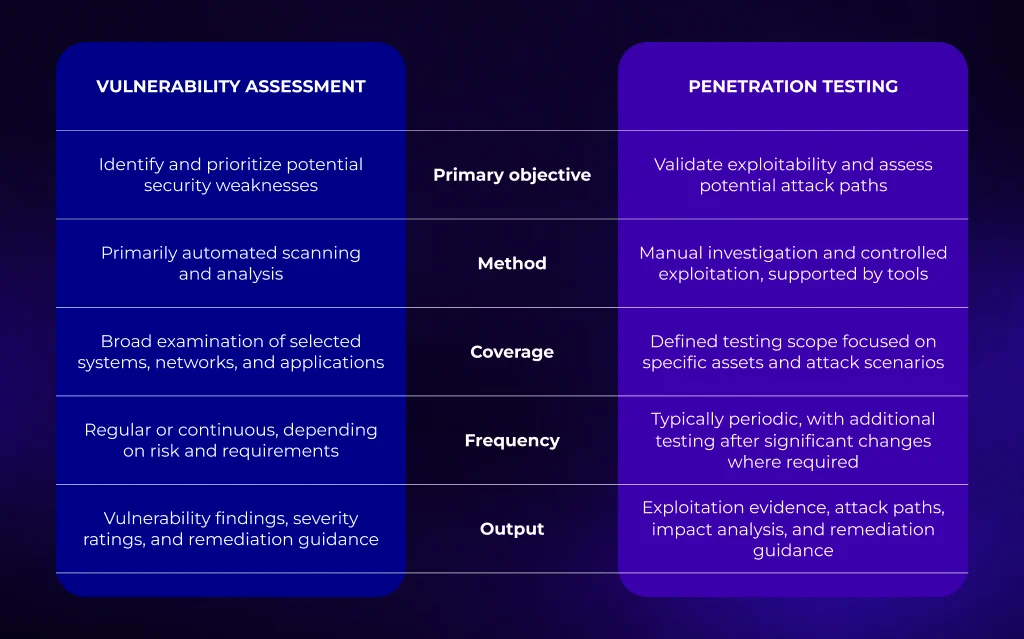
The difference is not simply that penetration testing is more advanced or more thorough. Each activity has a different purpose, and the evidence produced by one cannot automatically satisfy the objectives of the other.
A vulnerability scan may identify hundreds of known weaknesses across an environment. It provides a broad view of potential exposure, but it does not necessarily demonstrate how those weaknesses could be exploited.
A penetration test investigates specific attack scenarios in greater depth. However, it does not provide the same recurring coverage of known vulnerabilities across every asset in a large environment.
This distinction also matters outside technical security operations.
For example: a healthcare SaaS provider may submit a vulnerability scan report when a prospective customer asks for evidence of its most recent penetration test. The report may demonstrate that the provider scans for known vulnerabilities, but it does not demonstrate that a qualified tester has attempted to exploit weaknesses in the environment.
The customer is asking for different evidence because the two activities provide different levels of assurance.
Organizations should therefore define the purpose of each assessment before commissioning it. The goal is not to collect more security reports. It is to obtain the evidence needed to understand and manage risk.
PCI DSS requirements: Why organizations may need both
For organizations that store, process, or transmit payment card data, vulnerability scanning and penetration testing are distinct parts of the PCI DSS security testing requirements.
PCI DSS addresses these activities under separate requirements:
- Requirement 11.3: Covers vulnerability identification and management through internal and external vulnerability scanning.
- Requirement 11.4: Covers penetration testing to identify and validate weaknesses in systems and security controls.
The separation reflects the different purposes of these activities. Vulnerability scanning identifies known technical weaknesses, while penetration testing evaluates whether weaknesses can be exploited and whether security controls operate as intended.
1. PCI DSS vulnerability scanning requirements
Requirement 11.3 establishes expectations for identifying vulnerabilities through internal and external scanning.
External vulnerability scans must be performed at least quarterly by a PCI SSC Approved Scanning Vendor (ASV), in accordance with the applicable ASV Program requirements.
Internal vulnerability scanning is also required at least quarterly. Organizations must address identified vulnerabilities and perform additional scanning when necessary to verify remediation.
These activities help organizations maintain visibility into known weaknesses across the systems within the applicable PCI DSS scope.
2. PCI DSS penetration testing requirements
Requirement 11.4 addresses penetration testing and the evaluation of security controls.
PCI DSS requires internal and external penetration testing at least once every 12 months and after significant infrastructure or application changes, as applicable.
Testing must follow an established methodology and cover the relevant systems and security controls. Where network segmentation is used to isolate the cardholder data environment, the effectiveness of those controls must also be tested as required by the standard.
Penetration testers must have appropriate skills and experience, and the required organizational independence must be maintained. A tester does not automatically need to hold QSA or ASV status simply to conduct a penetration test.
How to choose the right approach for your organization
Choosing between vulnerability assessment and penetration testing should not come down to which activity is cheaper or produces a more detailed report. The decision should reflect the organization’s security objectives, risk exposure, and assurance requirements.
Three considerations can help determine which approach to prioritize and how to incorporate both into a security testing program.
1. Start with compliance and contractual requirements
Begin by identifying the regulatory standards, industry frameworks, and customer agreements that apply to your organization. These requirements may specify the type of testing, its frequency, and the evidence that must be maintained.
For example, an organization that processes payment card data must consider the separate vulnerability scanning and penetration testing requirements under PCI DSS. Completing vulnerability scans alone does not satisfy the requirement for penetration testing. Both activities need to be included in the organization’s testing program, with appropriate documentation to demonstrate compliance.
Other frameworks and customer contracts may establish different expectations. Security and compliance teams should therefore review the specific requirements that apply to their environment rather than assume that one testing schedule is sufficient.
2. Prioritize assets based on criticality and exposure
The level of testing should reflect the potential business impact of a security weakness. An internet-facing payment application, a database containing customer information, and an internal development server do not carry the same level of risk.
Vulnerability assessments help organizations maintain visibility across a broad range of assets and identify known weaknesses. Penetration testing provides deeper validation for critical systems where unauthorized access or exploitation could have serious consequences.
For example, a financial services company may conduct routine vulnerability scans across its entire IT environment while commissioning a penetration test specifically for its internet-facing banking application. This allows the organization to maintain broad visibility while examining whether weaknesses in a high-impact system could expose customer data or enable unauthorized transactions.
Testing priorities should account for factors such as external exposure, data sensitivity, system criticality, and potential operational or financial impact.
3. Evaluate internal capabilities, budget, and testing cadence
Organizations also need to consider whether they have the people, expertise, and resources to conduct and manage security testing effectively.
Vulnerability scanning can be performed more frequently because much of the process is automated. Penetration testing, however, requires specialist expertise and manual investigation, making it more resource-intensive and typically less frequent.
For example, a fintech startup with 150 employees and no dedicated penetration testing team may conduct quarterly vulnerability scans and engage an external provider for annual penetration testing. Working with one provider for both activities can simplify coordination and reporting, provided that each assessment has a clearly defined scope, methodology, and deliverables.
Larger organizations with established security teams may choose to manage routine vulnerability assessments internally while engaging independent specialists for penetration testing. The appropriate model depends on internal expertise, available resources, and the level of assurance required.
Ultimately, the objective is not to conduct as many tests as possible. It is to establish a sustainable testing cadence that identifies weaknesses regularly and validates the security of critical systems at appropriate intervals.
How Terralogic supports vulnerability assessment and penetration testing
Identifying vulnerabilities is only one part of managing security exposure. Organizations also need to understand which findings matter, how they could be exploited, and what actions should take priority.
Teralogic’s Threat and Vulnerability Management services support organizations in identifying and evaluating security weaknesses through vulnerability assessment and penetration testing.
A structured VAPT engagement can bring together several activities:
- Vulnerability assessment: Scheduled or continuous scanning to identify known vulnerabilities across relevant systems and infrastructure.
- Penetration testing: Controlled testing across network, web application, and infrastructure layers to investigate potential attack paths.
- Risk-focused reporting: Consolidated findings that help security teams understand vulnerabilities, potential impact, and remediation priorities.
- Compliance support: Assessment documentation that can contribute to relevant security and compliance activities.
The scope, testing frequency, and deliverables should be defined according to the organization’s environment and applicable requirements.
Explore Teralogic’s Threat and Vulnerability Management services to discuss an assessment approach aligned with your organization’s security and compliance requirements.
Conclusion
A vulnerability assessment can show an organization where known security weaknesses exist. A penetration test can demonstrate how selected weaknesses may be exploited and what an attacker could achieve.
The distinction matters because a list of vulnerabilities is not the same as an understanding of actual security exposure. Organizations need broad visibility to identify weaknesses, but they also need deeper testing to evaluate how those weaknesses interact and affect critical systems.
An effective security testing program uses both activities for their intended purposes, connects findings to remediation, and adjusts testing priorities as the environment changes.
Talk with Terralogic’s cybersecurity experts to discuss your organization’s vulnerability assessment and penetration testing requirements.
Frequently asked questions (FAQs)
1. What is the difference between vulnerability assessment and penetration testing?
A vulnerability assessment identifies and prioritizes potential security weaknesses across systems, networks, and applications, primarily through automated scanning.
Penetration testing uses controlled attack techniques to determine whether those weaknesses can be exploited and what an attacker could achieve.
In simple terms, vulnerability assessment identifies potential weaknesses, while penetration testing validates their exploitability and potential impact.
2. Should you do a vulnerability assessment before a penetration test?
A vulnerability assessment can be a useful starting point because it identifies known weaknesses across a broad range of assets. The results can help security teams and penetration testers understand where further investigation may be needed.
However, it is not a mandatory prerequisite for every penetration test. The appropriate sequence depends on the testing objectives, scope, and methodology.
3. How often should you conduct vulnerability assessments and penetration tests?
The frequency depends on the organization’s risk profile, infrastructure changes, and compliance obligations.
Many organizations perform vulnerability assessments monthly or continuously, while penetration testing is commonly conducted at least annually. These are general planning practices, not universal requirements.
Under PCI DSS, internal and external vulnerability scans must be conducted at least quarterly, with external scans performed by an ASV. Penetration testing must be performed at least annually and after significant infrastructure or application changes, as applicable.
4. Do organizations need both vulnerability assessment and penetration testing?
Most organizations benefit from both because the activities identify different types of security risk.
Vulnerability assessments provide recurring visibility into known technical weaknesses. Penetration testing investigates whether weaknesses can be exploited and may reveal attack paths or application logic flaws that automated scanning does not identify.
For organizations subject to PCI DSS, the two activities are addressed under separate requirements and cannot replace one another.