
An AI assistant can give the wrong answer even when the language model works as expected. The problem may lie in how it retrieves information, builds context, or interacts with other systems. That is why testing AI applications requires more than checking the final answer. It means testing every step that helps produce it, from retrieving the right information to executing the right action.
Retrieval-augmented generation (RAG) pipelines allow AI applications to search external knowledge sources before generating an answer. Model Context Protocol (MCP) enables AI applications to connect with external tools and systems, such as databases, APIs, and Jira. Both introduce additional points where errors can occur, including irrelevant search results, outdated information, incorrect tool calls, and failed integrations.
For QA engineers, the challenge is to identify where these failures originate and verify that each component works correctly as part of the complete workflow. This guide explains how to test RAG pipelines and MCP-based AI workflows, evaluate their performance using practical metrics, and build a testing strategy that improves reliability across the entire application.
Key takeaways
- RAG pipeline testing requires validating every stage, from query processing and retrieval to generation and final response formatting.
- A weak retrieval result or incorrectly assembled prompt can produce an inaccurate answer even when the language model works as intended.
- Model Context Protocol (MCP) testing adds checks for tool selection, parameter mapping, authentication, and error handling.
- A layered QA strategy combines component, integration, end-to-end, performance, security, failure injection, and regression testing.
- RAG pipeline evaluation metrics help teams measure retrieval quality, answer grounding, hallucination rate, and end-to-end task success separately.
- Reliable AI applications require both automated testing and human evaluation to identify technical failures and subtle quality issues.
What is a RAG pipeline?
A RAG pipeline is a sequence of components that transforms a user’s question into an answer grounded in retrieved information. It typically includes query processing, embedding generation, vector database retrieval, document ranking, prompt construction, language model generation, and post-processing.
Each component performs a specific function. A failure in any stage can affect the quality of the final response, even when the other components operate correctly.
A typical RAG pipeline follows this sequence:
- User query: The user submits a question.
- Query processing: The application prepares the input for retrieval.
- Embedding generation: The query is converted into a vector representation.
- Vector database retrieval: The system searches for relevant documents.
- Document ranking: Retrieved documents are ordered by relevance.
- Prompt construction: The selected context is assembled into a prompt.
- LLM generation: The language model generates an answer using the supplied context.
- Post-processing: The application formats the response and prepares it for delivery.
Why RAG pipeline testing matters
A reliable RAG application depends on the quality of the entire pipeline, not just the language model. Each stage influences what information reaches the model and how that information is used to generate a response.
Consider several possible failures. The embedding model may represent a query poorly, causing the vector database to return irrelevant documents. The retriever may rank an outdated policy above the current version, or the prompt template may truncate the most relevant passages. Post-processing may also remove citations that the model generated correctly.
In each case, the language model may produce a confident and well-written answer based on incomplete or incorrect information. Evaluating only the final response makes it difficult to determine why the answer failed.
Effective RAG pipeline testing helps teams:
- Identify defects at the component where they originate.
- Measure retrieval and generation quality independently.
- Detect inaccurate, incomplete, or unsupported responses.
- Validate security controls and failure-handling behavior.
- Maintain quality as models, prompts, indexes, and application components change.
The objective is not simply to determine whether the application returns an answer. It is to establish whether the application retrieves appropriate information, uses it correctly, and produces a reliable result.
How to test retrieval-augmented generation pipelines
Testing a RAG pipeline involves checking each stage in the order information moves through the system, from the user’s query to the final answer. Starting with individual components helps QA engineers identify defects early. Once each stage works as expected, integration and end-to-end tests can verify that the entire pipeline works together correctly.
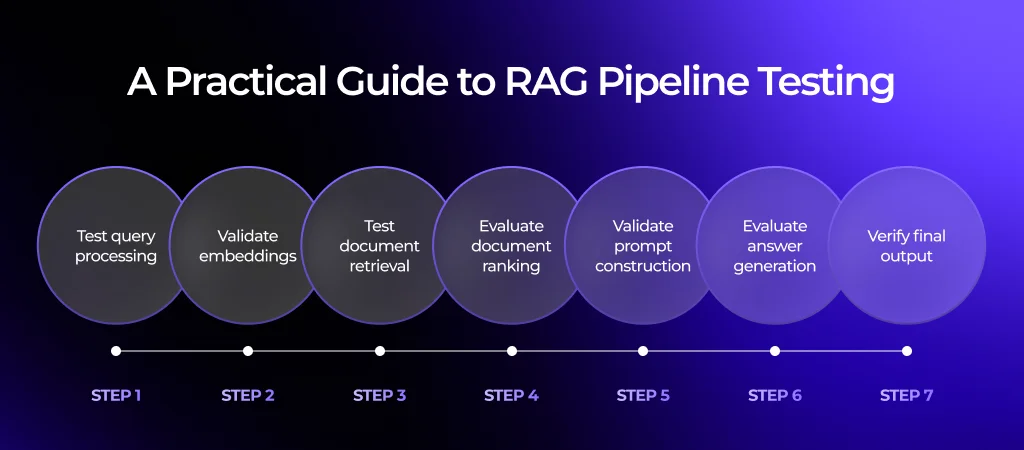
Step 1: Test query processing
Start by verifying that the application can handle different ways of asking a question. If the system misinterprets the input, later stages may retrieve irrelevant information or produce an incorrect answer.
Test the application with:
- Common misspellings and typos.
- Synonyms and alternative phrasings.
- Multilingual queries.
- Special characters and unusual input formats.
- Empty or malformed input.
Step 2: Validate embeddings
Next, check whether the application converts user queries into numerical representations that support relevant document retrieval. Inconsistent embeddings or incorrect model configurations can affect the quality of search results.
Verify that the correct embedding model and version are in use, and check that vector dimensions match the requirements of the retrieval system. Test different phrasings of the same question to see whether they can retrieve relevant content.
Repeat baseline tests whenever the embedding model or its configuration changes, as these updates can affect retrieval behavior.
Step 3: Test document retrieval
Once the query has been processed, verify that the vector database can find the intended documents. Problems with indexing, search configuration, or metadata filters can prevent relevant information from reaching the language model.
Test the following:
- Index integrity and consistency.
- Metadata filtering accuracy.
- Similarity search behavior.
- Top-K retrieval counts.
- Duplicate document handling.
Step 4: Evaluate document ranking
Retrieving relevant documents is only part of the process. The system must also rank them appropriately so that the most useful information is available to the language model.
Check whether relevant documents appear near the top of the results. Look for missing documents, irrelevant matches, outdated versions ranked above current ones, and excessive retrieval latency.
If the required information is missing or ranked too low, the model may generate an incorrect answer even when its generation capabilities are working as expected.
Step 5: Validate prompt construction
After retrieval, the application combines the user’s query with relevant documents to build a prompt for the language model. Check that this prompt includes the intended information and follows the expected structure.
Verify that:
- Retrieved documents are included correctly.
- The prompt template follows the required format.
- Token limits do not remove critical information.
- Context ordering is preserved where required.
- Instructions embedded in retrieved documents are handled safely.
Step 6: Evaluate answer generation
Once the prompt is validated, test whether the language model uses the supplied evidence correctly. A fluent response is not necessarily an accurate one, so evaluation should focus on the answer’s quality and its relationship to the retrieved context.
Measure the following:
- Groundedness and faithfulness: Does the answer align with the retrieved information?
- Hallucination rate: How often does the system produce unsupported or incorrect claims?
- Answer completeness: Does the response address the user’s question?
- Citation accuracy: Do cited sources support the associated claims?
- Response consistency: Does the system produce consistent results across repeated runs?
Step 7: Verify final output
Finally, check how the application processes and presents the generated answer. Post-processing errors can affect an otherwise accurate response by removing citations, changing its format, or exposing information that should be masked.
Verify the final output format, including Markdown and JSON where applicable. Check citation rendering, required fields, response structure, and sensitive-data masking.
After validating each stage individually, run integration and end-to-end tests to confirm that information flows correctly through the complete pipeline. This final check helps identify problems that only appear when components work together.
Model Context Protocol testing for AI workflows
While RAG pipelines retrieve information from knowledge sources, the Model Context Protocol (MCP) allows AI applications to interact with external tools and systems. These may include databases, REST APIs, and ticketing platforms such as Jira.
MCP-based workflows introduce additional failure points because the model must select an appropriate tool, provide valid parameters, and handle the result returned by that tool. Testing must therefore cover tool execution and workflow orchestration alongside the quality of the final response.
A typical MCP-based workflow follows this sequence:
- A user submits a request.
- The language model determines whether a tool is needed.
- The MCP client invokes the selected tool.
- The external system processes the request and returns a result.
- The language model uses the result to formulate a response.
- The application delivers the final response to the user.
RAG pipeline evaluation metrics
RAG pipeline evaluation metrics help QA teams measure different aspects of system quality. Rather than relying on one overall score, teams should evaluate retrieval, generation, end-to-end task completion, and MCP tool execution separately.
A strong overall result can hide a weak component. For example, a language model may sometimes produce a reasonable answer despite imperfect retrieval, making the pipeline appear more reliable than its retrieval performance suggests.
The following metrics provide a practical starting point.
- Precision@K measures the proportion of the top K retrieved relevant results. It helps determine whether the system is returning too many irrelevant documents.
- Recall@K measures how many of the relevant documents appear within the top K results. It helps identify whether the retriever is missing important information.
- Mean Reciprocal Rank (MRR) evaluates how highly the first relevant result appears across a set of queries. A higher MRR indicates that relevant results tend to appear closer to the top of the ranked list.
A layered testing strategy for RAG pipelines
Testing a RAG pipeline from start to finish can show whether the application gives the right answer, but it may not reveal why something went wrong. The problem could come from retrieving the wrong documents, building the prompt incorrectly, or generating an inaccurate response.
To find these problems more easily, QA teams should test the pipeline at different levels. Each testing layer focuses on a specific part of the application, from individual components to the complete workflow.
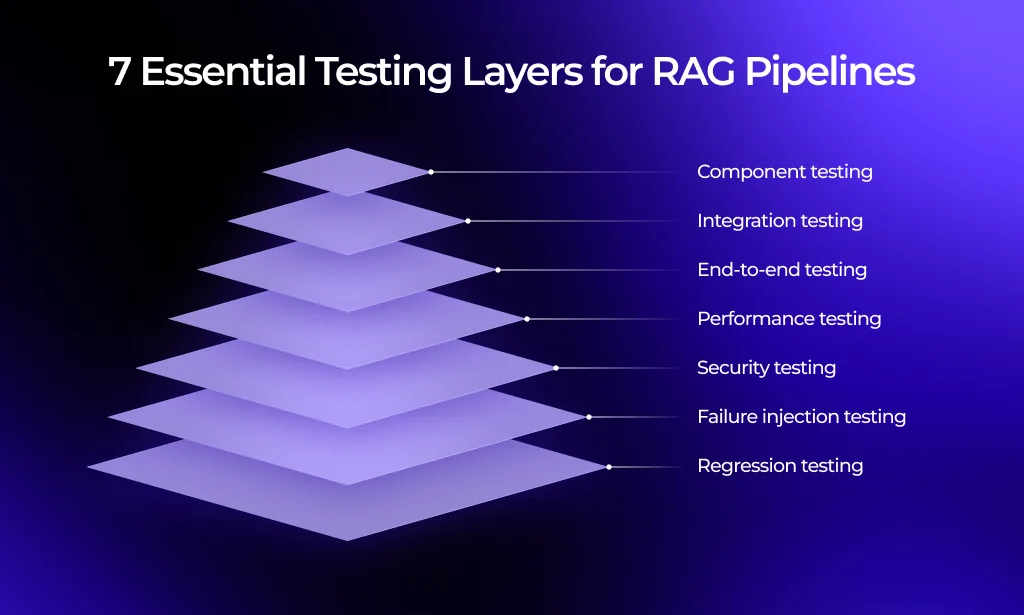
1. Component testing
Test each part of the pipeline separately to make sure it works as expected. This includes query processing, embedding generation, document retrieval, prompt construction, answer generation, and post-processing.
For example, check whether the retrieval component returns relevant documents for a given question.
2. Integration testing
Check whether different components work correctly together. Even if each component passes its individual tests, errors can occur when they exchange information.
For example, verify that the retriever sends the correct documents to the prompt builder and that the relevant information is preserved.
3. End-to-end testing
Test the entire workflow, from the user’s question to the final answer. Use realistic scenarios to check whether the application delivers the expected result.
For example, ask an HR assistant about its leave policy and verify that the answer reflects the correct policy information.
4. Performance testing
Check how quickly the pipeline responds and how well it handles multiple requests at the same time. Tools such as Locust and k6 can simulate user traffic and help identify performance bottlenecks.
For example, measure whether response times increase when many users submit questions simultaneously.
5. Security testing
Check whether the application can be manipulated into ignoring instructions, exposing sensitive information, or accessing tools without proper authorization.
For example, test whether a malicious instruction hidden in a retrieved document can influence the AI’s response or cause an unsafe action.
6. Failure injection testing
Intentionally make a component unavailable to see how the application responds. This helps verify that the system handles failures safely instead of producing incomplete or misleading answers.
For example, simulate a vector database outage and check whether the application reports the problem appropriately rather than answering without the necessary information.
7. Regression testing
Rerun existing tests whenever the team changes a prompt, model, document index, application logic, or integration. This helps catch new problems before they affect users.
For example, after updating a prompt template, check whether the AI still retrieves the right information, follows the required response format, and provides accurate answers. Playwright and Selenium can automate tests for user-facing interfaces, while component-level tests check the underlying pipeline.
Conclusion
Reliable AI applications depend on more than the language model. Every stage of a RAG pipeline, from retrieving relevant information to generating the final answer, must work correctly. Testing each stage separately helps QA teams identify defects, measure quality, and understand where failures originate.
MCP-based workflows require additional checks because AI applications can interact with external tools and systems. Testing must verify that tools are selected and called correctly, permissions are enforced, and failures are handled safely.
A layered testing strategy helps teams evaluate AI applications more consistently across accuracy, performance, and security. Explore how Terralogic can support your QA and test automation needs.
Frequently Asked Questions (FAQs)
1. How do you test retrieval-augmented generation pipelines?
Test query processing, embedding generation, vector database retrieval, document ranking, prompt construction, generation, and post-processing separately before running end-to-end tests. Use stage-specific metrics and a labeled evaluation dataset to identify where failures originate.
2. What are the best practices for testing RAG applications?
Maintain a labeled evaluation dataset, track embedding model and index versions, log retrieved documents alongside generated answers, and automate regression tests. Include hallucination checks and prompt injection testing, supported by human evaluation where automated metrics are insufficient.
3. How do you test MCP-based AI workflows?
Verify that the model selects the correct tool, maps request details to the right parameters, handles authentication, and responds appropriately to timeouts and malformed tool results. Also test permissions, failure handling, and the accuracy of the final response.
4. Which metrics matter for RAG pipeline evaluation?
Precision@K, Recall@K, and Mean Reciprocal Rank measure retrieval quality. Groundedness, faithfulness, answer relevance, and hallucination rate assess generation quality, while task success rate measures end-to-end performance. MCP workflows also need tool-call success and parameter-accuracy checks.
5. Which QA strategies work best for LLM-powered applications?
A layered approach combines component, integration, end-to-end, performance, security, failure injection, and regression testing. Automated tests should be supplemented with human evaluation of grounding, relevance, and edge cases, with the test suite rerun whenever relevant models, indexes, prompts, or integrations change.