
Testing a new application feature does not have to start with the user interface. In many cases, validating the backend first is a more effective way to identify defects, understand their root causes, and reduce debugging effort.
Modern applications rely on multiple layers working together. The frontend sends requests to backend APIs, which process business logic, interact with databases or other services, and return responses for the interface to display. A problem in any of these layers can affect what users eventually see.
When testing starts through the UI, it can be difficult to determine whether an unexpected result originates from the backend, the API response, or the frontend itself. API testing helps isolate these possibilities by validating backend behavior independently of the interface.
This is why API testing before UI testing is a valuable approach to backend testing. It allows QA teams to begin validating application functionality as soon as endpoints become available, rather than waiting for the frontend to be fully developed.
The objective is not to replace UI testing. It is to establish a testing sequence that verifies backend functionality first, then checks how the frontend consumes and presents the returned data.
This article explores the differences between API testing vs UI testing, the role of API validation in a broader testing strategy, and how engineering teams can apply a backend-first approach throughout the software development lifecycle.
Key takeaways
- API testing helps identify backend defects before they affect frontend behavior, making root-cause analysis more straightforward.
- A backend-first testing strategy allows QA teams to validate endpoints independently of frontend development.
- REST API testing provides a direct way to verify business logic, response structures, input validation, and error handling.
- Contract testing helps ensure that API providers and consumers follow an agreed request and response structure.
- The test pyramid supports a balanced approach, with more tests at the unit and service layers and fewer end-to-end UI tests.
- API test automation in CI helps teams detect defects earlier and maintain consistent backend validation as applications evolve.
What is API testing?
API testing is the process of validating an application’s Application Programming Interfaces (APIs) by sending requests directly to endpoints and examining the responses. It verifies whether backend services process requests correctly, apply the expected business rules, and return data in the required format.
Unlike UI testing, API testing does not require users or testers to interact with buttons, forms, or other visual elements. Instead, test requests are sent directly to the API using tools such as Postman or REST Assured.
For example, consider an application that allows users to retrieve customer information. When a user opens a customer profile, the frontend sends a request to a backend endpoint. The API processes that request, retrieves the relevant information, and returns a response for the interface to display.
API testing validates this process independently of the screen. It checks whether the endpoint returns the correct customer details, handles requests for missing records, and responds appropriately when required parameters are invalid.
Typical API testing activities include:
- Status code validation: Confirming that the endpoint returns the appropriate HTTP status code for successful and unsuccessful requests.
- Response schema validation: Checking that field names, data types, and required properties match the expected structure.
- Business logic validation: Verifying that the application applies the correct rules when processing requests.
- Input validation: Checking how the API handles missing, invalid, or unexpected values.
- Error handling: Confirming that the endpoint returns appropriate responses when requests cannot be processed.
- Integration validation: Checking whether the API exchanges data correctly with databases and other services.
What is a backend testing strategy?
A backend testing strategy is a structured approach to checking whether an application’s backend processes requests, applies business rules, stores data, and communicates with other systems correctly. It goes beyond checking whether an API returns a successful response. It also verifies whether the application produces the correct results and handles different scenarios as expected.
A typical backend testing strategy covers 3 main areas:
1. API testing
API testing checks whether an endpoint receives requests and returns the expected responses. It verifies status codes, response data, required fields, and how the endpoint handles invalid or incomplete requests. This helps identify issues in how different parts of an application exchange information.
For example: When an application requests customer information, the API should return the correct customer details. Testing should also verify how it responds when the customer ID is missing, invalid, or does not exist.
2. Business logic testing
Business logic testing verifies whether the backend applies the correct rules when processing requests. These rules determine how the application handles calculations, validations, permissions, and other operations based on business requirements. Testing them independently helps identify incorrect processing even when an API returns a successful response.
For example: When a customer places an order, the system must calculate the total price correctly, apply eligible discounts, and reject orders that do not meet the required conditions. Testing verifies that each rule produces the expected result across different scenarios.
3. Database and integration testing
Database and integration testing checks whether the backend stores information accurately and exchanges data correctly with other components. This includes verifying database operations and checking communication between internal services or external systems. These tests help identify issues such as incomplete data updates, failed service requests, or inconsistent information between connected components.
For example: After an order is placed, the system should save the correct order details in the database. If it connects to a payment service, testing should also verify that the payment request is processed correctly and that the resulting payment status is reflected in the order record.
Why test APIs before UI?
The main reason to prioritize API testing is defect isolation. When backend functionality is validated independently, QA teams can identify problems closer to their source instead of investigating them through multiple application layers.
Consider an application where a customer profile does not display the expected information. The issue could originate from the API returning an incomplete response, the backend retrieving incorrect data, or the frontend failing to process the returned fields.
Testing the API first helps determine whether the backend is returning the expected information. Once that behavior is confirmed, the investigation can move to the frontend if the displayed result is still incorrect.
This approach provides several practical advantages.
1. Identify defects closer to their source
An application request often passes through several components before the final result appears on screen. If an issue is discovered only through UI testing, developers may need to investigate the browser behavior, frontend code, API response, and backend processing to locate its origin.
API testing reduces this uncertainty by examining the request and response directly.
For example, an endpoint expected to return a customer object may silently return null instead. An API test can identify the incorrect response immediately by checking the expected fields and data structure.
If testing begins through the UI, the same defect may appear as a missing customer name or an incomplete profile page. The visible symptom does not necessarily indicate that the API response is the problem.
By validating the endpoint first, QA teams can provide developers with more specific defect information, including the request sent, the actual response, and the expected result.
2. Start testing before the UI is ready
Backend and frontend development do not always progress at the same pace. An API endpoint may be available for testing while the corresponding screen is still being designed or implemented.
Waiting for the complete UI before starting QA activities creates an unnecessary dependency between backend validation and frontend development.
With an API-first approach, testing can begin as soon as an endpoint is available in a development or staging environment. QA teams can review its contract, validate request parameters, and test expected responses without waiting for the frontend integration.
This allows development and testing activities to proceed in parallel. It also gives developers earlier feedback when an endpoint does not meet its expected requirements.
3. Reduce test execution time
API tests generally execute faster than UI tests because they do not require browser rendering, page navigation, or interaction with visual elements.
A UI test may need to launch a browser, authenticate a user, navigate through several screens, locate page elements, and wait for application responses before completing a test case. These additional steps increase execution time and introduce more variables that can affect test results.
API testing removes much of this overhead by communicating directly with the endpoint. This makes it suitable for validating large numbers of request and response scenarios within automated test suites.
The actual execution time depends on the application, test coverage, infrastructure, and service dependencies. However, API tests generally provide a faster feedback loop for backend functionality.
4. Reduce test maintenance
UI automation relies on elements such as selectors, page structures, and interaction timing. Changes to the frontend can cause automated tests to fail even when the underlying business logic remains unchanged.
For example, a developer may update a button’s HTML structure or change a page layout. An automated UI test that depends on the previous element selector may fail, requiring maintenance even though the API functionality is unaffected.
API tests are less dependent on these presentation-layer changes. As long as the endpoint contract and expected behavior remain consistent, the tests can continue validating backend functionality.
This makes API test automation particularly useful for regression testing, where existing functionality must be checked repeatedly as the application evolves.
The API-first testing approach in practice
An API-first testing strategy does not mean eliminating UI testing. It means organizing the testing process so that each application layer is validated at the appropriate stage.
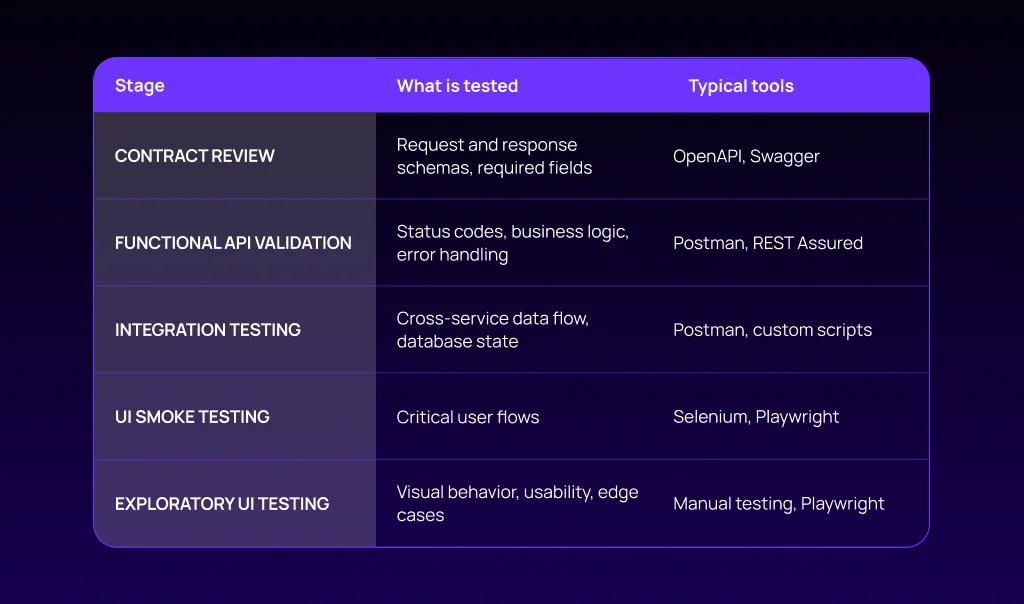
A typical feature testing workflow follows 5 stages, moving from backend validation to frontend verification. Each stage focuses on a different aspect of the application, helping QA teams identify defects before moving to the next testing layer.
1. Review the API contract
- Understand what the endpoint is expected to do.
- Check required parameters, request formats, response structures, and possible error conditions.
- Use the contract as the basis for defining test cases.
2. Perform functional API testing
- Verify whether the endpoint behaves according to its specifications.
- Test successful requests, invalid inputs, business rules, and error handling.
- Confirm that the API processes different scenarios correctly.
3. Conduct integration testing
- Check how the endpoint interacts with databases, internal services, and external systems.
- Verify how connected components exchange and process data.
- Identify issues that may not appear when an endpoint is tested in isolation.
4. Run UI smoke tests
- Verify that the frontend communicates with the API correctly.
- Test critical user journeys and confirm that core application functions work as expected after backend integration.
5. Perform exploratory UI testing
- Examine the application through actual user interactions.
- Focus on visual behavior, navigation, usability, and interface-related issues that API tests cannot identify.
Following this sequence gives each testing layer a clear responsibility. API and integration tests validate backend functionality and service communication, while UI tests focus on frontend integration and user experience.
What are the benefits of an API-first testing strategy?
An API-first testing strategy improves more than the speed of individual test cases. It changes when defects are discovered, how they are investigated, and how testing responsibilities are distributed across the development lifecycle.

1. Faster feedback loops
API testing allows QA teams to validate endpoints as soon as they become available. There is no need to wait for the frontend implementation before checking whether backend functionality works as expected.
This is particularly useful when backend and frontend teams work in parallel. QA can report issues with request handling, response data, or business logic while frontend development continues.
Earlier feedback gives developers more opportunities to address defects before the affected functionality is integrated into the complete application.
2. More stable automated tests
API tests are generally less affected by changes to page layouts, CSS, DOM structures, or browser rendering.
This does not mean API automation is immune to failures. Changes to endpoint behavior, authentication, test data, service availability, or environment configuration can still affect test results.
However, separating backend validation from UI automation reduces the number of frontend-related variables that can cause failures in backend test coverage.
3. Earlier defect discovery
Backend verification can begin as soon as an endpoint is deployed to a test environment, often before the corresponding UI is feature-complete.
This helps identify issues such as missing response fields, incorrect status codes, and unexpected business logic behavior before the frontend depends on those results.
When defects are detected earlier, developers can investigate the affected service without having to trace the problem through an integrated user workflow.
4. Lower UI test maintenance
A well-structured testing strategy does not require every backend rule to be verified through the browser.
For example, validating whether an API rejects an invalid request can be handled through API tests. The UI test can then focus on whether the application displays the appropriate validation message and prevents users from submitting incorrect information.
Separating these responsibilities reduces duplicated checks and allows UI automation to focus on critical user-facing behavior.
Shift-left API testing: Catching defects earlier
Shift-left testing is the practice of moving testing activities earlier in the software development lifecycle. Instead of waiting until development is complete, teams begin validating functionality as soon as individual components become available.
API testing is well suited to this approach because backend endpoints can be tested independently of the frontend.
For example, when a developer exposes a new endpoint, QA engineers can begin service layer testing against it. They can review the API specification, validate the request and response structure, and test business rules using valid and invalid inputs.
This can happen before the frontend team has completed the corresponding screens.
The same principle applies to automated testing. API test suites can be integrated into CI pipelines and executed when code changes are submitted or when a new build is created, depending on the team’s workflow.
If an endpoint returns an unexpected response or violates its contract, the issue can be identified before the affected functionality progresses further through the development process.
Shift-left API testing therefore helps establish continuous feedback between development and QA. Rather than concentrating defect discovery at the end of a development cycle, teams can validate backend behavior throughout implementation.
How to validate the backend before frontend testing
Before testing the user interface, QA teams should first verify that the backend works as expected. A structured validation process helps identify issues in API requests, business logic, and data handling before they affect the user experience.
The following 6 steps provide a practical approach.
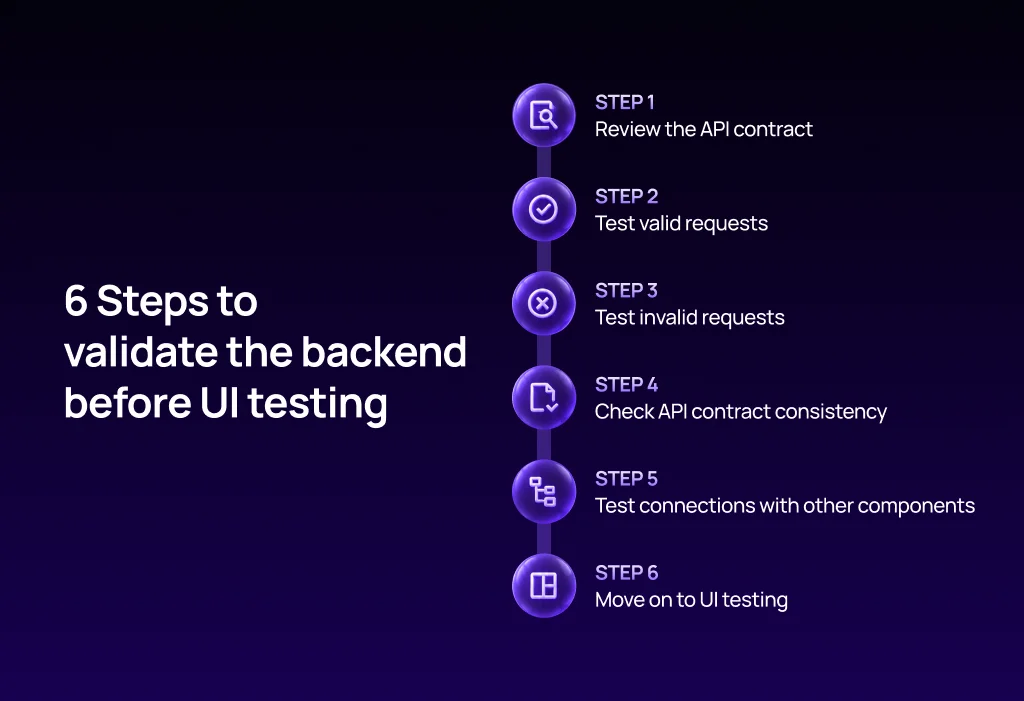
Step 1: Review the API contract
Start by reviewing the API documentation or OpenAPI specification. It explains how an endpoint should work, including:
- Required request parameters and fields
- Expected data types and formats
- Response structure
- Possible error codes
Use this information as a reference when preparing test cases. It helps QA teams understand what the API should return instead of simply checking whether a request receives a response.
Step 2: Test valid requests
Send requests with valid information and check whether the API returns the expected results.
For each request, verify:
- The correct HTTP status code
- The expected response data
- All required fields are present
- The returned values are correct
For example: When requesting customer information with a valid customer ID, the API should return the corresponding customer record with the required details.
Step 3: Test invalid requests
Check how the API responds when it receives incorrect, incomplete, or unexpected information. These tests help identify whether the endpoint handles errors properly instead of processing invalid requests incorrectly.
Common scenarios include:
- Missing required fields
- Incorrect data types
- Empty or null values
- Invalid parameter values
- Values outside permitted limits
- Requests without proper authorization
For each scenario, verify that the API returns the expected error response and handles the request appropriately.
Step 4: Check API contract consistency
Verify that the API’s actual requests and responses match the agreed contract. This is important because changes to response fields, data types, or formats can affect applications and services that depend on the API.
For example: If the frontend expects a customer ID, name, and email address, but the API changes the name of one field, the frontend may no longer display the information correctly.
Contract testing helps detect these incompatibilities before they affect connected applications. It is particularly useful when multiple services or frontend applications rely on the same API.
Step 5: Test connections with other components
After checking individual endpoints, verify how they work with databases, internal services, and external systems.
An API may return the correct response when tested independently but fail when it needs information from another service or must update a database. Integration testing helps identify problems in these interactions.
When a defect occurs, record the request, actual response, expected result, and conditions under which the issue appeared. This gives developers the information they need to investigate and reproduce the problem.
Step 6: Move on to UI testing
Once backend functionality has been validated, QA teams can begin testing the frontend. The focus now shifts to whether the interface communicates with the API correctly and displays the returned information as expected.
Check the following areas:
- Data display: Does the interface show the correct information returned by the API?
- Form behavior: Are user inputs submitted and processed correctly?
- Navigation: Do key user journeys work as expected?
- Error handling: Does the interface respond appropriately when an API request fails?
- User interaction: Do buttons, forms, and other interface elements behave correctly?
This final stage verifies that the backend and frontend work together as expected from the user’s perspective.
API testing vs UI testing: Which should come first?
API testing and UI testing validate different parts of an application. The choice is not about deciding which method is more important, but understanding where each provides the most effective coverage.
API testing focuses on backend functionality, data exchange, and business logic. UI testing focuses on the application as users interact with it through a browser or interface.
Both are necessary, but API testing should generally come first because it validates the source of the data and logic before checking how the frontend presents them.
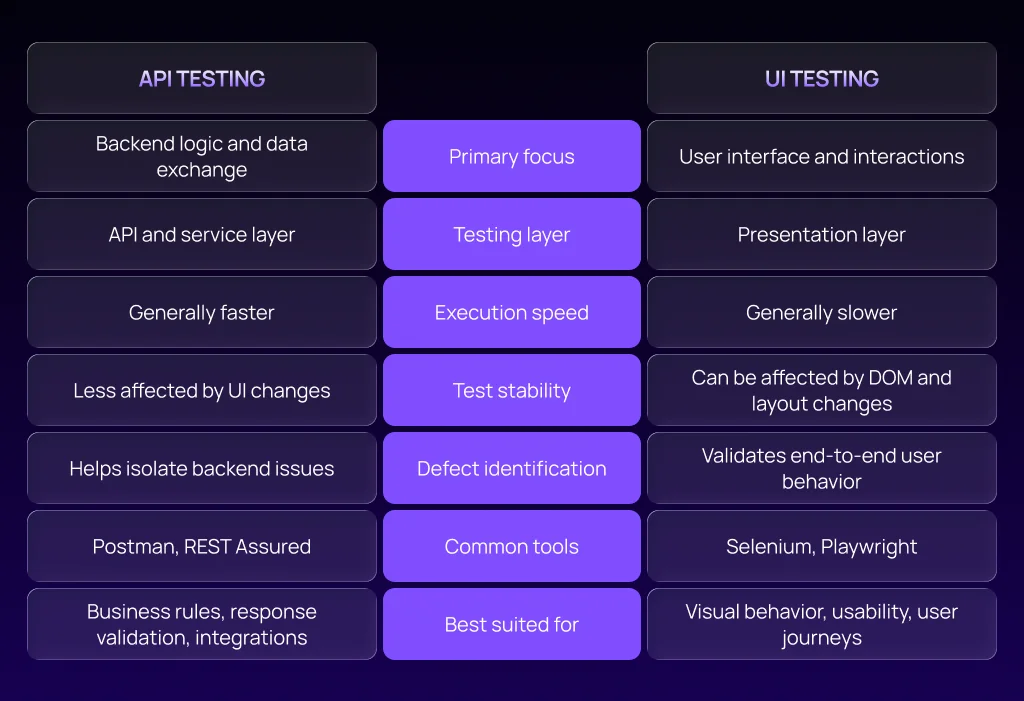
Consider a registration feature as an example.
API testing can verify whether the registration endpoint accepts valid information, rejects invalid email addresses, handles missing fields, and returns the expected response.
UI testing checks whether users can complete the registration form, whether validation messages appear correctly, and whether the interface responds appropriately after submission.
Testing the API first confirms that the backend validation rules work as expected. UI testing then verifies that those rules are correctly reflected in the user experience.
This distinction helps prevent duplicated test coverage. Backend requirements can be validated at the API layer, while UI tests focus on interactions and behavior that cannot be checked through API requests alone.
How the test pyramid supports API-first testing
The test pyramid shows how testing can be distributed across different levels of an application. It recommends having more tests at the lower levels, where individual functions and services can be checked quickly, and fewer tests at the UI level, where complete user journeys are tested.
This approach helps teams maintain test coverage while managing execution time and test maintenance.
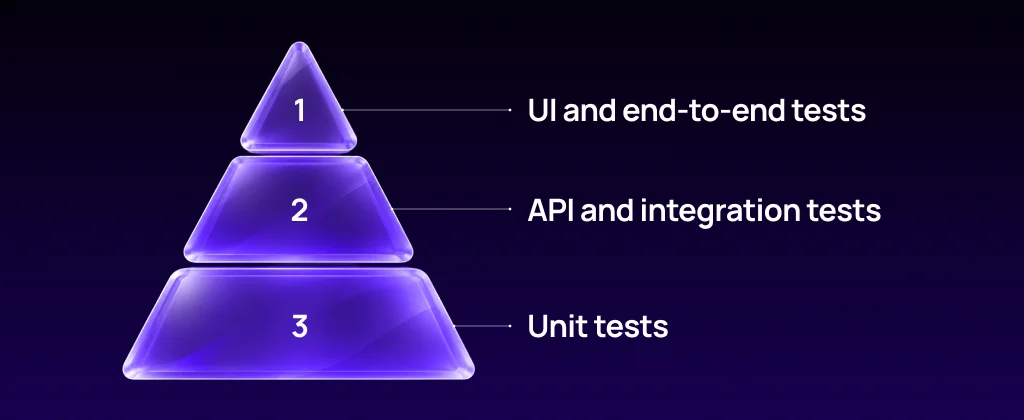
Unit tests
Unit tests form the base of the pyramid. They check individual functions or components independently to confirm that each one works as expected.
Because these tests focus on small pieces of code without requiring the entire application to run, they are generally fast to execute. This makes them suitable for frequent automated checks during development.
API and integration tests
API and integration tests sit in the middle of the pyramid. They check whether backend services process requests correctly, apply business rules, and exchange data with other components as expected.
This layer is central to API-first testing. It allows QA teams to validate complete backend operations without relying on the user interface. Teams can cover more scenarios at this level while avoiding the additional setup and dependencies involved in UI testing.
UI and end-to-end tests
UI and end-to-end tests sit at the top of the pyramid. They check whether the application works correctly from the user’s perspective by testing complete journeys across the frontend, backend, and connected components.
These tests are important for verifying that different parts of the application work together. However, they usually require more setup and depend on more components than unit or API tests. As a result, they can take longer to execute and require more maintenance.
The test pyramid highlights an important principle: not every requirement needs to be tested through the UI.
For example: Checking whether an API rejects an invalid email address can be handled through API testing. Checking whether the registration form displays the correct error message requires UI testing.
A balanced testing strategy assigns each requirement to the appropriate testing level. API tests handle backend behavior, while UI tests focus on interface behavior and complete user journeys. This reduces duplicated test coverage and helps teams maintain a more efficient testing process.
API validation best practices
API testing should check more than whether an endpoint returns a successful response. QA teams also need to verify that the returned data is correct, invalid requests are handled properly, and changes do not break existing functionality.
The following practices help teams make API testing more consistent and reliable.
1. Check the response data, not just the status code
A successful status code does not always mean an API has returned the correct result. An endpoint may return 200 OK while some required fields are missing or contain incorrect values.
QA teams should check:
- Whether all required fields are included.
- Whether each field has the correct data type.
- Whether the returned values match the expected results.
- Whether nested data follows the expected structure.
This helps identify problems that may not be visible when checking status codes alone.
2. Test different types of requests
An API should work correctly when it receives valid information and respond appropriately when the request is incorrect or incomplete.
QA teams should test scenarios such as:
- Valid requests with complete information.
- Requests with missing required fields.
- Requests with incorrect data types or values.
- Empty or null values.
- Values outside the accepted range.
- Requests from unauthorized users.
These tests help confirm that the API can process valid requests and handle errors according to its specifications.
3. Check API compatibility when changes are made
When an API changes, applications that depend on it may also be affected. Even a small change, such as renaming a response field or changing its data type, can prevent another service or frontend application from processing the response correctly.
Contract testing helps detect these issues by checking whether API requests and responses still follow the agreed specification.
Teams should include contract tests in their Continuous Integration (CI) process so that incompatible changes can be identified before they are released.
4. Keep test environments and data consistent
API test results can vary when environments use different configurations, datasets, or connected services. This makes it harder to determine whether a test failure comes from the API itself or from differences in the testing environment.
To reduce this uncertainty, teams should:
- Use consistent configurations across test runs.
- Prepare reliable and repeatable test data.
- Ensure required services and dependencies are available.
- Document any differences between test and production environments.
This makes test results easier to reproduce and more useful when investigating defects.
5. Keep API documentation and test cases updated
API specifications describe how an endpoint should behave, while automated tests verify whether it actually behaves that way. If the API changes but its documentation and test cases are not updated, teams may end up testing against outdated requirements.
Whenever an endpoint is modified, review its API specification and related test cases together. Keeping these assets aligned helps QA teams validate the current implementation and gives developers a reliable reference when investigating issues.
6. Run API regression tests after changes
A change to one part of the backend can affect other endpoints that depend on the same service or business logic. These problems may go unnoticed if testing only focuses on the newly modified functionality.
API regression tests help check whether previously working endpoints still behave as expected after code changes. Include relevant tests in the automated regression suite and run them as part of the development and release process.
This helps teams identify unintended effects before moving on to UI testing or releasing the changes.
What does shift-left testing with API validation look like day to day?
In daily development workflows, shift-left testing means validating backend functionality as soon as the relevant endpoints become available.
For teams using CI pipelines, automated API tests can run on pull requests or other defined build events. This allows backend validation to become part of the regular development process rather than a separate activity performed after implementation.
A typical workflow looks like this:
- A developer implements or updates an API endpoint.
- The API specification and expected behavior are reviewed.
- Automated API tests validate endpoint functionality, response schemas, and error handling.
- Integration and contract checks run as part of the CI pipeline.
- Failed tests are reported for investigation before the feature progresses.
- Once backend validation passes, UI and end-to-end tests verify the corresponding user journeys.
This approach creates feedback at multiple levels of the application. Developers can identify backend issues through API test results, while UI testing focuses on integration and user-facing behavior.
It also makes test failures easier to investigate because each testing layer has a clearer responsibility. Instead of relying on a UI regression suite to identify every defect, teams can use focused tests to validate the relevant application components.
Conclusion
API testing before UI testing is not about skipping frontend validation. It is about structuring QA activities so that backend defects are identified before they become harder-to-trace UI symptoms.
In applications where multiple services, APIs, and frontend components work together, testing through the interface alone can make defect investigation more complicated. Validating the backend independently gives QA teams a clearer view of how requests are processed, how data is returned, and where unexpected behavior originates.
By combining REST API testing, contract testing, integration checks, and targeted UI automation, engineering teams can build a more efficient and maintainable testing workflow.
The key is to validate data and business logic at the service layer first, then verify how the application presents that information to users. When each testing layer has a clearly defined responsibility, teams can reduce unnecessary debugging, improve feedback cycles, and deliver more reliable application functionality. Book a free consultation with Terralogic to discuss your software testing needs.
Frequently asked questions (FAQs)
1. Why should API testing come before UI testing?
API testing allows QA teams to verify backend functionality before testing the user interface. By checking requests, responses, and business logic directly, teams can identify backend defects closer to their source. It also allows testing to begin before the frontend is fully developed.
2. What are the main benefits of API-first testing?
API-first testing helps teams find backend defects earlier, get faster test feedback, and reduce reliance on UI automation. It also makes regression testing easier to maintain because API tests are less affected by changes to the frontend.
3. How do you test an API before the frontend is ready?
QA teams can test API endpoints directly using tools such as Postman or REST Assured. The process typically includes reviewing the API contract, testing valid and invalid requests, checking response data, validating business rules, and testing interactions with other services.
4. Does API testing replace UI testing?
No. API testing and UI testing serve different purposes. API testing checks backend functionality, data processing, and communication between services, while UI testing verifies visual elements, user interactions, and complete application workflows. Both are necessary to validate the application as a whole.