
Finding a vulnerability is only the beginning. The more important question is: what could an attacker actually do with it?
A vulnerability may look serious in a security report, but its real impact depends on how it can be exploited, what systems it can reach, and what an attacker could access after gaining entry. Penetration testing helps answer those questions by simulating controlled attacks against an organization’s systems, applications, networks, and other defined attack surfaces.
This is what separates penetration testing from simply scanning for vulnerabilities. A skilled tester attempts to exploit weaknesses, combine multiple findings, bypass security controls, and trace realistic attack paths to demonstrate what could happen in a real compromise.
That perspective becomes increasingly important as organizations expand their attack surface across web applications, APIs, cloud environments, remote access, and AI-powered systems. Knowing that a weakness exists is useful. Understanding whether it can become a viable attack path is what helps security teams prioritize what needs to be fixed first.
This guide explains what penetration testing is, the different types of pentests, how the penetration testing process works, how it differs from vulnerability assessment and red teaming, and how organizations can turn pentest findings into meaningful remediation.
Key takeaways
- Penetration testing validates real-world risk. It goes beyond identifying vulnerabilities by testing whether they can actually be exploited and what an attacker could achieve.
- Different attack surfaces require different testing approaches. Network, web applications, APIs, cloud environments, physical systems, social engineering, and AI applications can each require specialized testing.
- A pentest is different from a vulnerability assessment. Vulnerability assessments identify potential weaknesses, while penetration testing actively tests their exploitability and impact.
- Methodology matters. Scoping, reconnaissance, exploitation, post-exploitation, reporting, and remediation should follow a structured process with clearly defined rules of engagement.
- Testing is only valuable when findings are addressed. A penetration test should result in prioritized remediation, clear ownership, and retesting where appropriate.
- Compliance can influence testing requirements. Frameworks and regulations such as PCI DSS, DORA, and other industry requirements may define specific expectations for security testing.
- Modern penetration testing is expanding. Cloud-native architectures, APIs, AI systems, and new attack techniques are creating additional attack surfaces that traditional testing approaches may not fully cover.
What is penetration testing?
Penetration testing is a controlled and authorized simulation of a real cyberattack. It allows security professionals to safely test an organization’s systems, applications, networks, or other defined targets to identify weaknesses that an attacker could exploit.
The goal is not simply to find vulnerabilities, but to understand whether they can actually be exploited and what an attacker could access or achieve. This gives organizations a clearer view of their real security exposure and helps them prioritize which weaknesses need to be addressed first.
7 types of penetration testing every organization should know
Organizations rarely have a single attack surface. Networks, web applications, APIs, cloud environments, employees, physical facilities, and AI systems can all provide different paths into an environment. Because each area has its own technologies and attack techniques, penetration testing needs to be tailored to what the organization operates and the risks it needs to understand.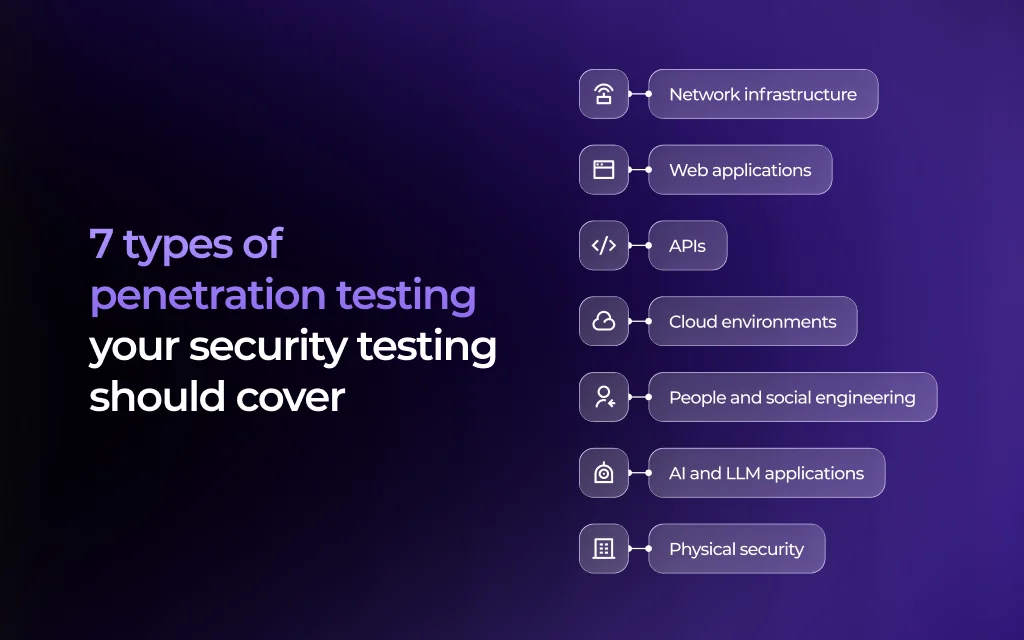
1. Network penetration testing
Network penetration testing examines whether an attacker could gain access to an organization’s network and move beyond the initial entry point. It covers both external systems exposed to the internet and internal environments where a compromised account or device could provide additional access.
Common areas tested:
- Firewalls, routers, and VPNs
- Active Directory and user privileges
- Exposed ports and services
- Privilege escalation
- Lateral movement
2. Web application penetration testing
Web applications often handle sensitive information and business-critical functions, making them an important attack surface. Testing examines whether weaknesses in application security controls could allow attackers to access data or perform actions without proper authorization.
Common areas tested:
- Authentication and session management
- Authorization and access controls
- Injection vulnerabilities
- Cross-site scripting (XSS)
- Insecure direct object references (IDOR)
- Business logic flaws
- Security misconfigurations
3. API penetration testing
APIs connect applications and services and often provide direct access to backend data and business functions. If authentication or authorization controls are weak, an attacker may be able to access information or perform actions beyond their intended permissions.
Common areas tested:
- Authentication and authorization
- Broken object-level authorization (BOLA)
- Broken function-level authorization (BFLA)
- Excessive data exposure
- Rate limiting
- Injection vulnerabilities
4. Cloud penetration testing
Cloud environments introduce security considerations that differ from traditional infrastructure. Identity permissions, storage configurations, containers, serverless functions, and cloud services can each create potential attack paths.
Common areas tested:
- Identity and access management
- Cloud storage exposure
- Privilege escalation
- Container security
- Serverless functions
- Cloud configuration
5. Social engineering and phishing simulation
Technical controls are only part of an organization’s security posture. Attackers can also manipulate employees into revealing information, approving fraudulent requests, opening malicious content, or providing access.
Common scenarios tested:
- Phishing
- Vishing
- Pretexting
- Physical access attempts
- AI-generated voice or video impersonation
6. Physical penetration testing
Physical security can provide another path to systems and sensitive information. Physical penetration testing evaluates whether an unauthorized person could bypass controls and reach restricted areas or equipment.
Common areas tested:
- Access control systems
- Badge security
- Tailgating
- Server room access
- Document disposal
- CCTV and physical security gaps
7. AI / LLM penetration testing
AI-powered applications introduce attack techniques that traditional application testing may not fully address. An AI system may process sensitive information, respond to untrusted prompts, use external tools, or connect directly to business systems.
Common areas tested:
- Prompt injection
- Jailbreaking
- Training data extraction
- Model inversion
- Adversarial inputs
- AI API abuse
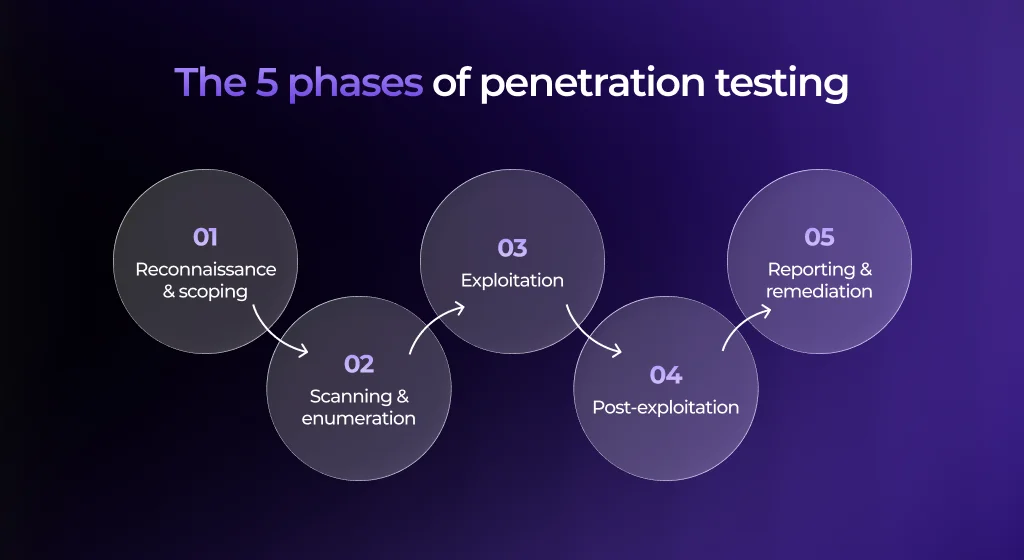
Penetration testing methodology: the 5-phase process
A penetration test needs a structured methodology to produce meaningful results. The process defines what will be tested, how the testing will be conducted, how vulnerabilities will be validated, and how the results will be translated into remediation priorities.
Common references include the Penetration Testing Execution Standard (PTES), the OWASP Testing Guide for web applications and APIs, and NIST SP 800-115, which provides guidance for security testing and assessment. The exact approach can vary depending on the type and scope of the engagement.
The level of information provided to testers also affects how the test is conducted:
- Black box: Testers start with little or no prior information, simulating an external attacker.
- Grey box: Testers receive limited information, such as valid credentials, while some internal details remain unknown.
- White box: Testers receive extensive information, such as architecture documentation, source code, or configuration details.
1. Reconnaissance and scoping
Every penetration test begins by defining what can and cannot be tested. This stage establishes the rules of engagement so the testing can be conducted safely and within the organization’s authorization.
Key activities include:
- Define targets and testing scope
- Establish testing windows and permitted techniques
- Identify out-of-scope systems
- Set emergency contacts and escalation procedures
- Gather information through OSINT, DNS enumeration, and technology discovery
Key outputs:
- Scope and rules-of-engagement document
- Initial threat model
- Target and attack-surface inventory
2. Scanning and enumeration
Once the scope is established, testers investigate the defined environment to understand what systems, services, technologies, and potential vulnerabilities are present. This creates the technical picture needed before attempting exploitation.
Key activities include:
- Port and service discovery
- Vulnerability scanning
- Web application crawling
- API endpoint discovery
- Authentication mechanism analysis
- Technology and version identification
Key outputs:
- Asset and service map
- Initial vulnerability findings
- Defined attack surface for exploitation
3. Exploitation
This is where penetration testing goes beyond vulnerability scanning. Testers attempt to safely exploit identified weaknesses to determine whether they are actually exploitable and what level of access they could provide.
Common techniques may include:
- Authentication bypass
- Injection attacks
- Privilege escalation
- Credential attacks
- Lateral movement
- Chaining multiple vulnerabilities
Key outputs:
- Proof-of-concept evidence
- Exploitation results
- Documented attack paths
- Evidence of potential business impact
4. Post-exploitation
A successful compromise does not necessarily show the full extent of the risk. Post-exploitation testing examines what an attacker could access or do after gaining an initial foothold, while remaining within the agreed rules of engagement.
Key activities may include:
- Assess accessible systems and data
- Test lateral movement
- Evaluate privilege escalation paths
- Assess persistence opportunities
- Simulate controlled data access or exfiltration
Key outputs:
- Data and system access inventory
- Attack path documentation
- Lateral movement map
- Business impact assessment
5. Reporting and remediation
The final phase turns technical testing into information that security teams and business leaders can act on. A useful penetration testing report should explain not only what was found, but also how the findings could affect the organization and what should be done next.
A typical report includes:
- Executive summary for leadership
- Technical findings and severity ratings
- Exploitation evidence
- Attack narrative and affected systems
- Remediation recommendations
- Risk-prioritized remediation roadmap
- Retesting plan for significant findings
Penetration testing vs vulnerability assessment vs red team: what’s the difference?
These three approaches serve different purposes. The key difference is what each one is trying to understand about your security posture.
- Vulnerability assessment: Identifies and prioritizes known vulnerabilities across systems and applications. It answers: “What weaknesses do we have?”
- Penetration testing: Actively attempts to exploit vulnerabilities to determine whether they can be used in a real attack and what an attacker could access or achieve. It answers: “What can an attacker actually do?”
- Red team exercise: Simulates a realistic, targeted attack to test whether the organization’s people, processes, and security controls can detect and respond to an attacker. It answers: “Could we detect and stop a real attack?”
What happens to pentest findings? The remediation gap
A penetration test only creates value when its findings lead to action. A report can identify exploitable weaknesses and show how an attacker could reach sensitive systems or data, but those findings still create risk if they remain unresolved.
This is where many penetration testing programs face a remediation gap. Organizations may complete the test, receive a detailed report, and still struggle to turn those findings into clearly owned and prioritized remediation work.
The impact of this gap can vary depending on the severity of the finding and the organization’s ability to address it. More serious findings typically receive greater attention, but unresolved high-impact weaknesses can continue to leave the same attack path open.
AI and LLM testing introduces another challenge. Security teams may already have established processes for fixing traditional application or infrastructure vulnerabilities, while issues such as prompt injection or jailbreaks can require changes to the AI system, its safeguards, data access, or surrounding governance.
Pentest findings should therefore be treated as a prioritized remediation roadmap, rather than a report to file away.
- Assign an owner: Give every finding to a responsible team or individual.
- Prioritize by risk: Consider exploitability, potential impact, and exposure alongside severity.
- Set remediation targets: Establish clear timelines based on the risk of each finding.
- Track progress: Monitor findings through remediation instead of treating the report as the end of the engagement.
- Retest significant findings: Verify that fixes have actually closed the attack path.
When is penetration testing required? Regulatory and compliance mandates
For some organizations, penetration testing is more than a security best practice. Certain regulations and industry standards require specific forms of security testing, while others require organizations to regularly evaluate whether their security controls are effective. The exact requirement depends on the organization’s industry, systems, jurisdiction, and regulatory scope.
The important distinction is that not every framework requires a penetration test in the same way. PCI DSS has explicit penetration testing requirements, while HIPAA requires periodic technical and non-technical evaluations rather than prescribing penetration testing specifically. DORA has specific Threat-Led Penetration Testing (TLPT) requirements for certain financial entities, while NIS2 requires appropriate cybersecurity risk-management measures that can include security testing.
Here are the key requirements organizations should understand:
- PCI DSS: Organizations within PCI DSS scope must perform external and internal penetration testing at least annually and after significant infrastructure or application changes. Testing must cover the relevant network and application layers, with additional testing required when network segmentation is used to reduce the cardholder data environment scope.
- HIPAA: The HIPAA Security Rule requires covered entities and business associates to perform periodic technical and non-technical evaluations of their security measures, including when environmental or operational changes affect ePHI. HIPAA does not specifically mandate a penetration test, so organizations should determine the appropriate testing approach based on their risks and environment.
- DORA: Certain EU financial entities identified under DORA must conduct advanced testing through TLPT at least every three years. These tests are designed to simulate realistic threats and must be performed by testers meeting DORA’s requirements.
- NIS2: NIS2 requires in-scope organizations to implement cybersecurity risk-management measures, including policies for assessing the effectiveness of cybersecurity risk-management measures. The directive does not impose one universal penetration-testing frequency, and specific requirements can depend on national implementation.
- SOC 2: SOC 2 does not universally prescribe an annual penetration test as a standalone requirement. However, penetration testing can provide useful evidence for demonstrating that security controls are designed and operating effectively, and customers or auditors may request testing evidence depending on the engagement.
- ISO/IEC 27001: ISO/IEC 27001 provides a framework for managing information security risks rather than prescribing one universal penetration-testing schedule. Organizations can use penetration testing as part of their broader security testing, vulnerability management, and risk-assessment activities.
Conclusion
Penetration testing gives organizations a practical way to understand how their security controls would hold up against a real attack. Rather than simply identifying vulnerabilities, it helps demonstrate how weaknesses can be exploited, how attack paths can develop, and what an attacker could ultimately access.
As attack surfaces expand across networks, web applications, APIs, cloud environments, and AI-powered systems, testing also needs to evolve with them. The most useful penetration testing programs therefore go beyond meeting a compliance requirement. They use testing results to prioritize remediation, validate security controls, and reduce the attack paths that could lead to a real incident.
A penetration test should not be treated as the final step in a security assessment. Its real value comes from what happens after the report: assigning ownership, fixing significant weaknesses, and retesting to confirm that the identified risks have been addressed.
Need to understand where your organization is most exposed? Talk to Terralogic’s cybersecurity experts about penetration testing, attack surface validation, and remediation.
1. What is penetration testing?
Penetration testing (also called a pentest or pen test) is a controlled, authorized cyberattack simulation in which skilled security professionals attempt to exploit vulnerabilities in an organization’s systems, applications, networks, or physical controls before real attackers can. Unlike a vulnerability scan, which identifies known vulnerabilities, penetration testing actively exploits them to demonstrate what an attacker could actually achieve.
It answers a practical question: If a skilled attacker targeted the organization today, how far could they get, and what could they access?
2. What are the types of penetration testing?
The seven main types of penetration testing are:
- Network penetration testing: External and internal network infrastructure, Active Directory, and lateral movement.
- Web application penetration testing: Web application vulnerabilities, including those covered by the OWASP Top 10.
- API penetration testing: API security issues such as BOLA, BFLA, and excessive data exposure.
- Cloud penetration testing: Cloud configuration, IAM, containers, and other cloud-specific attack paths.
- Social engineering: Phishing simulations, vishing, and impersonation scenarios.
- Physical penetration testing: Access control bypass, tailgating, badge security, and physical access.
- AI/LLM penetration testing: Prompt injection, jailbreaking, training data extraction, and other AI-specific attack techniques.
The right combination depends on the organization’s technology environment, attack surface, and security requirements.
3. How often should penetration testing be done?
The frequency of penetration testing depends on regulatory requirements, the organization’s risk profile, and changes to its environment. Some regulations and standards specify particular testing intervals, while organizations may also conduct testing after significant infrastructure, application, or security changes.
For example, PCI DSS includes specific penetration testing requirements, while DORA requires Threat-Led Penetration Testing (TLPT) at defined intervals for certain financial entities. Organizations should therefore determine testing frequency based on the requirements that apply to their environment rather than relying on a single schedule.
4. What is the difference between penetration testing and a vulnerability assessment?
A vulnerability assessment identifies and prioritizes known vulnerabilities using scanning and assessment tools. It answers: What weaknesses exist?
Penetration testing goes further by actively attempting to exploit vulnerabilities and combine weaknesses to determine what an attacker could actually access or achieve. It answers: What can an attacker actually do?
Vulnerability assessments are typically more automated and broader in coverage, while penetration testing relies on skilled testers to validate vulnerabilities, explore attack paths, and demonstrate potential impact.