
AI is changing how software testing is performed, but not simply by automating more test cases.
Modern AI can assist with activities such as test case generation, test maintenance, defect analysis, regression test selection, and risk identification. Generative AI adds another layer by allowing testers to work with natural language when creating or analyzing tests.
The result is a shift in how QA teams spend their time. Instead of focusing primarily on repetitive test execution and maintenance, testers can spend more time on exploratory testing, business logic, risk analysis, and overall quality strategy.
This guide explores how AI in software testing is being used today, where AI testing tools can add value, how the role of testers is changing, and what the future of software testing may look like.
Key takeaways
- AI can automate and assist with several repetitive software testing activities.
- AI test automation can support test generation, maintenance, regression testing, and defect analysis.
- Generative AI introduces natural-language approaches to test creation and analysis.
- AI does not remove the need for human judgment, especially for exploratory and business-focused testing.
- QA roles are evolving toward broader quality engineering and AI-assisted workflows.
- Organizations need to evaluate AI testing tools based on their testing environment, data, applications, and quality objectives.
What is AI in software testing?
AI in software testing is the use of artificial intelligence to assist or automate activities across the software testing process. It can use technologies such as machine learning, natural language processing, generative AI, and analytics to help teams design, execute, analyze, and maintain tests.
AI can be applied to tasks such as:
- Generating test cases from requirements or user stories
- Identifying patterns in test results and historical defects
- Prioritizing tests based on risk or application changes
- Detecting anomalies and potential defects
- Analyzing test failures and logs
- Maintaining automated tests when application interfaces change
- Generating test data and test scenarios
- Supporting testers through natural-language interactions
How is AI changing software testing?
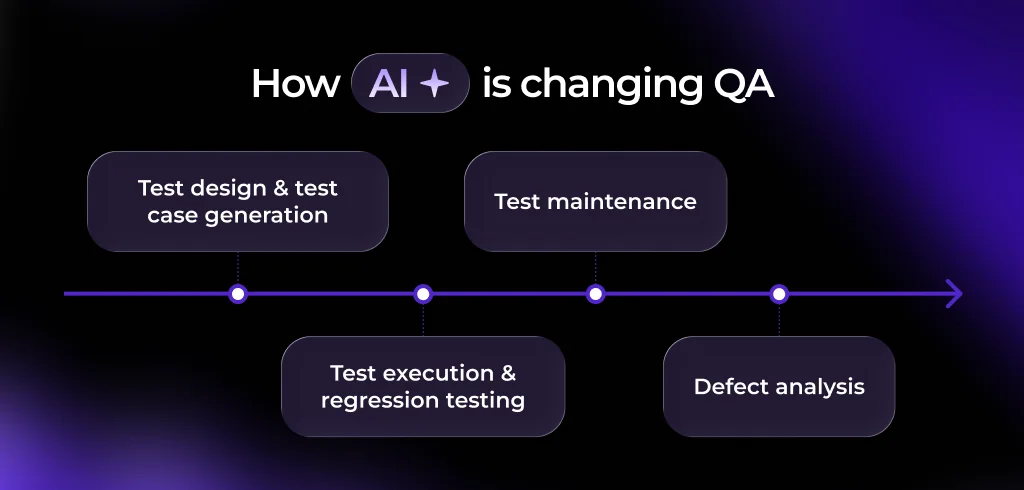
AI is being applied across different stages of the software testing lifecycle, from designing test cases to analyzing test results. Instead of replacing the entire testing process, AI can support specific activities that traditionally require significant manual effort.
The practical impact depends on how AI is implemented. Some applications focus on generating tests, while others help teams select regression tests, maintain automation, or analyze failures.
1. Test design and test case generation
Test design is often one of the most time-consuming parts of QA, especially when applications have many features, user flows, and business rules. Testers need to translate requirements into scenarios that cover both expected behavior and potential edge cases.
AI-powered test case generation can analyze inputs such as requirements, user stories, application behavior, or existing test data to suggest potential test scenarios. This gives testers a starting point and can help expand coverage without requiring every scenario to be created manually.
However, generated tests still need human review. AI may misunderstand a requirement, create redundant scenarios, or miss important business logic that is not clearly represented in the available data.
2. Test execution and regression testing
Regression testing becomes more difficult as applications and test suites grow. Running the entire test suite after every change can take significant time, even when only a small part of the application has been modified.
AI can help teams identify which tests are more relevant to a particular change by analyzing factors such as application changes, previous failures, test history, or other available signals. Instead of treating every test as equally important for every release, teams can focus execution on areas that require greater attention.
This does not mean that AI should automatically remove tests from a regression cycle. Test selection still needs to be validated against the team’s coverage requirements and risk tolerance.
3. Test maintenance
Automated tests need ongoing maintenance because applications change over time. User interfaces are redesigned, elements are renamed, workflows are updated, and selectors used by automated tests can become invalid.
Some AI testing tools can identify these changes and adjust test interactions automatically. This capability is often referred to as self-healing test automation because the automation can adapt when parts of the application change.
For example, if a UI element changes in a way that breaks an existing locator, an AI-assisted tool may identify another way to locate the same element. The tester still needs to confirm that the updated test is interacting with the correct element and validating the intended behavior.
4. Defect analysis
A failed test does not always mean that the application itself contains a defect. Failures can also result from environment problems, test data, timing issues, configuration changes, or problems within the test itself.
AI can help testers analyze information from test failures, logs, execution history, and previous defects to identify patterns and group related failures. This can reduce the amount of time spent manually reviewing large volumes of test results.
For example, several failed tests may be caused by the same underlying issue. AI-assisted analysis can help surface that relationship so testers can investigate the likely root cause rather than treating every failed test as a separate problem.
AI-powered QA vs traditional QA
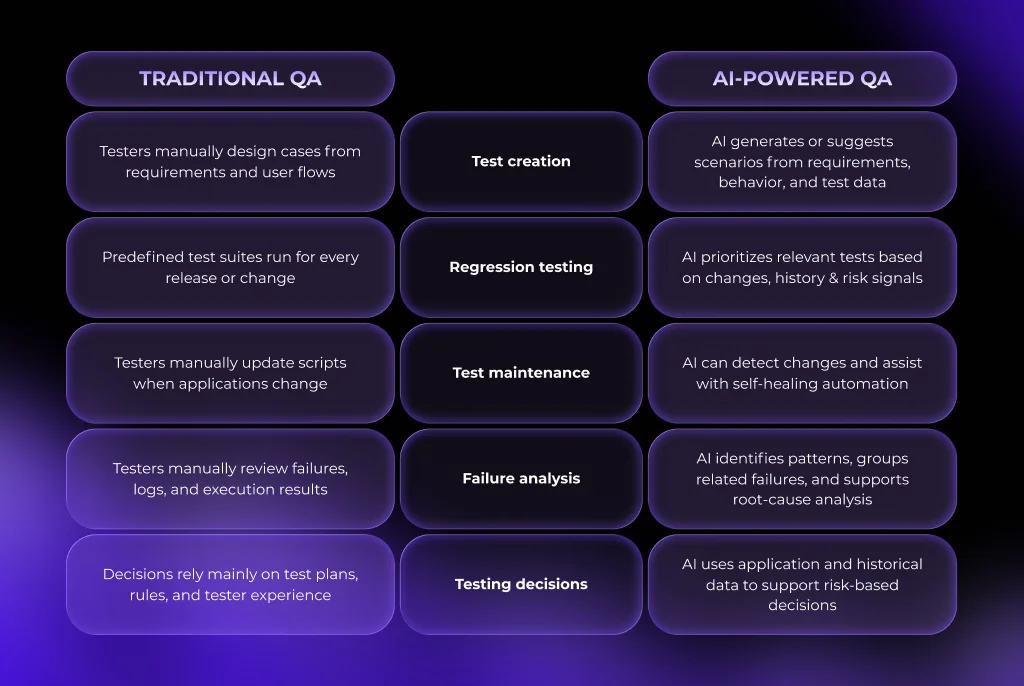
Traditional QA relies on predefined test cases, automation scripts, and manual analysis. AI-powered QA adds AI to these workflows to help teams generate tests, prioritize testing, maintain automation, and analyze results.
The difference is not simply manual testing vs. AI testing. It is about how testing work is performed and where AI can assist testers.
Generative AI in software testing
Generative AI is changing how testers interact with testing tools by allowing them to use natural language to describe what they want to test. Instead of manually translating every requirement into individual test cases or scripts, testers can use generative AI to create an initial set of testing scenarios and supporting artifacts.
In software testing, generative AI can help create test cases, test data, test scripts, test scenarios, and explanations of test failures based on inputs such as requirements, user stories, application behavior, or existing test information.
For example, consider a simple requirement:
“A customer should be able to reset a password using a registered email address.”
A tester could provide this requirement to a generative AI system and ask it to identify potential test scenarios. The system might suggest:
- Successful password reset with a registered email
- Attempt using an unregistered email
- Expired password reset link
- Invalid or reused reset token
- Password that does not meet policy requirements
- Multiple password reset attempts
This can help testers move from a single requirement to a broader set of scenarios more quickly. It is particularly useful when teams need to work through large numbers of requirements or identify additional edge cases during test design.
However, generated output should be treated as test assistance, not test authority. AI may misunderstand business rules, generate redundant scenarios, or overlook risks that require domain knowledge.
Testers still need to review the generated scenarios, verify that they reflect the actual requirements, and decide which cases should become part of the test suite. The value of generative AI is therefore not simply generating more tests, but helping testers reach useful test coverage faster while keeping human judgment in the process.
AI test automation and autonomous testing
Traditional test automation follows predefined instructions. Testers define the actions, conditions, and expected results, and the automation executes those steps repeatedly.
AI test automation adds AI capabilities to this process. AI can assist with tasks such as generating test cases, identifying relevant tests, adapting automation when application behavior changes, and analyzing test results. The tester still defines the testing objectives and remains involved in reviewing the results.
Autonomous testing takes this a step further by allowing systems to make more testing decisions with limited human intervention. Depending on the technology, an autonomous testing system may identify test scenarios, select relevant tests, execute them, analyze the results, and determine what should be investigated next.
Agentic testing: what changes?
Agentic testing takes AI-assisted and autonomous testing a step further by using AI agents to plan and perform a sequence of testing activities. Instead of responding to a single instruction, an agent can work toward a testing objective, decide what actions to take, and use information from previous steps to determine what to do next.
For example, a testing agent could be given the objective of validating a customer login workflow. It may:
- Understand the testing objective and requirements
- Explore the relevant application workflow
- Identify potential test scenarios
- Generate test cases
- Execute the tests
- Analyze failures and test results
- Produce findings for a tester to review
This differs from traditional automation, where the test flow is explicitly defined in advance. It also differs from a basic AI testing tool that performs a single task, such as generating test cases or analyzing a failed test.
The potential benefit is a more adaptive testing workflow. An agent can use information gathered during one step to influence the next, which may be useful when applications, test conditions, or results vary between executions.
However, greater autonomy also introduces additional considerations. Teams need visibility into the agent’s actions, appropriate permissions for the environments and tools it can access, and mechanisms for reviewing its decisions and results.
Agentic testing does not remove the need for human oversight. As testing systems become more autonomous, validating what the agent tested, how it reached its conclusions, and whether the results provide sufficient coverage becomes increasingly important.
What is the role of testers in the AI era?
AI is changing the type of work testers spend time on, but it does not remove the need for human testers. As AI takes on more repetitive activities such as test generation, execution, maintenance, and result analysis, testers can spend more time on tasks that require context, judgment, and deeper understanding of the product.
A tester still needs to determine whether the right things are being tested, whether the results are meaningful, and whether the software meets its business and user requirements. These decisions cannot be based solely on whether an AI system reports that a test has passed.
From test execution to quality engineering
The role is gradually moving beyond executing predefined test cases. Testers increasingly need to understand how the application works, where risks are concentrated, and how different parts of the development and delivery process affect quality.
Skills that become increasingly relevant include:
- Test automation: Building and maintaining reliable automated tests
- API testing: Validating application behavior beyond the user interface
- CI/CD: Integrating testing into continuous delivery workflows
- Cloud testing: Working with distributed and cloud-based environments
- AI-assisted testing: Using AI tools to generate, maintain, and analyze tests
- Data and analytics: Using test results and historical data to identify patterns
- Risk-based testing: Prioritizing testing based on business and technical risk
- Domain knowledge: Understanding the business rules and customer experience behind the software
The shift is therefore not simply from manual tester to AI. It is from spending most of the time executing repetitive checks toward using automation and AI to support broader quality engineering activities.
Conclusion
AI is becoming part of the software testing lifecycle, changing how teams approach test design, automation, maintenance, and analysis. Its value goes beyond generating more tests. AI can reduce repetitive work, process large amounts of testing data, identify patterns, and support faster testing decisions.
As more testing activities become AI-assisted, the role of testers also continues to evolve. AI can handle more repetitive work, but testers remain responsible for asking whether the right things are being tested, evaluating risks, understanding business context, and exploring behavior that automated processes may overlook.
Effective software testing will therefore continue to depend on both technology and human expertise. As AI capabilities develop, closer collaboration between intelligent testing systems and experienced testers can help teams improve testing efficiency while maintaining the quality and reliability of their software.
Talk to Terralogic’s technology experts to explore how modern testing approaches can support your organization’s software quality goals.
Frequently Asked Questions (FAQs)
1. Will AI replace software testers?
No. AI can automate repetitive testing activities, but human testers remain important for critical thinking, exploratory testing, risk assessment, and understanding business context. The role of testers is evolving toward quality engineering and AI-assisted testing rather than disappearing.
2. What are the benefits of AI-powered QA?
AI-powered QA can improve testing efficiency by reducing repetitive work, accelerating test generation and regression testing, supporting test maintenance, and helping analyze defects and test results. It can also help teams identify patterns and focus testing efforts where they are most relevant.
3. What skills should testers learn?
Testers should develop skills in test automation, API testing, CI/CD, cloud testing, and AI-assisted testing tools. Playwright, Selenium, data analysis, and domain knowledge can also help testers adapt to increasingly AI-assisted quality engineering workflows.