
A vulnerability scan can find thousands of weaknesses. But which ones actually need attention first?
Security teams face a constant stream of new vulnerabilities across applications, infrastructure, cloud environments, and endpoints. The challenge is no longer simply finding vulnerabilities but deciding which ones pose meaningful risk and require action.
Vulnerability management helps organizations make those decisions through a continuous process of identifying, prioritizing, remediating, and verifying security weaknesses.
This guide explains the vulnerability management process, its lifecycle, risk-based prioritization, and the best practices organizations can use to manage vulnerabilities more effectively.
Key takeaways
- Vulnerability management is continuous. It goes beyond running periodic vulnerability scans and includes discovery, prioritization, remediation, and verification.
- Not every vulnerability carries the same risk. Severity is only one factor. Exploitability, exposure, asset criticality, and business impact also matter.
- Asset visibility comes first. Organizations cannot effectively manage vulnerabilities on systems, applications, or cloud assets they do not know exist.
- CVSS alone is not enough. A risk-based approach adds real-world context to help security teams determine which vulnerabilities need attention first.
- Remediation needs verification. Applying a patch or changing a configuration does not automatically mean the vulnerability is closed. Organizations need to confirm that the exposure has actually been addressed.
- The goal is to reduce the number of real attack paths. A mature vulnerability management program helps security teams focus limited remediation resources on weaknesses that could have the greatest impact.
What is vulnerability management?
Vulnerability management is the continuous process of identifying, evaluating, prioritizing, and remediating security weaknesses across an organization’s systems, applications, and networks. It is an ongoing security program rather than a single scan or assessment.
The process does not end when a vulnerability is discovered. Security teams need to determine how serious the weakness is, whether it is exposed or exploitable, what systems could be affected, how it should be remediated, and whether the fix actually worked.
This is also where vulnerability management differs from related security activities:
- Vulnerability assessment: Identifies and evaluates vulnerabilities at a specific point in time. It is one part of a broader vulnerability management program.
- Patch management: Focuses on deploying software and security updates. It is one remediation method within vulnerability management.
- Vulnerability management: Covers the complete cycle from asset discovery and assessment through prioritization, remediation, and verification.
For example: a retailer that performs one vulnerability scan before an annual compliance audit may identify weaknesses at that point in time. Without a process for discovering new assets, monitoring new vulnerabilities, prioritizing findings, and verifying remediation throughout the year, it does not have a continuous vulnerability management program.
Why vulnerability management matters in 2026
The challenge is not simply the number of vulnerabilities organizations need to manage. It is the growing gap between how quickly new weaknesses can become relevant to attackers and how long organizations may need to investigate and remediate them.
A vulnerability management program helps security teams address three practical problems:
1. The attack surface keeps changing
Organizations continuously add new applications, cloud workloads, endpoints, APIs, and third-party services. Assets can also change ownership or configuration without being reflected immediately in a central inventory.
If security teams do not have an accurate view of what is connected to the environment, vulnerabilities can remain undiscovered or unmanaged.
2. Not every vulnerability deserves the same response
Security teams can quickly accumulate large numbers of vulnerability findings. Treating every finding with the same urgency can overwhelm remediation teams and make it harder to address the weaknesses that create the greatest actual risk.
Prioritization helps security teams focus on vulnerabilities based on factors such as exploitability, exposure, asset criticality, and potential business impact.
3. Remediation can fail without verification
Finding and fixing a vulnerability are only part of the process. A patch may fail to deploy, a configuration may remain unchanged, or another instance of the vulnerable software may still exist elsewhere in the environment.
This makes verification an essential part of vulnerability management. A finding should not be considered closed simply because a remediation action was assigned or a patch was deployed.
The vulnerability management lifecycle: 5 stages
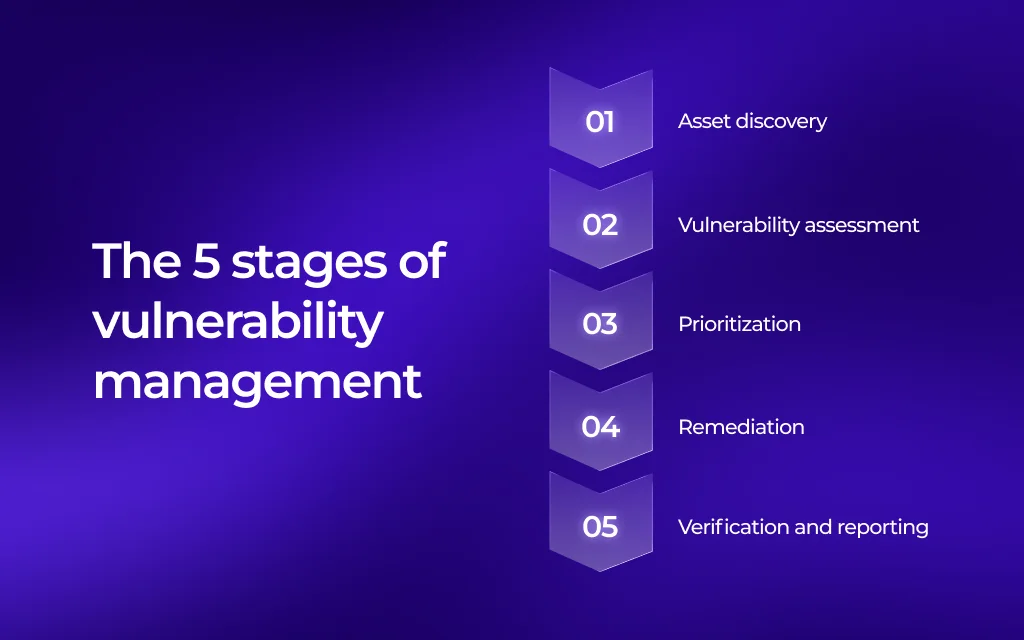
Vulnerability management works as a continuous cycle rather than a checklist. The core stages are asset discovery, vulnerability assessment, prioritization, remediation, and verification and reporting. The final stage feeds back into the next discovery cycle as the environment and threat landscape change.
1. Asset discovery
The first step is understanding what needs to be protected. This includes systems, applications, endpoints, cloud assets, network devices, and other components that form part of the organization’s technology environment.
An incomplete asset inventory creates an immediate blind spot. Security teams cannot reliably assess or protect systems they do not know exist.
Key activities:
- Discover on-premises and cloud assets
- Maintain an up-to-date asset inventory
- Identify internet-facing systems
- Track applications, endpoints, and network devices
- Identify unmanaged or unknown assets
Key output:
A current and continuously updated asset inventory.
2. Vulnerability assessment
Once assets are identified, security teams assess them for known security weaknesses. This can include vulnerability scanning, authenticated assessments, configuration checks, and analysis against vulnerability databases and vendor advisories.
The goal is to build a clear picture of which vulnerabilities exist and where they are located.
Key activities:
- Scan systems and applications
- Assess internal and external attack surfaces
- Use authenticated scanning where appropriate
- Identify affected software and versions
- Map findings to assets
Key output:
A list of identified vulnerabilities associated with specific assets.
3. Prioritization
A vulnerability scan can tell security teams what is wrong, but it does not automatically tell them what needs to be fixed first.
Prioritization considers the context around each vulnerability, including exploitability, internet exposure, asset criticality, available protections, and potential business impact. CVSS can provide useful severity information, but it should not be the only factor used to determine remediation priority.
Key activities:
- Review CVSS severity
- Check for known exploitation
- Assess asset criticality
- Consider network exposure
- Evaluate potential business impact
- Assign remediation owners and priorities
Key output:
A risk-ranked remediation queue.
4. Remediation
Remediation is the process of reducing or eliminating the identified exposure. Applying a security patch is one common approach, but it is not the only option.
Depending on the situation, remediation may involve:
- Applying a software patch
- Updating or replacing vulnerable software
- Changing system configurations
- Restricting access
- Applying compensating controls
- Removing an exposed service
- Formally accepting residual risk where appropriate
The important point is that remediation needs clear ownership and defined timelines. Without accountability, vulnerabilities can remain open even after they have been identified and prioritized.
5. Verification and reporting
The final stage is often overlooked. After remediation, security teams need to verify that the vulnerability has actually been addressed.
This may involve rescanning the affected asset, validating configuration changes, or performing additional testing to confirm that the original attack path is no longer available.
Program-level reporting can then track metrics such as:
- Mean time to remediate (MTTR)
- Number of open vulnerabilities
- Aging of critical findings
- Remediation SLA performance
- Vulnerability backlog trends
- Recurring vulnerabilities
How to prioritize vulnerabilities beyond CVSS scores
CVSS is useful for communicating the technical severity of a vulnerability, but severity alone does not provide the full risk picture.
Consider two vulnerabilities with the same high CVSS score. One may exist on an isolated development server with no sensitive data, while the other affects an internet-facing application that handles customer information.
The technical severity may be similar, but the organizational risk is not.
A risk-based vulnerability management approach considers several factors together:
- Severity: How serious is the vulnerability technically?
- Exploitability: Can the vulnerability be exploited, and is exploitation being observed?
- Exposure: Is the affected asset accessible from the internet or other untrusted environments?
- Asset criticality: What business process or information depends on the affected system?
- Business impact: What could happen if the vulnerability were successfully exploited?
- Existing controls: Are segmentation, access controls, or other safeguards limiting the potential impact?
Known exploitation is particularly important when prioritizing vulnerabilities. CISA’s Known Exploited Vulnerabilities (KEV) catalog can provide an additional signal that a vulnerability is being actively exploited in the wild.
The objective is not to ignore high-severity vulnerabilities. It is to make sure remediation resources are directed toward the vulnerabilities that represent the most meaningful risk to the organization.
Vulnerability management best practices and tools
A vulnerability management program needs more than scanning software. The technology should support a process that continuously discovers assets, prioritizes findings, tracks remediation, and verifies results.
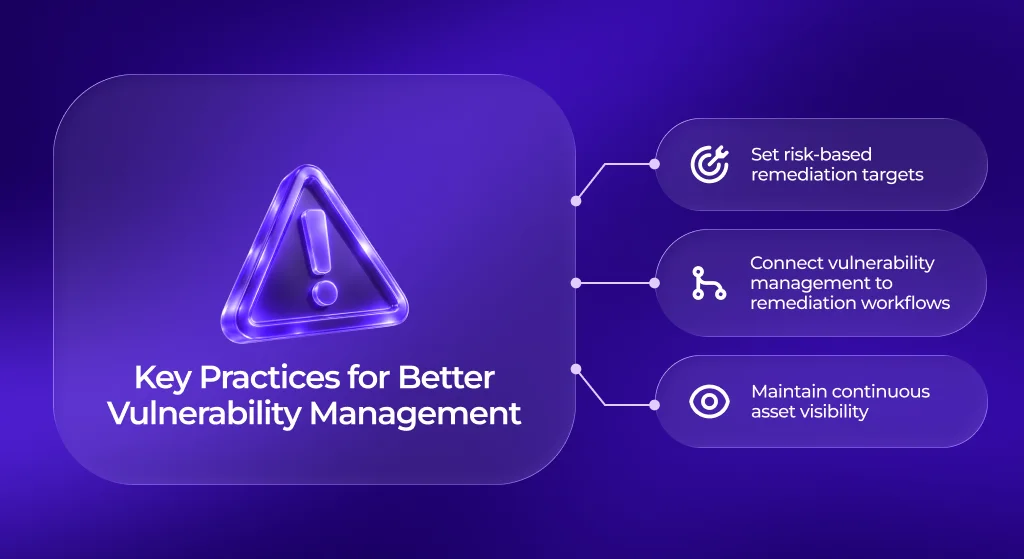
1. Set risk-based remediation targets
Define remediation timelines according to the risk of the vulnerability rather than using one deadline for every finding.
Actively exploited vulnerabilities affecting exposed or business-critical systems may require much faster action than lower-risk findings on isolated assets.
Track mean time to remediate (MTTR) alongside other metrics to understand whether the organization is actually reducing exposure over time.
2. Maintain continuous asset visibility
Asset discovery should not be limited to an annual inventory exercise or quarterly scan.
Cloud environments, SaaS applications, remote endpoints, and third-party connections can change quickly. Continuous discovery helps identify assets that may otherwise remain outside the vulnerability management program.
3. Connect vulnerability management to remediation workflows
Security teams should be able to move from finding to action without relying entirely on manual processes.
Useful integrations can connect vulnerability management with:
- IT service management platforms
- Ticketing systems
- Patch management tools
- Configuration management
- Security operations workflows
- Asset inventories
Building or outsourcing your vulnerability management program
Organizations can build vulnerability management capabilities internally, use managed services, or combine both approaches. The right model depends on the organization’s environment, internal expertise, technology stack, and ability to sustain the program over time.
A practical starting point is to establish these six capabilities:
- Inventory your assets: Include on-premises, cloud, SaaS, endpoints, and internet-facing systems.
- Define your assessment approach: Cover both external and authenticated internal environments where appropriate.
- Create a risk-based prioritization model: Go beyond raw CVSS scores and include exploitability, exposure, and business context.
- Set remediation SLAs: Define timelines by risk level and assign clear ownership.
- Build verification into the process: Rescan or otherwise validate significant remediations.
- Report program performance: Track MTTR, backlog trends, aging findings, and SLA performance.
The challenge is often not acquiring a scanner. It is sustaining the processes around it. Prioritization requires security context, while verification requires teams to confirm that remediation has actually reduced the risk.
Organizations without the internal capacity to manage these activities continuously can consider a managed Threat & Vulnerability Management service. Terralogic’s Threat & Vulnerability Management service supports the vulnerability management lifecycle with continuous asset visibility, vulnerability assessment, risk-based prioritization, and remediation support.
Conclusion
Vulnerability management is not a scanning exercise. It is a continuous process that connects asset visibility, vulnerability assessment, risk-based prioritization, remediation, and verification.
The goal is not to fix every vulnerability at once. It is to understand which weaknesses create the greatest risk and make sure they are addressed before they become viable attack paths.
A mature program also closes the loop. Finding a vulnerability is only the beginning, and deploying a patch is not necessarily the end. Organizations need to verify that remediation worked and use those results to improve the next cycle.
As attack surfaces continue to change, vulnerability management needs to remain continuous, risk-based, and connected to the broader security program.
Looking to strengthen your vulnerability management program? Talk to Terralogic’s cybersecurity experts about building a more effective approach to vulnerability discovery, prioritization, and remediation.
Frequently Asked Questions (FAQs)
1. What is vulnerability management in simple terms?
Vulnerability management is the continuous process of finding, evaluating, prioritizing, and fixing security weaknesses across an organization’s systems, applications, and networks. Unlike a one-time vulnerability scan, it continues as new vulnerabilities and assets emerge.
2. What are the 5 steps of the vulnerability management lifecycle?
The five core stages are asset discovery, vulnerability assessment, prioritization, remediation, and verification and reporting. The final stage feeds back into asset discovery, making vulnerability management a continuous cycle rather than a one-time process.
3. What’s the difference between vulnerability management and vulnerability assessment?
A vulnerability assessment identifies and evaluates vulnerabilities at a specific point in time. Vulnerability management is the broader, continuous program that includes assessment along with prioritization, remediation, and verification.
4. How often should vulnerability scans be run?
The appropriate frequency depends on the organization’s environment, risk profile, regulatory requirements, and how quickly its systems change. Internet-facing and frequently changing environments generally require more continuous visibility than relatively static environments.
The important principle is that scanning should support an ongoing vulnerability management process rather than serve as an annual or occasional exercise.
5. Is CVSS enough to prioritize vulnerabilities?
No. CVSS provides a useful measure of technical severity, but it does not capture the full organizational risk. Security teams should also consider factors such as exploitability, known exploitation, network exposure, asset criticality, and potential business impact.
6. What is the difference between vulnerability management and patch management?
Patch management focuses specifically on identifying, deploying, and tracking software updates. Vulnerability management is broader and can include patching as well as configuration changes, access restrictions, compensating controls, risk acceptance, and verification.
7. What is mean time to remediate (MTTR)?
Mean time to remediate measures how long it takes an organization to address vulnerabilities after they are identified. Tracking MTTR can help security teams understand whether remediation is becoming faster and whether high-risk findings are being addressed within defined targets.
8. Can vulnerability management be outsourced?
Yes. Organizations can use managed vulnerability management services when they do not have the internal resources or expertise to continuously handle asset discovery, scanning, prioritization, remediation tracking, and verification. The appropriate model depends on the organization’s risk, environment, and internal capabilities.