
A microservice can pass its tests and still cause a production issue when it interacts with another service. As applications grow, testing becomes more complex because a single business workflow may depend on several services, each with its own logic, API, configuration, and data.
For QA teams, the challenge is to identify these failures without making every test run slower as the application expands. Running the entire test suite after every code change can delay feedback, while testing only individual services can leave important integration problems undetected.
CI/CD test automation helps teams address this balance by connecting automated tests to the software delivery process. The key is not to automate everything indiscriminately, but to decide which tests should run, when they should run, and how their results should guide development decisions.
This guide explains how to design a scalable testing framework for microservice applications, from selecting the right test levels to managing parallel execution, controlling test data, and investigating failures. The focus is on practical QA decisions that help teams maintain reliable test coverage as their applications evolve.
Key takeaways
- CI/CD test automation integrates automated validation into the build and delivery process, helping teams identify defects earlier.
- A layered testing strategy balances fast component and API checks with integration and end-to-end validation.
- Parallel test execution can shorten feedback cycles when tests are independent and shared resources are managed correctly.
- Repeatable environments and controlled test data help teams distinguish application defects from testing problems.
- Useful failure reports make it easier to identify whether a problem originates in the application, automation code, or test environment.
- A scalable automation strategy prioritizes meaningful coverage and reliable feedback over simply increasing the number of tests.
Understanding CI/CD test automation
CI/CD test automation is the practice of running automated software tests as part of the continuous integration and continuous delivery pipeline. When developers submit code changes, the pipeline can build the application, execute selected tests, and report whether the changes meet the required quality criteria.
For microservice applications, this means validating both individual services and their interactions. A service-level test may confirm that an API returns the expected response, while an integration test checks whether that service exchanges the correct information with its dependencies.
The value of CI automation comes from placing these checks at appropriate stages of development. Fast tests can catch common problems soon after a change, while broader tests can verify service interactions and important business workflows before a release progresses.
A typical CI/CD testing workflow
A CI/CD pipeline runs automated tests at different stages of the software delivery process, helping QA teams identify problems as code moves from development toward release. In a microservice application, each stage serves a different purpose, from catching basic defects early to verifying interactions between services and validating critical user workflows.
A typical workflow includes the following stages:
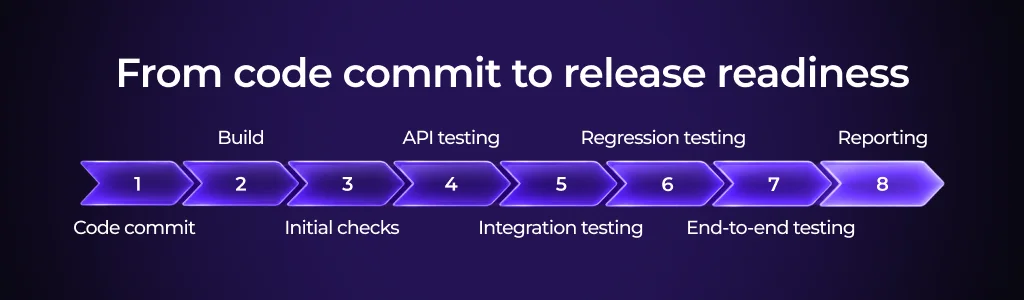
- Code commit: A developer submits a change to source control.
- Build: The pipeline builds the affected component and prepares the required artifacts.
- Initial checks: Fast tests detect basic functional problems early.
- API testing: Automated checks validate service endpoints, requests, responses, and business rules.
- Integration testing: Tests verify communication and data exchange between dependent services.
- Regression testing: A broader suite checks whether existing functionality still behaves as expected.
- End-to-end testing: Critical user workflows are validated across the application.
- Reporting: The pipeline collects results so the team can decide whether the change is ready for the next stage.
A layered testing strategy for microservices
Testing every scenario through the complete application can make an automation suite slow and difficult to maintain. A layered testing strategy assigns each test to the level best suited to validating the intended behavior.
For example, a calculation or business rule can often be verified within a single component. Testing it through the full application would introduce additional dependencies without necessarily providing better evidence. By contrast, checking whether an order service sends the correct information to a payment service requires integration coverage.
A practical microservices testing strategy includes 4 main test levels:
1. Component and unit testing
Component and unit tests validate the logic within an individual function, class, or service component. They can check whether a discount is calculated correctly, whether invalid input is rejected, or whether a business rule produces the expected result under different conditions. By isolating the logic being tested, these tests help teams identify the source of a defect without having to investigate failures across multiple services.
2. API testing
API tests validate the contract between a service and the systems that call it. They check whether endpoints accept the expected request parameters, enforce validation and authentication rules, return the correct status codes, and provide responses in the expected format. For example, an API test can verify that an order service rejects a request with a missing customer ID instead of creating an incomplete order.
3. Integration testing
Integration tests verify that 2 or more components or services work correctly together. They check whether one service sends the required data, whether the receiving service interprets it correctly, and whether the interaction produces the expected result. For example, a test can verify that an order service passes the correct order amount to a payment service and handles the response appropriately when the payment is declined.
4. End-to-end testing
End-to-end tests validate a complete business workflow across the services involved in delivering it. For example, an e-commerce test might create an order, process its payment, update the order status, and verify that the customer receives the expected confirmation. This level of testing helps uncover failures caused by interactions across the application, but its reliance on multiple services and environments can make execution slower and maintenance more demanding.
API testing in a microservice environment
APIs are common communication boundaries between microservices, making API testing a core part of CI/CD test automation. However, receiving a successful HTTP status does not necessarily mean that an API behaves correctly. A service might return a response with the wrong data, apply an incorrect business rule, or allow access that should have been denied.
An effective API testing approach should validate the service contract and the behavior expected by the application.
What should API tests validate?
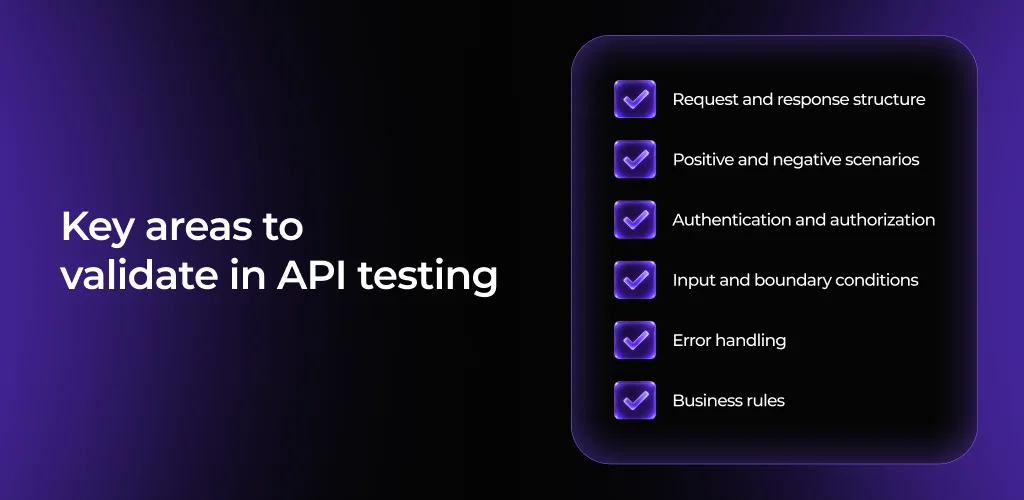
- Request and response structure: Confirm that required fields, data types, response formats, and status codes match the API contract.
- Positive and negative scenarios: Verify that valid requests succeed and invalid requests are rejected or handled appropriately.
- Authentication and authorization: Check that users and services can access only the operations permitted by their assigned permissions.
- Input and boundary conditions: Test permitted values, invalid inputs, and values at or around defined limits.
- Error handling: Verify how the service responds to malformed requests, unavailable dependencies, and unexpected conditions.
- Business rules: Confirm that the service applies the intended logic rather than merely returning a technically valid response.
Integration testing across service dependencies
A microservice can pass its individual tests and still fail when it communicates with another service. Integration testing addresses this gap by checking whether connected components exchange information correctly and respect their expected contracts.
Consider an order service that accepts a purchase request but sends an incorrect product identifier to the inventory service. The order service may pass its own tests because the request is accepted, yet the overall transaction can still fail when the inventory service processes the data.
To identify these problems, QA teams should map the important service dependencies and design tests around the interactions that matter most. These tests should cover data mapping, API contracts, dependency responses, and error handling when a downstream service becomes unavailable or returns unexpected information.
Mocks, stubs, and service virtualization can help isolate individual services during specific tests. However, simulated dependencies cannot confirm that every real integration works correctly. Critical service interactions should also be validated against actual dependencies where appropriate.
The right balance depends on the application. Isolated tests help pinpoint defects, while realistic integration tests provide evidence that connected services can work together as intended.
End-to-end automation for critical business workflows
End-to-end automation verifies that a complete business workflow works from the user’s initial action to the expected result. It can reveal issues that isolated API and integration tests miss, particularly when a workflow depends on several services working together.
However, using end-to-end testing for every scenario can increase execution time and make the suite harder to maintain. A failure may involve several services, shared data, or asynchronous operations, making it difficult to identify the original cause.
A more effective approach is to prioritize high-value user journeys for end-to-end automation. For example, an e-commerce application might need end-to-end coverage for placing an order and completing payment, while individual input validations can be tested at the API level.
This approach keeps end-to-end coverage focused on workflows where complete application validation adds value. Lower-level tests can handle more detailed functional checks, allowing the pipeline to provide broader coverage without making every test unnecessarily expensive.
Parallel test execution for faster feedback
As the number of automated tests grows, running them sequentially can extend pipeline duration and delay feedback to developers. Parallel test execution addresses this problem by running independent tests simultaneously across multiple workers.
For example, a team might distribute API tests, integration tests, UI regression tests, and independent functional scenarios across separate workers. This can reduce total execution time when the workloads can run concurrently without competing for the same resources.
Before introducing parallel execution, QA teams should address several factors that can affect test reliability and execution efficiency:
- Test independence: Tests should not rely on a specific execution order or modify shared resources in ways that affect other tests. For example, two tests updating the same order record may produce inconsistent results when run simultaneously.
- Test data and resource isolation: Each test should use appropriately isolated test data, establish its own prerequisites, and clean up resources it creates or modifies. This reduces conflicts between workers and helps prevent failures caused by shared state.
- Workload distribution: Tests vary in execution time and resource requirements. Distributing them unevenly can leave some workers idle while others continue running, limiting the overall reduction in pipeline duration.
- Resource availability: Running more tests concurrently increases demand on test environments, databases, and other shared infrastructure. Teams need to ensure these resources can support the planned concurrency without creating bottlenecks or introducing environment-related failures.
Selecting the right tests for each CI stage
Running the complete test suite after every code change may appear thorough, but it can make CI automation slower without providing proportionately better feedback. A more effective approach selects tests according to their purpose, execution cost, and relevance to the change.
Different test types serve different purposes at each stage of the CI pipeline:
- Smoke tests: Check basic application availability and essential functionality after a build or deployment. They help identify major issues before the pipeline proceeds to more extensive testing.
- Service and API tests: Validate the behavior of affected services and their interfaces, including request handling, response structures, and business rules.
- Integration tests: Verify important interactions between dependent services, helping detect problems in data exchange and service communication.
- Regression tests: Check existing functionality for unintended changes caused by new code or modifications to shared components.
- End-to-end tests: Validate critical business workflows across the application to confirm that connected services work together as expected.
Making test failures actionable
A failed automated test should give QA engineers and developers enough information to begin investigating the problem. Without useful evidence, the team may need to rerun the entire pipeline or manually reproduce the scenario before understanding what went wrong.
What a useful failure report should include:
- Test name and execution status.
- Failure message and relevant stack trace.
- Request and response details for API failures, where available.
- Relevant application or service logs.
- Screenshots or execution traces for UI failures, where applicable.
- Environment configuration and execution details.
- Build information and execution time.
The information should help the team understand both what failed and under what conditions. For example, an API test report that includes the request, response, and relevant service logs can help identify whether the problem involves incorrect application behavior, a contract mismatch, or an unavailable dependency.
Failure classification is equally important. A product defect, an automation defect, and an environment failure require different corrective actions. Clear reporting helps teams investigate the right problem instead of treating every failed test as evidence that the application is broken.
The QA engineer’s role in CI/CD
CI/CD automation is most effective when QA engineers help shape the testing strategy rather than focusing only on writing scripts. Their role includes deciding what should be tested, where validation belongs in the pipeline, and how test results should influence delivery decisions.
Typical responsibilities include:
- Designing the test automation strategy and identifying high-value scenarios.
- Developing and maintaining automated tests for APIs, integrations, and critical workflows.
- Supporting CI/CD test execution and improving test stability.
- Analyzing failures to distinguish product defects from automation and environment problems.
- Monitoring coverage, execution time, and test reliability.
- Providing clear quality feedback to support release decisions.
Common challenges in microservices test automation
As a microservice application grows, the automation framework must accommodate more service dependencies, integration points, test data, and test scenarios. Without careful management, these factors can increase pipeline duration, make failures harder to diagnose, and reduce confidence in test results.
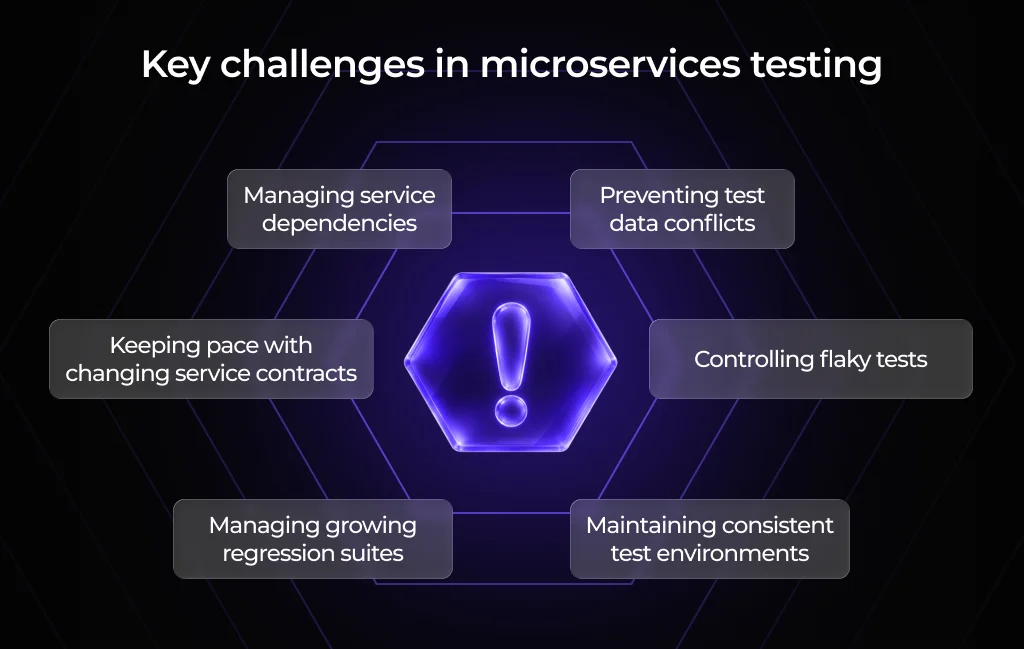
- Managing service dependencies: Tests may rely on several services being available and correctly configured. A failure in one dependency can disrupt downstream tests, making it difficult to determine whether the problem lies in the application code or the surrounding services.
- Preventing test data conflicts: Concurrent tests may create, modify, or delete the same records. Without isolated test data and proper cleanup, these interactions can produce inconsistent results and failures that are difficult to reproduce.
- Controlling flaky tests: Asynchronous processing, timing differences, and variable service response times can cause tests to pass in one run and fail in another. Repeated unreliable results make it harder for teams to distinguish genuine defects from test instability.
- Maintaining consistent test environments: Differences in configuration, unavailable dependencies, or inconsistent environment state can cause failures unrelated to the code being tested. These issues reduce the reliability of test results and complicate troubleshooting.
- Managing growing regression suites: As test coverage expands, running every regression test at every pipeline stage can increase feedback time. Teams need to prioritize tests according to change scope and release risk while retaining sufficient coverage.
- Keeping pace with changing service contracts: Changes to API endpoints, request and response schemas, or service behavior can invalidate existing automated tests. Teams must update affected tests and verify that dependent services continue to communicate as expected.
Conclusion
Effective CI/CD test automation is not just about running tests faster or increasing test coverage. It is about building a reliable process that helps teams identify defects early, maintain software quality, and deliver changes with greater confidence.
As applications evolve, testing strategies must evolve with them. A well-designed automation framework combines the right testing methods, reliable test environments, and actionable feedback to support both development efficiency and long-term software quality.
Terralogic supports organizations in strengthening their software quality and testing practices through its QA and implementation expertise. Explore how Terralogic can help improve your software testing approach.
Frequently asked questions (FAQs)
1. What is CI/CD test automation?
CI/CD test automation is the practice of running automated software tests as part of the build and delivery pipeline. It allows teams to validate code changes throughout development, identify defects earlier, and use test results to inform release decisions.
2. Which tests should run first in a CI/CD pipeline?
Fast checks, such as smoke tests and focused component or API tests, are generally useful early in the pipeline because they can identify common problems before more expensive tests run. Integration, regression, and end-to-end tests can follow according to the application’s architecture, change scope, and risk.
3. How does parallel test execution improve testing efficiency?
Parallel test execution runs independent tests simultaneously rather than one after another, potentially reducing total execution time. To keep results reliable, teams must manage shared test data, isolate resources, and remove dependencies between tests wherever practical.
4. How can QA teams reduce flaky tests in microservice applications?
Start by identifying patterns in failed runs and reviewing relevant logs, traces, test data, and environment conditions. Address the underlying cause, such as timing assumptions, shared state, unstable dependencies, or automation defects, instead of relying on repeated retries to hide inconsistent results.