
AI is changing how network engineers approach troubleshooting, configuration, and day-to-day operations. Tasks that once required manual log analysis, documentation searches, or repetitive configuration work can now be accelerated with AI-assisted tools.
The opportunity is significant, but so is the risk of treating AI output as authoritative. A technically plausible recommendation can still be incorrect for a specific topology, software version, traffic pattern, or operational constraint.
The central issue is therefore not whether AI should be used in network engineering. It is how network engineers use AI without surrendering the judgment required to operate production infrastructure safely.
AI can provide speed, broad technical knowledge, and a useful starting point for analysis. Network engineers provide the environment-specific context, validation, critical thinking, and accountability that AI does not have.
This article examines where AI in network engineering provides practical value, where over-reliance creates risk, and how human oversight can be incorporated into AI-assisted network operations.
Key takeaways
- AI in network engineering can accelerate analysis, troubleshooting, and routine configuration work, but it does not replace network-specific judgment.
- AI can assist with log parsing, unfamiliar error codes, configuration generation, and first-pass root cause hypotheses.
- AI-generated output can be technically plausible while still being wrong for a specific network environment.
- Over-reliance on AI can create risks including silent failures, skill erosion, accountability gaps, and context blindness.
- Human-in-the-loop AI is essential when AI output can affect live network infrastructure.
- The value of AI automation depends on the engineer’s ability to provide context, validate the output, and remain accountable for the final decision. Pasted markdown
The changing role of network engineers in the AI era
AI does not eliminate the need for network engineers. It changes where their time and expertise are most valuable.
Routine activities such as log parsing, boilerplate configuration generation, and first-pass root cause analysis can increasingly be assisted by AI. This can reduce the time required to move from raw technical information to an initial analysis or working configuration.
What remains difficult to automate is the judgment required to apply that information to a specific environment. Network engineers understand the topology, business context, service-level commitments, operational constraints, and vendor-specific behavior that an AI system may not have access to.
The role therefore shifts from executing every technical task manually toward reviewing, validating, and making context-dependent decisions.
This does not make domain knowledge less important. As more execution becomes automated, engineers need a stronger understanding of network architecture and behavior to determine whether an AI-generated answer is actually correct.
Where AI in network engineering provides practical value
AI is most useful in network engineering when it can reduce the time spent processing information, investigating unfamiliar issues, or preparing repetitive technical work. These tasks can benefit from AI assistance because the technology can quickly organize information and produce an initial analysis for an engineer to review.
The key is to use that speed without transferring technical judgment to the AI. Engineers still need to validate the output against the actual network environment, configuration, and operational requirements.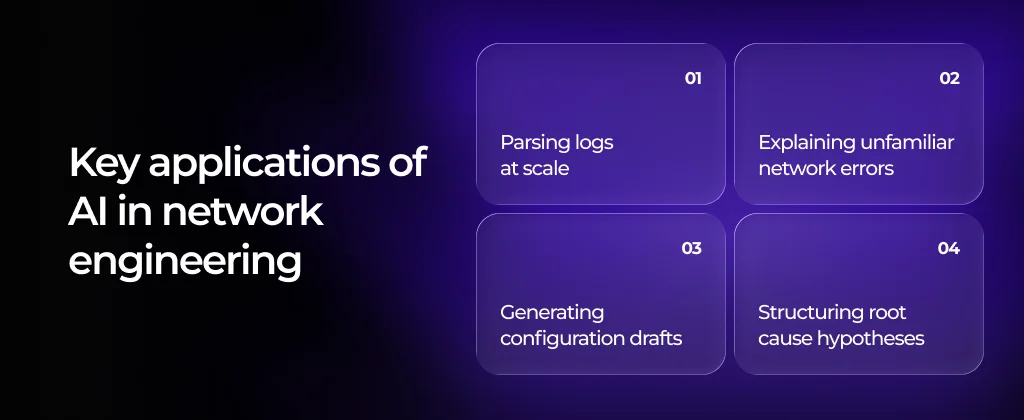
1. Parsing logs at scale
Large network environments can generate substantial volumes of syslog and event data. Reviewing every entry manually can make it difficult to identify recurring patterns or anomalies quickly.
AI can process these logs and surface patterns that deserve further investigation. An engineer can then compare those findings with known network behavior and established baselines before deciding whether they indicate a real issue.
Example: If recurring error messages appear across a large set of syslog entries, AI can group related events and highlight the pattern. The engineer can then determine whether the pattern is expected behavior or evidence of an emerging problem.
2. Explaining unfamiliar network errors
Troubleshooting sometimes involves protocol or platform errors that an engineer has not encountered before. Finding the relevant documentation and understanding what the error means can add significant time to an investigation.
AI can provide an initial explanation of unfamiliar BGP or OSPF errors and suggest areas for further investigation. Engineers can then verify the explanation against the relevant vendor documentation and the software version running in the environment. Pasted markdown
Example: An engineer encountering an unfamiliar BGP error can ask AI to explain the likely causes and identify relevant verification steps. Rather than treating that explanation as the diagnosis, the engineer uses it to narrow the investigation and confirms the findings against the actual device and vendor documentation.
3. Generating configuration drafts
Repetitive configuration work is another area where AI can reduce manual effort. It can generate starting configurations for tasks such as ACLs, QoS policies, and VLANs based on the requirements provided by the engineer.
However, a syntactically valid configuration is not necessarily suitable for a production environment. The engineer still needs to review each line against the network architecture, existing policies, dependencies, and operational constraints.
Example: An engineer can use AI to generate a draft ACL based on a defined set of traffic requirements. Before deployment, the engineer reviews the rules, checks for unintended access or traffic restrictions, and confirms that the configuration fits the existing security and network design.
4. Structuring root cause hypotheses
When troubleshooting a complex incident, engineers often need to consider several possible causes at the same time. AI can help organize those possibilities from available technical information such as traceroute results, routing data, logs, and reported symptoms.
AI can structure a first-pass root cause hypothesis and suggest areas to verify. The engineer must then prioritize those hypotheses based on the actual topology, available evidence, and known conditions in the environment.
Example: If an engineer is investigating intermittent connectivity, AI can analyze the available traceroute and routing information and suggest several possible causes. The engineer can then determine which hypothesis is most relevant based on the network topology and verify it using the appropriate commands and operational data.
The limits of AI context in network engineering
The central limitation of AI in networking is context.AI systems can draw on broad technical information, including RFCs, vendor documentation, community discussions, and configuration examples. However, they do not automatically know the topology, customer commitments, recent changes, operational constraints, or hardware-specific behavior of a particular network. Pasted markdown
That distinction becomes especially important when AI output is applied to live infrastructure. A configuration can be syntactically valid and still be operationally wrong. In an IOS-XR environment, for example, an incorrect route policy can affect traffic across a segment even if the generated command itself does not produce a syntax error.
Network automation therefore introduces a different type of risk from ordinary text generation. Changes to live network infrastructure can be stateful, interconnected, and difficult to detect immediately when something goes wrong.
AI can provide:
- Broad knowledge of protocols, vendors, and common failure modes
- Rapid pattern matching across large amounts of information
- Draft configurations, summaries, and structured analysis
- Consistent assistance without fatigue or decision fatigue
Engineers provide:
- Knowledge of the specific topology and business context
- Judgment about whether an AI recommendation makes sense in the environment
- Accountability for the change being made
- The ability to provide relevant technical context and ask the right questions
The distinction is important because AI can provide an answer, but it cannot independently establish that the answer is appropriate for a specific production network. Pasted markdown
Risks of over-relying on AI in networking
The biggest risk is not using AI in network engineering. The risk comes from treating AI output as correct simply because it sounds technically convincing. When engineers stop questioning or validating AI recommendations, that behavior can gradually become part of the normal operational process.
This is particularly important in networking because a seemingly small configuration error can affect traffic, routing, or service availability. The faster AI can generate recommendations, the easier it can become to move from an AI suggestion to a production change without enough technical review.

1. Silent failures
Not every network problem produces an obvious error. Some configuration mistakes can continue to affect traffic while the network still appears to be functioning normally from an operational perspective.
For example, an incorrect BGP configuration or an MPLS-related issue can result in dropped packets or degraded service without immediately generating a clear system alert. The problem may only become apparent when users experience connectivity issues, application performance degrades, or an SLA is affected.
This makes AI-generated changes involving routing and traffic handling particularly important to validate. An engineer needs to understand what the change is expected to do, what could be affected, and what evidence would indicate that the change is working as intended.
2. Loss of troubleshooting skills
AI can make troubleshooting faster, but speed should not replace the reasoning process that allows engineers to understand a network problem. Troubleshooting is also how engineers build experience with protocols, failure patterns, and the behavior of different network environments.
If an engineer repeatedly asks AI for an answer and accepts the recommendation without working through the problem, that reasoning process can gradually weaken. Over time, this creates a difficult situation: the engineer may become less capable of evaluating an AI answer precisely when strong technical judgment is needed to identify that the answer is wrong.
AI is most useful when it helps engineers investigate faster while still requiring them to understand the underlying problem. The goal should be to reduce repetitive work, not to remove the thinking required to troubleshoot effectively.
3. Accountability gaps
AI can generate a configuration or recommend a troubleshooting step, but it does not take responsibility for the result. The decision to accept, modify, test, and deploy that recommendation still belongs to the engineer responsible for the network.
If an AI-generated configuration causes an outage, saying that “the AI suggested it” does not explain why the change was considered appropriate or why it was safe to deploy. The engineer remains accountable for evaluating the recommendation and understanding its potential impact before applying it to production.
This is particularly important in environments where network changes can affect customer services or business-critical applications. AI can support the decision-making process, but it cannot replace the person responsible for making the final technical decision.
4. Missing network context
AI can have broad knowledge of networking concepts, protocols, and common failure modes, but that knowledge does not automatically include the details of a specific production environment. Important information may include recent configuration changes, the actual network topology, hardware behavior, software-version issues, or decisions made during previous incidents.
For example, an AI recommendation may appear reasonable based on general networking knowledge but still be inappropriate because another engineer recently changed part of the configuration or because the specific platform has a known issue. Without that context, the AI is evaluating the problem from an incomplete picture.
Critical thinking skills in the AI era
The growing use of AI does not make critical thinking less important for network engineers. As AI becomes more capable of generating configurations, explaining errors, and suggesting troubleshooting paths, engineers need stronger skills to determine whether those outputs are actually correct for their environment.
Critical thinking is not about rejecting AI recommendations. It is about knowing what to verify, when to verify it, and why the verification matters before an AI-generated recommendation is applied to a production network.

1. Understand the architecture before prompting
AI can only work with the context it receives. If an engineer does not provide enough information about the environment, the AI may produce an answer that is technically valid but unsuitable for the network being managed.
Before using AI for a network problem, engineers should understand the relevant architecture and provide useful context such as the vendor, platform, software version, topology, traffic profile, and operational constraints. This gives AI a clearer basis for analyzing the specific problem rather than responding only from general networking knowledge.
For example, asking AI to troubleshoot a routing issue without identifying the platform, software version, or network design can lead to a generic recommendation. The engineer needs to understand the environment first so they can determine what information AI actually needs.
2. Know what a correct output looks like
Engineers cannot reliably evaluate AI output if they do not understand what a correct result should look like. Technical expertise remains the foundation for distinguishing a useful recommendation from one that simply sounds convincing.
Consider a BGP troubleshooting scenario. An engineer who understands the expected BGP behavior in that environment can compare the AI’s recommendation against that baseline and identify inconsistencies. An engineer without that knowledge may accept the recommendation simply because the explanation appears technically detailed.
The goal is not for engineers to know every possible answer before using AI. They need enough domain knowledge to recognize whether an answer is plausible, what assumptions it depends on, and what needs to be verified.
3. Verify before applying
An AI-generated command should be treated as a recommendation, not as a production-ready instruction. Before applying it, engineers need to understand what the command changes, what systems or traffic it could affect, and whether it is appropriate for the current network configuration.
Verification can include reviewing the command line by line, checking relevant vendor documentation, comparing it with existing configuration standards, and considering how the change could affect routing or traffic. The appropriate validation process will depend on the type and potential impact of the change.
AI can make it much faster to generate a proposed solution, but that speed can also make it easier to skip review. Verification therefore needs to remain a deliberate part of AI-assisted network operations rather than something engineers do only when a recommendation looks suspicious.
4. Stay curious, not dependent
AI should help engineers understand a problem more quickly, not replace the process of understanding it. When engineers use AI only to obtain an answer, they may miss an opportunity to understand the reasoning behind the recommendation.
A better approach is to ask AI to explain its reasoning, identify its assumptions, compare alternative hypotheses, or explain why one troubleshooting path is more likely than another. This turns the interaction into part of the engineering investigation rather than simply an answer-generation exercise.
Engineers who understand why a recommendation works are also better prepared to recognize when the same recommendation does not apply to a different network or situation. That distinction becomes increasingly important as AI becomes more integrated into everyday network operations.
Balancing AI automation with human oversight
AI automation can make network operations faster, but speed should not come at the expense of engineering judgment. A human-in-the-loop AI approach keeps AI responsible for assisting with analysis or generating recommendations, while the network engineer remains responsible for reviewing the output and deciding whether it is appropriate to use.
This approach is particularly important when AI-generated recommendations could affect a live network. Before an AI-generated configuration or troubleshooting action is applied, engineers can use three checks to determine whether the recommendation is ready for production.
1. Context: did AI receive enough information?
The quality of an AI recommendation depends heavily on the context provided. If important details about the network are missing, AI may produce an answer that is technically reasonable but does not fit the actual environment.
Depending on the task, engineers should provide relevant information such as the vendor, platform, software version, topology, traffic characteristics, and operational constraints. This gives AI a clearer basis for analyzing the problem and reduces the chance of receiving a generic recommendation that does not apply to the network.
For example, a routing question that does not identify the platform or relevant topology may lead to a recommendation that works in one environment but is inappropriate in another. Providing the right context is therefore the first step in making AI assistance useful.
2. Validation: does the output make sense for the environment?
Once AI provides a recommendation, the engineer needs to compare it with what is already known about the network. The goal is to determine whether the recommendation fits the current configuration and whether its expected behavior matches the problem being investigated.
This review may involve checking the existing configuration, routing design, MPLS behavior, change history, and operational requirements. If the proposed change needs a maintenance window or should first be tested on a non-critical path, those requirements need to be considered before deployment.
An AI-generated answer should therefore move the investigation forward, not bypass the normal validation process.
3. Accountability: can the engineer explain the change?
The final check is whether the engineer understands the recommendation well enough to take responsibility for applying it. Before deploying an AI-generated configuration, the engineer should be able to explain what the change does, why it is needed, and how it could affect the network.
If the engineer cannot independently explain why a command is correct for the specific situation, the recommendation is not ready for production. Understanding the change is especially important when the command can affect routing, traffic flow, or other interconnected network functions.
Human oversight is therefore not something that slows AI automation down unnecessarily. It provides the technical judgment needed to use automation safely while keeping accountability with the engineer responsible for the network.
Conclusion
AI in network engineering is changing how technical work gets done, but it does not remove the need for network expertise. As AI takes on more of the repetitive work, the ability to evaluate its output becomes an increasingly important part of the engineer’s role.
AI can process information quickly, generate configuration drafts, explain unfamiliar errors, and structure potential root cause hypotheses. These capabilities can significantly accelerate troubleshooting and routine operations when they are used within an appropriate engineering workflow.
The limitation is context. AI does not automatically know the topology, operational constraints, business requirements, recent changes, or vendor-specific conditions of a production network. Without that context, even a technically sound recommendation can be the wrong recommendation for the environment.
That makes critical thinking and human oversight of AI increasingly important. Network engineers need to understand their environments deeply enough to provide the right context, recognize what a correct answer should look like, verify AI output independently, and remain accountable for the final decision.
The practical principle is straightforward: use AI to move faster, but use engineering judgment to decide what is correct.
AI adoption should therefore be considered alongside the broader security architecture and operational controls surrounding the network. Terralogic’s security consulting and implementation services help organizations assess their current security environment, identify gaps, and implement controls that support secure and resilient network operations.
Frequently Asked Questions (FAQs)
1. Why should network engineers not blindly trust AI?
AI tools may have broad knowledge of networking concepts, but they do not automatically have access to a specific network’s topology, vendor-specific behavior, customer requirements, or recent configuration changes. An AI-generated configuration can therefore appear technically correct while still being inappropriate for the actual environment.
Network engineers should independently validate AI output before applying it to live infrastructure. Pasted markdown
2. What are the risks of over-relying on AI in networking?
Over-reliance on AI can contribute to silent failures, skill erosion, accountability gaps, and context blindness. In routing environments such as BGP and OSPF, incorrect configurations can propagate through the network and create operational impact without always producing an obvious error.
Consistent validation is therefore important not only for preventing immediate mistakes, but also for maintaining the engineering judgment required to identify incorrect AI output. Pasted markdown
3. How can network engineers balance AI automation with human oversight?
A human-in-the-loop AI approach keeps the engineer responsible for the final decision. Before applying AI output, engineers should provide sufficient technical context, validate the recommendation against their own knowledge and the environment, and confirm that they can explain why the proposed change is appropriate.
This allows AI automation to accelerate technical work without removing human oversight from production network operations. Pasted markdown
4. How does AI change the role of network engineers?
AI shifts more routine execution and first-pass analysis toward automation. Tasks such as log parsing, configuration generation, and initial root cause analysis can be accelerated, allowing engineers to spend more time on architecture-specific decisions, validation, and troubleshooting.
As automation increases, domain expertise becomes more important because engineers need to determine whether AI output is appropriate for their specific environment. Pasted markdown
5. What critical thinking skills do network engineers need in the AI era?
Network engineers need to understand their architecture deeply enough to provide relevant context, recognize what a correct output should look like, verify AI recommendations independently, and understand the reasoning behind AI-generated conclusions.
These skills allow engineers to use AI as a technical accelerator without becoming dependent on its output. Pasted markdown