


What happens to personal data after it enters an AI system?
That question is becoming harder to answer as organizations use AI to analyze customer information, train models, automate decisions, and support everyday business processes. Data that was once collected for a defined purpose can now flow through prompts, models, third-party AI platforms, and automated workflows.
The privacy challenge is not simply whether an organization has permission to collect personal data. It is whether the organization can still understand, control, and justify what happens to that data throughout the AI lifecycle.
This becomes even more important as AI regulations evolve. GDPR continues to govern the processing of personal data, while the EU AI Act introduces additional requirements for certain AI systems. At the same time, employees may introduce new risks through unapproved AI tools without realizing what information they are exposing.
For organizations adopting AI in 2026, privacy needs to be considered alongside AI governance and risk management from the beginning. This guide explores the key AI and data privacy risks, the regulations shaping AI privacy compliance, real-world examples, and practical best practices for governing AI while protecting personal data.
Key takeaways
- AI changes how personal data is processed. Data used for training, fine-tuning, prompting, and AI-driven decisions creates privacy considerations that traditional data governance may not fully address.
- Privacy and AI governance need to work together. Organizations need visibility into what data AI systems use, why it is used, where it goes, and who can access it.
- Shadow AI is a growing privacy concern. Employees using unapproved AI tools can expose personal, confidential, or proprietary information outside established governance and security controls.
- GDPR and the EU AI Act are complementary, not interchangeable. Organizations may need to meet both sets of requirements when AI systems process personal data in relevant contexts.
- AI-driven decisions require additional scrutiny. Systems that profile, score, or make decisions about individuals can create transparency, fairness, human oversight, and privacy obligations.
- AI governance should be risk-based. Frameworks such as NIST AI RMF and ISO/IEC 42001 can help organizations establish structured processes for identifying, assessing, and managing AI risks.
- AI privacy compliance is an ongoing program. AI tools, models, data flows, and regulations continue to evolve, so organizations need continuous monitoring rather than a one-time assessment.
What is AI and data privacy?
AI and data privacy refers to how personal data is collected, used, and protected when it is processed by AI systems. This includes personal data used to train or fine-tune models, information entered into AI tools, and data processed through AI-driven applications.
The same core privacy principles still apply:
- Purpose limitation: Personal data should be used for a clear and appropriate purpose.
- Data minimization: Organizations should use only the personal data necessary for the AI use case.
- Transparency: Individuals should understand how their personal data is being used where required.
- Lawful processing: Organizations need an appropriate legal basis for processing personal data.
What makes AI different is the way data moves through the AI lifecycle. Traditional privacy programs often deal with defined data flows and established systems. AI can introduce additional processing through training datasets, prompts, models, outputs, and third-party AI services, making it harder to track how personal data is used or retained.
Key AI data privacy risks organizations face in 2026
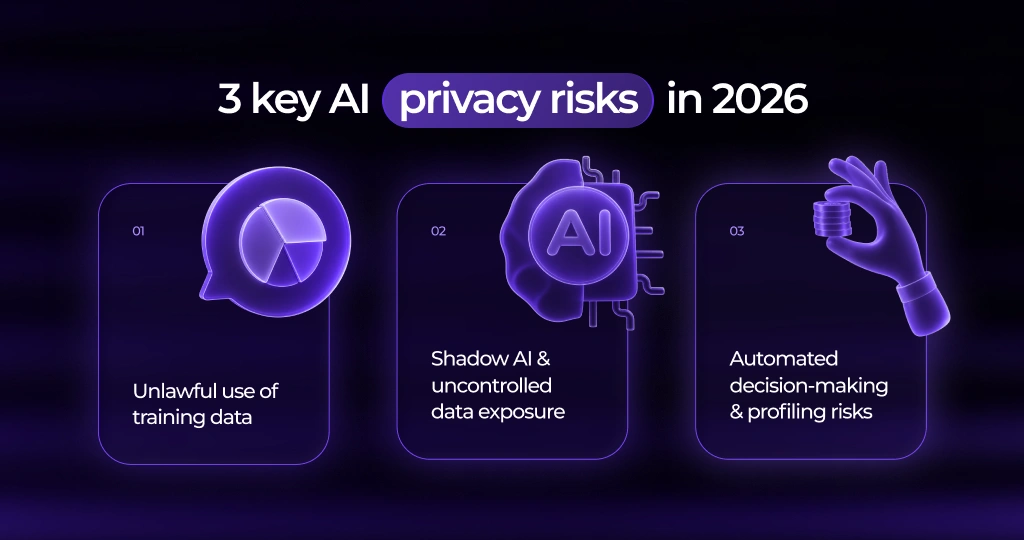
AI creates privacy risks at different stages of the AI lifecycle. Personal data can enter an AI system through training datasets, employee prompts, connected applications, or automated decision-making processes. Each creates a different set of privacy considerations that organizations need to address.
1. Unlawful use of training data
AI systems may be trained or fine-tuned using personal data from internal systems, customers, public sources, or third parties. Before using that data for AI, organizations need to determine where it came from, why it was originally collected, and whether there is an appropriate legal basis for using it for AI purposes.
The challenge often arises when data collected for one business purpose is reused for another. Organizations may need to reassess whether the new use is compatible with the original purpose, whether the data is necessary, and whether individuals have been adequately informed.
The European Data Protection Board has specifically addressed these questions in its Opinion 28/2024 on AI models. It highlights the need to assess the appropriate legal basis for processing personal data in AI development and deployment, as well as whether an AI model can genuinely be considered anonymous.
Example: An organization uses historical customer support records to train an AI assistant. The records contain names, contact details, and conversation histories, but the organization has not assessed whether the original purpose and legal basis allow that information to be reused for AI training.
2. Shadow AI and uncontrolled data exposure
A different risk emerges when employees use AI tools outside the organization’s approved technology environment. An employee may enter customer information, employee records, confidential documents, or other sensitive data into an external AI service without first checking whether the tool is authorized for that type of information.
The issue is not simply unauthorized AI use. It is the loss of organizational control over personal data once that information is submitted to an unapproved service. The organization may not know what contractual protections apply, where the data is processed, how long it is retained, or whether it can be used for other purposes.
IBM’s 2025 Cost of a Data Breach research found that one in five organizations studied had experienced a breach linked to shadow AI. Organizations with high levels of shadow AI also reported average breach costs that were $670,000 higher than those with low or no shadow AI.
This makes shadow AI a data governance issue as well as a security issue. Organizations need to know which AI tools are being used, what information employees are entering, and whether those tools meet their privacy and security requirements.
Example: An employee uploads a customer list or internal document to a public AI tool to summarize or analyze it. Because the tool has not been approved by the organization, the privacy team may have no visibility into how the information is processed, stored, or retained.
3. Automated decision-making and profiling risks
AI can increasingly influence decisions about individuals, including hiring, lending, insurance, access to services, and other areas where an automated assessment may significantly affect a person.
The privacy risk becomes greater when individuals do not receive adequate information about how their data is used, cannot exercise applicable rights, or when appropriate human oversight is missing. Under GDPR, Article 22 addresses certain decisions based solely on automated processing that produce legal or similarly significant effects, subject to specific conditions and exceptions.
The regulatory landscape is also developing in the United States. California’s updated CCPA regulations include requirements related to automated decision-making technology, including certain rights to access information about and opt out of qualifying uses. The regulations took effect January 1, 2026, with specific compliance timing for certain ADMT uses.
For organizations, the important question is therefore not simply whether AI is being used. It is what decisions the AI influences, what personal data it uses, and what rights and safeguards apply to the people affected.
Example: An organization uses an AI system to screen job applicants and rank candidates before a hiring manager reviews them. If the organization cannot explain how the system uses personal data or provide appropriate human oversight, the process may create privacy, transparency, and fairness concerns.
AI privacy regulations: what applies in 2026
AI privacy requirements depend on the AI use case, the type of data involved, and the jurisdictions where the organization operates. Some requirements come from privacy laws, while others specifically address AI systems or provide governance frameworks.
Here are the key regulations and frameworks organizations should understand in 2026:
1. EU AI Act
The EU AI Act takes a risk-based approach to AI regulation, with different requirements depending on the type and risk level of an AI system. High-risk systems face stricter requirements covering areas such as data governance, risk management, transparency, and human oversight.
For organizations deploying high-risk AI systems in relevant EU contexts, data governance is particularly important because the quality and management of data used by the system can directly affect compliance and AI reliability.
2. GDPR
The GDPR continues to apply when AI systems process personal data. This means organizations must consider whether they have a valid legal basis for processing and whether the way data is collected and used meets core privacy requirements.
Key areas include:
- Lawful basis — having a valid legal basis for processing personal data
- Purpose limitation — using data for defined and appropriate purposes
- Data minimization — using only the data necessary for the intended purpose
- Transparency — providing appropriate information about how personal data is used
- Individual rights — supporting applicable rights such as access, correction, and deletion
3. California ADMT rules
California has introduced specific privacy requirements for certain uses of automated decision-making technology (ADMT) under the CCPA. These requirements are relevant when businesses use automated systems to make or support certain decisions that can significantly affect consumers or employees.
Depending on the use case, organizations may need to provide notices and support rights such as access and opt-out. This makes it important to identify where AI is being used to evaluate or make decisions about individuals and determine whether the use falls within the applicable requirements.
4. NIST AI RMF
The NIST AI Risk Management Framework (AI RMF) is a voluntary framework that helps organizations identify, assess, and manage AI risks. Rather than establishing legal requirements, it provides a practical structure for building an AI governance program.
The framework is organized around four functions:
- Govern — establish policies, roles, and accountability
- Map — understand the AI system, its context, and potential risks
- Measure — evaluate and monitor identified risks
- Manage — prioritize and address those risks
5. ISO/IEC 42001
ISO/IEC 42001 is an international standard for establishing an Artificial Intelligence Management System (AIMS). It provides a structured approach for organizations that want to define responsibilities, policies, processes, and controls for managing AI across its lifecycle.
The standard can help organizations move from individual AI risk assessments to a more consistent organization-wide governance approach. Unlike the GDPR or EU AI Act, ISO/IEC 42001 is voluntary rather than a legal requirement.
AI data privacy best practices: building a responsible program
Managing AI privacy requires more than creating a policy after AI tools are already in use. Organizations need to understand where AI is being used, what personal data it handles, and what safeguards are in place before expanding AI adoption.
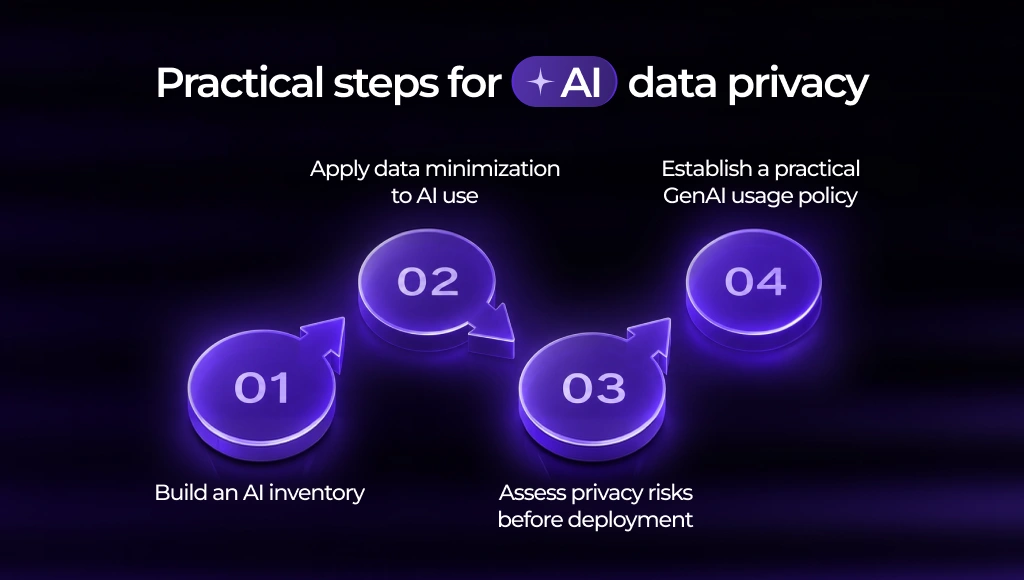
A practical program can start with 4 key steps:
1. Build an AI inventory
Start by identifying all AI tools and use cases across the organization, including both approved and unauthorized tools. For each one, document what the AI system does, what personal data it processes, where that data comes from, and which people or systems can access it.
This gives the organization a clearer view of its actual AI environment. It can also reveal shadow AI use that may otherwise remain outside the organization’s privacy and security controls.
2. Apply data minimization to AI use
Personal data should not automatically be included in AI training datasets or prompts simply because it is available. Organizations should determine what information is actually necessary for each AI use case and remove or limit data that is not needed.
This applies to both model development and everyday AI use. Organizations should also assess how AI providers handle submitted data, including retention, reuse, and data isolation, before allowing personal or sensitive information to be processed.
3. Assess privacy risks before deployment
Privacy assessments should happen before an AI system is deployed, particularly when it processes sensitive personal data, profiles individuals, or influences decisions about them.
Where required, organizations should conduct a Data Protection Impact Assessment (DPIA) to identify privacy risks and define appropriate safeguards. For relevant high-risk AI systems under the EU AI Act, organizations may also need to consider a Fundamental Rights Impact Assessment (FRIA).
The goal is to identify and address privacy risks while the AI system can still be changed, rather than discovering them after deployment.
4. Establish a practical GenAI usage policy
Employees need clear guidance on which AI tools are approved, what information they can enter, and what types of data should never be submitted to external AI services.
However, a policy alone is unlikely to eliminate shadow AI. Organizations should provide approved AI tools that are practical and accessible for employees to use, while applying appropriate privacy and security controls around them.
This creates a more sustainable approach: instead of simply restricting AI use, organizations can give employees a clear and governed way to use AI productively.
Conclusion
AI is changing how organizations collect, use, and manage personal data. As AI becomes part of everyday business processes, privacy risks can emerge not only from the data used to train models, but also from employee use of AI tools and AI-driven decisions.
The right response is not to slow AI adoption, but to build privacy into how AI is governed. Organizations need visibility into their AI use cases, clear rules for handling personal data, appropriate risk assessments, and ongoing oversight as AI systems and regulations evolve.
Need help building or strengthening your AI privacy and governance program? Talk to Terralogic’s cybersecurity and data privacy experts about assessing AI risks, strengthening governance, and aligning your AI practices with applicable requirements.
FAQs
1. What is AI data privacy?
AI data privacy refers to the rules and practices that govern how personal data is collected, used, and protected when it is processed by AI systems. This includes personal data used for training and fine-tuning models, information entered into AI tools, and data used by AI systems to make or support decisions.
2. Does the EU AI Act replace GDPR for AI systems?
No. The EU AI Act and GDPR address different aspects of AI and data protection. The AI Act regulates AI systems based on their risk level, while GDPR continues to govern the processing of personal data. An organization may need to comply with both when an AI system processes personal data in relevant circumstances.
3. What is the biggest AI privacy risk for organizations?
There is no single risk that applies to every organization, but shadow AI is a significant concern because employees may use unapproved AI tools to process personal or confidential information. Without appropriate governance, organizations may have limited visibility into what data is being shared and how external AI services handle it.
4. Do US companies need to comply with the EU AI Act?
Potentially, yes. The EU AI Act can apply to organizations outside the EU when their AI systems fall within the regulation’s territorial scope, including certain systems placed on the EU market or whose outputs are used in the EU. US organizations should therefore assess whether their AI products, services, or operations fall within the Act’s scope rather than assuming location alone determines applicability.
5. Is NIST AI RMF a legal requirement?
No. The NIST AI Risk Management Framework is a voluntary framework designed to help organizations identify and manage AI risks. Organizations can use it to structure AI governance and risk management, but it does not replace applicable laws or regulations.
6. When should an organization conduct a DPIA for an AI system?
A DPIA should be considered before processing begins when an AI use case is likely to result in a high risk to individuals’ rights and freedoms under applicable data protection law. This can include AI systems that involve extensive profiling, sensitive personal data, or significant automated decision-making. The specific requirements depend on the applicable jurisdiction and use case.