


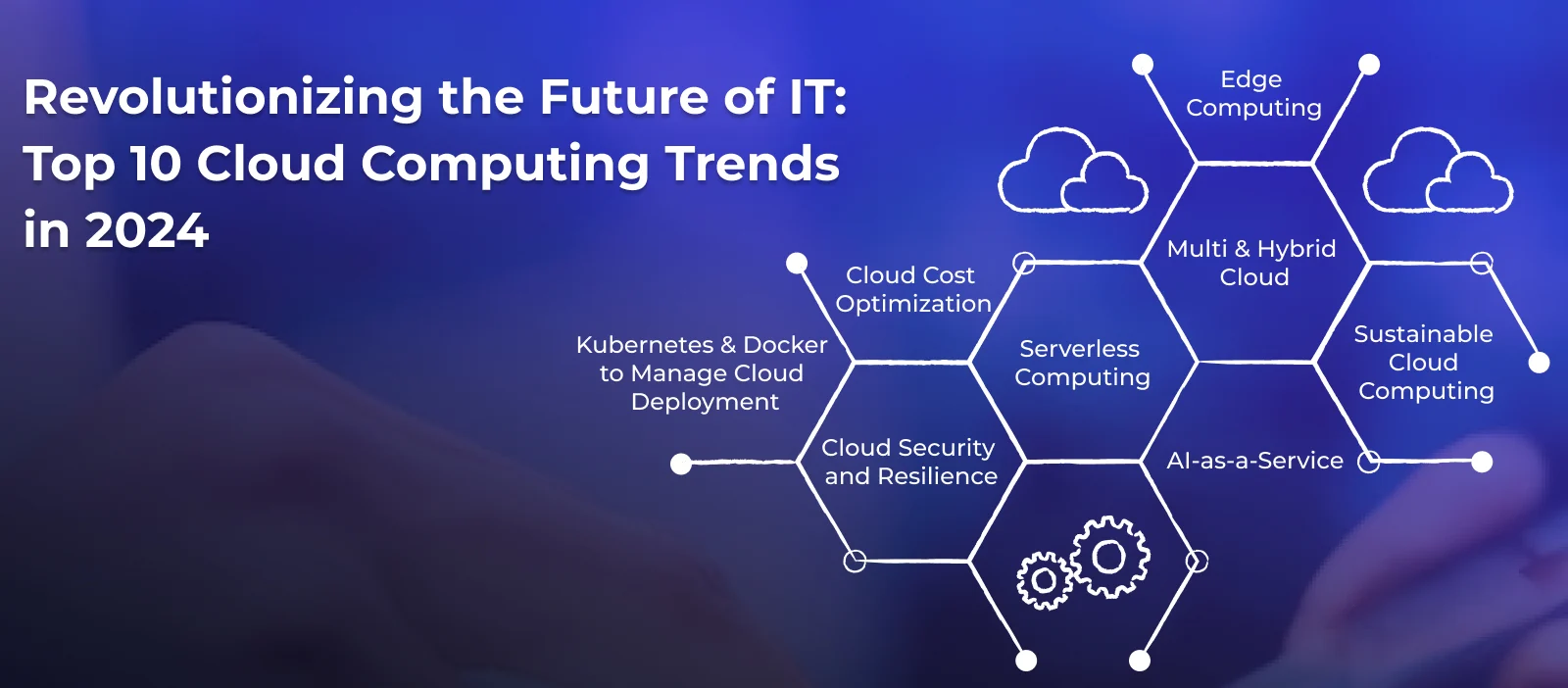
On the verge of enormous transformation, the cloud solution provider is reforming the businesses’ operations, imparting extraordinary scalability, flexibility, and price performance, with anticipation to spend over one trillion dollars for the first time. This investment brings about improvements that might revolutionize industries worldwide. Cloud computing will keep developing in upcoming years as companies continue to leverage the economies and services cloud carriers provide. So, it’s time to discover the Top cloud computing trends of 2024.

Top 8 Cloud Computing Trends in 2024
AI-as-a-Service
AI is revolutionizing various industries globally with the cloud playing a crucial role in enabling AI to be accessible to businesses worldwide. Gen AI models, like ChatGPT, are trained on large pieces of data and require significant computing power. Now, companies can leverage powerful AI technologies like large language models without incurring hefty costs associated with training and housing these systems in-house. This trend is set to make AI more accessible and cost-effective for businesses of all sizes. So, AI-as-a-service through Cloud Solution Provider platforms will empower such organizations to leverage this transformative technology in the upcoming years.Edge Computing
Although edge computing isn’t a new concept, organizations worldwide are increasingly adopting it. The global computing market is said to grow, using USD 111.33 billion up to 2028, recording a CAGR of 15.7%. Area computing is said to become an imperative component of cloud computing, addressing bandwidth and latency problems with the aid of dispensing and processing data toward the user. It may help businesses improve reliability, optimize the overall performance, and deliver fast services.Sustainable Cloud Computing
The growth of green computing, called green IT, is expected in the upcoming years. Since organizations depend on the cloud for the operations, disaster recovery is a necessity for cloud computing. This trend has been pushed with the awareness that about 1.8% to 3.9% of worldwide greenhouse fuel emissions originate from the worldwide statistics and verbal exchange technology (ICT) zone. Computing that lacks experience reduces carbon emissions and electricity consumption inside the complete lifecycle of generation additives, from format to disposal reduces environmental impact. Cloud carriers invest in effective disaster restoration solutions that allow businesses to get over disruptions, including herbal disasters or cyberattacks. These solutions ensure enterprise continuity and decrease downtime. The provider vendors aim to acquire net-zero commitments in 2024. It could be done by decreasing customers’ carbon footprint and promoting greener cloud computing, keeping with international climate change efforts.Multi and Hybrid Cloud
Organizations with multi-cloud and hybrid strategies are predicted to grow next year. Based on the last survey, roughly 81% of organizations stated they were working with two or more providers. The hybrid and multi-cloud subsequent-gen infrastructure is expected to gain significant traction within the coming years as businesses are looking for stability, safety, and flexibility. These methods allow Organizations to distribute workloads across cloud companies and on-premises infrastructure. By leveraging the strengths of different cloud structures, organizations can optimize their operations as well as maintain manipulation of their data and applications.Serverless Computing
Serverless computing is expected to witness significant growth of 23.17% CAGR over 2023-2028. This method makes coding easier by allowing developers to concentrate solely on writing code without needing to manage the underlying infrastructure. It results in several benefits to developers, including faster time-to-market, scalability, and lower expenses for the deployment of new services. With the maturing of serverless computing, we can anticipate more widespread adoption across industries, with greater efficiency and reduced operational overhead.