


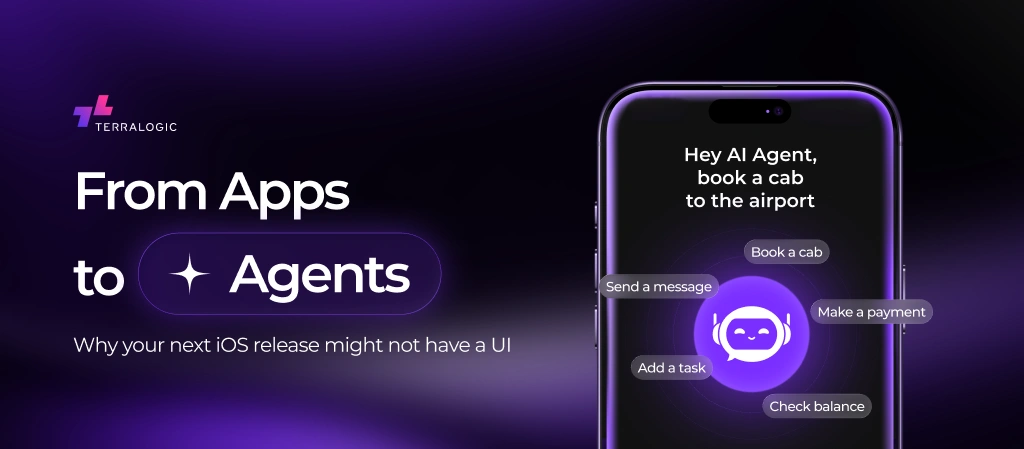
What happens when users no longer need to open an app to use what it offers?
For years, mobile applications have been built around a familiar interaction model: users open an app, navigate through its screens, and take an action. That model is beginning to change as AI assistants become capable of understanding requests and interacting with application capabilities directly.
Apple’s App Intents framework is one of the clearest examples of this shift. By exposing specific actions that Siri and other system experiences can invoke, an app can make its functionality available without requiring users to navigate through the traditional interface. Emerging agent-to-app protocols are taking the idea further by exploring how AI agents can discover and interact with capabilities across applications.
This shift has implications beyond the user interface. It affects how developers structure business logic, how applications expose their capabilities, how AI systems discover those capabilities, and how product teams think about engagement, trust, and monetization.
In this guide, we will look at how AI agents for mobile app development are changing the role of the mobile app, from App Intents and agent-to-app interaction to application architecture and capability discovery. We will also examine what this means for developers and product teams as AI-driven interactions become a more practical part of mobile experiences.
Why this isn’t just theoretical
It is easy to think of AI agents in mobile apps as a future trend. However, the underlying technologies are already being integrated into real mobile development. App Intents can expose application actions to Siri and system experiences, while emerging agent-to-app protocols are exploring more direct interaction between AI systems and application capabilities.
The change matters because it affects more than how users interact with an app. It changes how developers build applications and how businesses think about the role an app plays in the customer journey.
- For users, friction is disappearing. Reordering groceries, checking a bank balance, or booking a ride traditionally requires opening an app and moving through several screens. When an app exposes the right capability, an AI assistant can potentially initiate that task from a single request.
- For engineers, architecture becomes more important. Teams that already separate business logic from UI code have an advantage because an App Intent or AI agent can become another caller of logic that already exists. Teams with tightly coupled UI and business logic may need considerably more work before their features can be exposed in this way.
- For businesses, app visibility is changing. The traditional model assumes that users discover an app, open it, and interact with its interface. In an agent-driven model, an AI may determine which app capability to use without the user ever seeing the application itself.
The important question is therefore not simply whether AI agents will matter to mobile apps. It is whether applications are being designed so their capabilities can participate in this new interaction model.
Apps become callable capabilities
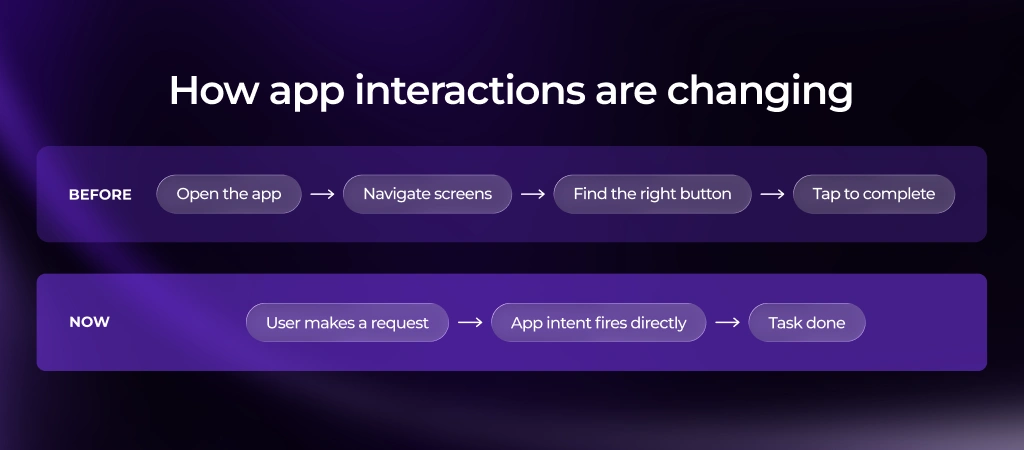
Consider how food delivery changed the relationship between customers and restaurants. A customer no longer needs to walk through a restaurant’s doors to access what the restaurant provides. The delivery platform exposes the restaurant’s underlying capability — preparing and fulfilling an order — through a different interface.
Apple’s App Intents framework introduces a similar idea for mobile applications. Developers can expose specific actions as named, callable capabilities that Siri, Shortcuts, and system experiences can invoke without requiring users to navigate through the application’s UI.
Consider a fitness app. Today, starting a run might involve opening the app, selecting a workout, and tapping a start button. An exposed App Intent can make the underlying action directly callable, allowing a user to request that a running workout begin without following the traditional screen-by-screen flow.
The architectural shift is important: the capability becomes more important than the screen used to access it. The UI remains valuable, but it is no longer necessarily the only interface through which functionality can be reached.
For developers exploring AI agents for mobile app development, this creates a new way to think about features. Instead of treating every capability as something that exists primarily for a particular screen, teams can consider whether the underlying action can be clearly defined and made available to other interaction channels.
Agent-to-app interaction
App Intents address system-level interactions, but the broader development of agentic AI for mobile app development raises another question: how can AI systems discover and interact with capabilities across different applications?
p>Model Context Protocol, or MCP, provides one useful way to understand this direction. Think of it like a universal power socket. Instead of creating a completely different connection between every AI system and every external tool, a common protocol can provide a consistent way for systems to discover and use capabilities.
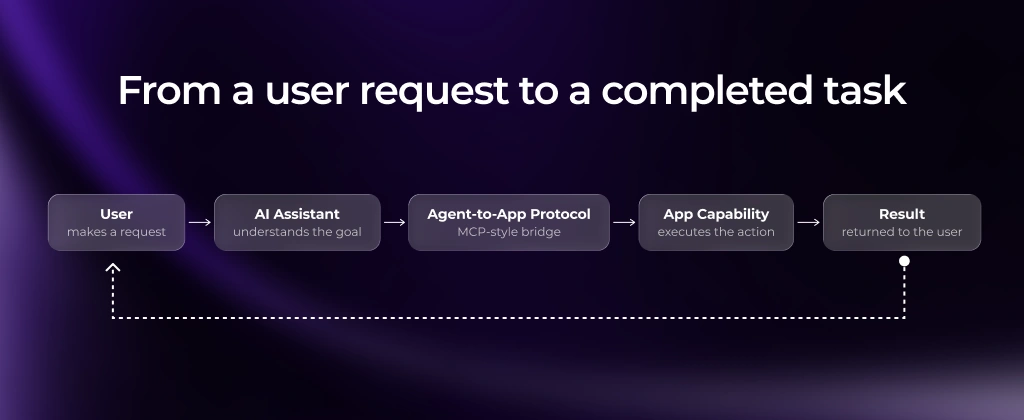
Emerging agent-to-app protocols are exploring a similar model for AI assistants and applications. Rather than requiring every integration to be manually connected, an AI system could discover that an application provides a particular capability and determine when that capability is relevant to a user’s request.
Imagine a user asking an AI assistant to compare delivery times across several services. Instead of opening each application, searching for the information, and comparing the results manually, the assistant could potentially discover the relevant capabilities and call them directly.
This changes the role of the mobile application. The app is no longer necessarily the destination where the user completes the task. It can become one of several capabilities that an AI agent coordinates to complete the task.
For developers, that means the application needs to be understandable not only to people but potentially to AI systems. The capability needs to be clearly defined, appropriately exposed, and capable of handling requests outside the assumptions of a traditional UI flow.
Architectural implications
A useful way to think about this change is to separate the capability from the interface used to access it.
The business logic of an application should not depend on whether a user reaches it through a button, Siri, an App Intent, or an AI agent. When those layers are properly separated, the same underlying operation can support multiple interaction models.

Clean Architecture already provides a natural place for this separation. The Use Case layer describes what the application can actually do without tying that capability to a particular UI.
Consider a SendMoneyUseCase or AddExpenseUseCase. If the business logic is properly isolated, a traditional screen can call it today while an App Intent or AI agent can become another caller tomorrow. The underlying logic does not need to understand who initiated the request.
This is where the mobile app development AI agent discussion becomes an architectural discussion as much as an AI discussion. The teams best positioned for agent-driven experiences may not necessarily be the teams with the most AI code. They may be the teams whose existing architecture already exposes clean, reusable capabilities.
For teams considering AI agents for mobile app development 2026, the architectural question is increasingly practical: Can this business capability be called independently of the UI?
If the answer is yes, exposing a new interaction channel may require relatively little additional work. If the answer is no, the move toward AI can expose technical debt that already exists within the application.
A new kind of app discoverability
App discovery has traditionally been built around human behavior. A person searches the App Store, finds an application, installs it, opens it, and then looks for the feature they need.
AI-driven capability discovery introduces another model. Instead of asking “Which app should I download?”, a user can ask an AI to complete a task, and the AI determines which available capability can fulfill that request.

That creates a different form of discoverability.
Developers may need to think beyond App Store optimization and consider whether an AI system can correctly understand what their application is capable of doing. App Intents definitions, metadata, structured descriptions, and clear capability naming can all become part of that equation.
This is where the concept of capability SEO becomes useful. Traditional SEO helps search engines understand web content. Capability-oriented optimization is about making an application’s functionality sufficiently clear and structured for an AI system to identify and invoke the right capability.
An application can therefore have an excellent interface and still be difficult for an AI agent to discover if its capabilities are poorly defined.
As AI agents in mobile apps future trends develop, capability discoverability could become a discipline of its own. Product teams may eventually evaluate not only whether users can find a feature, but whether AI assistants can correctly identify, understand, and invoke that feature.
The competitive question may shift from “Can users find our app?” to “Can an AI find the capability our app provides?”
The design and business challenge
The technical opportunity comes with a significant product challenge: what happens when users complete tasks without seeing the application?
If an AI agent completes a task on behalf of the user, the application may lose several interactions that traditionally happened inside its interface. This does not necessarily make the experience worse, but it changes where the product needs to create value.
That can affect four areas in particular:
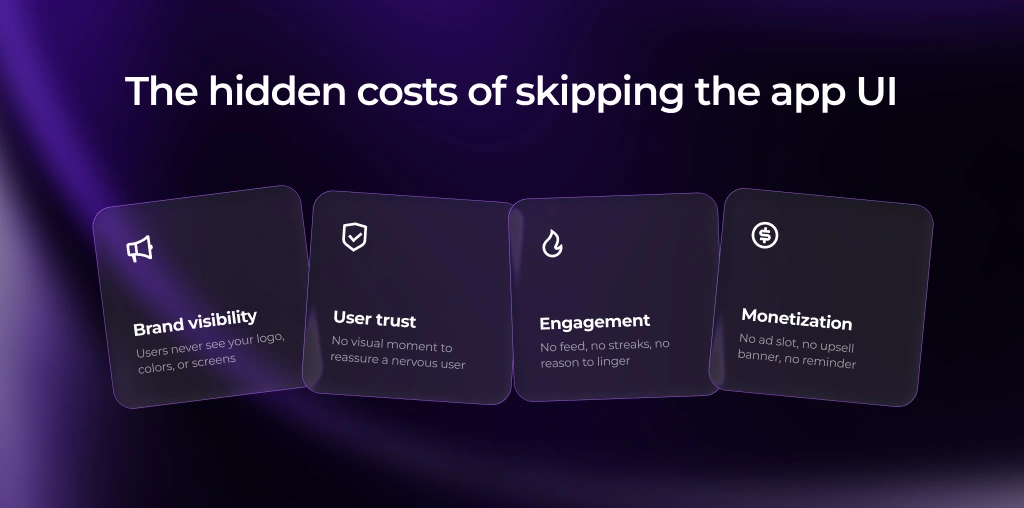
- Brand visibility — the user may never see the application’s interface.
- Trust-building — there may be fewer visual cues that reassure the user before an important action.
- Engagement — the user may no longer browse, explore, or return to the application simply to complete a task.
- Monetization — advertising, upsells, subscriptions, and other screen-based mechanisms may not translate directly to agent-driven interactions.
This means product teams cannot treat agent-driven interaction as simply another distribution channel. They need to consider how the brand, trust model, and business model work when the UI is no longer guaranteed to be part of the interaction.
For teams exploring AI agents for mobile app design, the challenge is therefore not simply creating an AI-accessible feature. It is designing an experience that remains understandable, trustworthy, and commercially viable when the interface becomes optional.
The words you’ll keep hearing
As AI becomes more involved in mobile app development, developers will encounter a number of terms that describe different parts of this shift. Some refer to specific Apple technologies, while others describe architectural patterns or new ways for AI systems to interact with applications.
Understanding these terms makes the broader change easier to follow. The following concepts appear throughout the discussion around AI agents, callable app capabilities, and the move beyond traditional UI-driven interactions.
- App Intents — Apple’s framework for exposing specific app actions as callable capabilities that Siri and system experiences can trigger directly.
- MCP (Model Context Protocol) — an open protocol designed to provide a consistent way for AI systems to discover and interact with external tools and capabilities.
- Agent-to-app protocol — a standardized mechanism that allows an AI agent to discover and interact with capabilities provided by an application.
- Use Case layer — the part of an application architecture that contains business logic independently of the UI, making that logic reusable across different callers.
- Capability SEO — the practice of describing an application’s capabilities clearly enough for AI systems to discover and understand them.
- Headless interaction — completing a task through an application’s underlying capability without requiring the user to interact with its traditional UI.
- Zero-UI — an interaction model where the interface becomes secondary to voice, automation, or AI-driven task completion.
Old way vs. new way
The shift toward AI agents for mobile apps becomes easier to understand when we compare it with the way mobile applications have traditionally been built and used.
In the traditional model, the application interface is the main gateway to its functionality. Users find the app, open it, navigate through its screens, and interact with the features they need. In an agent-driven model, the user can describe what they want first, while an AI system identifies and invokes the capability that can complete the task.
This does not make the traditional app model obsolete. Instead, it introduces another way for users and systems to access the same underlying functionality.

The difference is not simply a change in interface. The traditional model is app-first: the user finds the application and then finds the capability. The emerging model can be capability-first: the user describes the task, and an AI system determines which capability can complete it.
The dilemma: why this isn’t a simple win
As AI agents become more involved in mobile app experiences, the shift creates both opportunities and practical challenges. The main considerations for mobile teams are:
- Less control over presentation — When an AI delivers the result instead of the application’s interface, product teams have less control over how the information is presented and experienced.
- A new attack surface — App capabilities exposed to AI agents need appropriate authorization, validation, and input handling. A capability that was designed around a trusted UI flow may introduce new risks when accessed by another system.
- New challenges for monetization — Advertising, upsells, engagement features, and other screen-based business models may not translate directly to headless interactions. Product teams need to reconsider where commercial interactions happen when users may never open the app.
- Discoverability is changing — AI systems need to understand what an application can do before they can use its capabilities. As agent-to-app standards continue to develop, developers will need to think about how capabilities are described, structured, and made discoverable.
Why this matters if you’re new to iOS development
For developers starting with iOS, the most useful lesson may not be about AI at all. It is about separating what an application does from how a person interacts with it.
A feature whose business logic is independent of its UI can be reused through different interaction channels. A user can trigger it through a button today, an App Intent tomorrow, and potentially an AI agent later.
Building that separation from the beginning is considerably easier than trying to extract business logic from tightly coupled UI code after the application has already grown. As AI agents mobile apps 2026 become a more practical development consideration, this architectural discipline can make applications easier to extend regardless of which interaction model ultimately becomes dominant.
For developers entering this space, the goal should not be to predict exactly which AI protocol will win. It is to build applications with enough separation and flexibility that they can adapt as those protocols evolve.
Conclusion
AI is changing the way users interact with mobile applications, but that does not necessarily mean mobile apps are going away. The more significant shift is that the interface may no longer be the only way users access an application’s capabilities.
App Intents and emerging agent-to-app protocols are moving applications toward a model where specific capabilities can be discovered and invoked by systems beyond the traditional UI. For developers, this makes application architecture increasingly important. Business logic that is separated from the interface can support different interaction models, while clearly defined capabilities can make an application easier for AI systems to discover and use.
The change also has implications for product strategy. When an AI agent can complete a task without opening the application, teams need to reconsider how they approach discoverability, user trust, engagement, and monetization. The focus is no longer only on building better interfaces, but also on making the capabilities behind those interfaces accessible, reliable, and ready for new forms of interaction.
For organizations exploring AI agents for mobile app development, the priority should be to understand how these technologies fit into the existing product and architecture rather than adopting them simply because they are new. A well-structured application can continue supporting traditional interfaces while giving teams the flexibility to adapt as AI-driven experiences evolve.
The future of mobile development may not be about building fewer interfaces. It may be about building applications whose capabilities can work beyond the interface.
Considering AI agents for your mobile application? Talk to Terralogic’s technology experts about your application architecture and how to prepare your product for AI-driven experiences.
Frequently Asked Questions (FAQs)
1. What is an AI agent for mobile apps?
An AI agent for mobile apps is an AI system that can understand a user’s request and interact with an application’s capabilities to complete a task. Instead of requiring the user to navigate through screens, the agent can potentially identify and invoke the appropriate application action.
App Intents and emerging agent-to-app protocols are examples of technologies moving mobile experiences toward this model.
2. Will AI agents replace mobile apps?
AI agents are unlikely to simply replace mobile apps. Instead, they may change how users access the capabilities provided by those apps.
A user may not always need to open an application to complete a particular task, but the underlying application can still provide the business logic, data, services, and capabilities required to complete it. The more significant shift is from app-first interaction to capability-first interaction.
3. What are AI agents in mobile apps used for?
AI agents can potentially be used to complete tasks that traditionally require users to navigate through multiple screens. Examples include booking services, checking information, managing expenses, sending messages, starting workouts, or interacting with other application functions.
The specific capabilities depend on what the application exposes and what the operating system or agent-to-app protocol allows the AI system to access.
4. How do AI agents affect mobile app architecture?
AI agents make separation between business logic and UI increasingly valuable. If business logic is tightly coupled to screens or ViewModels, exposing that functionality to another caller can require significant changes.
With a clean architecture, a Use Case can potentially be called by a traditional UI, an App Intent, or an AI agent without changing the underlying business logic. This makes architectural decoupling an important consideration for AI agents for mobile app development.
5. What is the future of AI agents in mobile apps?
The direction is moving toward applications whose capabilities can be discovered and invoked without requiring users to navigate the traditional interface. App Intents, agent-to-app protocols, and structured capability descriptions are early examples of this model.
The long-term outcome is still developing, but mobile teams can prepare by separating business logic from the UI, clearly defining capabilities, and considering how their applications can participate in AI-driven workflows.