


What happens after someone clicks “Accept All” on your cookie banner?
For many organizations, that’s where the conversation about privacy ends. In reality, it’s where the responsibility begins. Every customer interaction, employee record, marketing campaign, and AI-powered application depends on personal data. Managing that data responsibly has become a business requirement, not just a legal obligation.
As privacy regulations continue to expand worldwide, organizations are expected to do more than protect data from cyberattacks. They must understand what personal data they collect, why they collect it, how long they keep it, who they share it with, and whether every processing activity complies with applicable laws. Customers, regulators, and business partners increasingly expect organizations to answer these questions with confidence.
Data privacy provides the governance framework for meeting those expectations. It helps organizations establish clear rules for handling personal information, reduce regulatory risk, strengthen customer trust, and support responsible innovation, including the adoption of AI.
This guide explains what data privacy is, how it differs from data security, the core privacy principles organizations should follow, the global privacy regulations shaping business today, and the practical steps enterprises can take to build a sustainable data privacy program.
Key takeaways
- Data privacy governs how organizations collect, use, share, retain, and delete personal information while respecting individuals’ rights.
- Data privacy, data security, and data protection are closely related but serve different purposes and should not be used interchangeably.
- Privacy regulations now extend far beyond GDPR, with laws in the EU, United Kingdom, United States, Brazil, India, Vietnam, and many other jurisdictions.
- A successful data privacy program is built on principles such as transparency, lawful processing, purpose limitation, data minimization, and accountability.
- Modern privacy risks include AI-driven data processing, third-party vendors, cross-border data transfers, and evolving regulatory requirements.
- Building an enterprise data privacy program requires continuous governance, documented processes, and privacy-by-design rather than a one-time compliance effort.
What Is Data Privacy?
Data privacy is the practice of governing how personal data is collected, used, stored, shared, and deleted. It gives individuals the right to control how their personal information is handled while requiring organizations to process that data lawfully, transparently, and only for legitimate purposes.
Personal data includes any information that can identify an individual, either directly or indirectly. This includes names, email addresses, phone numbers, IP addresses, device identifiers, location data, financial information, health records, biometric data, and online activity that can be linked to a specific person.
Although the terms are often used interchangeably, data privacy, data security, and data protection have different meanings. Data privacy defines how personal data should be collected and used, data security focuses on protecting data from unauthorized access and cyber threats, and data protection is the broader discipline that combines both privacy and security to safeguard personal information.
This distinction is important because complying with privacy regulations requires more than implementing technical security controls. Organizations must also establish policies, governance processes, and accountability measures to ensure personal data is handled responsibly throughout its lifecycle.
The Global Data Privacy Law Landscape in 2026
Data privacy has evolved into a global business requirement. While the European Union’s GDPR helped establish many of today’s privacy standards, organizations are now expected to comply with a growing number of regulations across different countries and regions. As businesses expand internationally, understanding how these laws differ has become an important part of managing privacy and compliance risks.
Although each regulation has its own legal requirements, most share common goals: protecting personal data, increasing transparency, giving individuals more control over their information, and holding organizations accountable for how they collect and process personal data.
1. General Data Protection Regulation (GDPR)
The General Data Protection Regulation (GDPR) is the European Union’s primary data privacy law and is widely regarded as the global benchmark for privacy legislation. It applies to organizations that process the personal data of individuals in the EU, regardless of where the organization is located. GDPR introduced many concepts that have since been adopted worldwide, including lawful processing, data subject rights, privacy by design, and organizational accountability.
2. UK GDPR
Following Brexit, the United Kingdom retained most GDPR requirements through the UK GDPR and the Data Protection Act 2018. Although the framework remains largely aligned with the EU GDPR, organizations operating in both jurisdictions should understand the differences in regulatory oversight, international data transfers, and reporting obligations. Businesses serving customers in both regions often need to comply with both frameworks simultaneously.
3. California Consumer Privacy Act (CCPA) and California Privacy Rights Act (CPRA)
The CCPA and its amendment, the CPRA, are among the most influential privacy laws in the United States. They give California residents greater control over their personal information by allowing them to know what data organizations collect, request its deletion or correction, and opt out of certain data-sharing activities. Because many organizations operate nationwide, these laws have influenced privacy practices well beyond California.
4. State Privacy Laws in the United States
Unlike the European Union, the United States does not have a single federal privacy law that applies across the country. Instead, individual states have introduced their own comprehensive privacy regulations, each with different thresholds, consumer rights, and compliance obligations. Organizations operating in multiple states often need a unified privacy program that can satisfy the requirements of several state laws at the same time.
5. Lei Geral de Proteção de Dados (LGPD)
Brazil’s Lei Geral de Proteção de Dados (LGPD) establishes a comprehensive framework for protecting the personal data of individuals in Brazil. Similar to GDPR, it requires organizations to have a lawful basis for processing personal data, respect individuals’ privacy rights, and implement appropriate safeguards to protect personal information. The regulation applies to organizations both inside and outside Brazil when they process the personal data of Brazilian residents.
6. Digital Personal Data Protection (DPDP) Act
India’s Digital Personal Data Protection (DPDP) Act provides a national framework for collecting and processing digital personal data. It introduces responsibilities for organizations, known as data fiduciaries, while giving individuals greater control over how their personal information is used. The law reflects India’s growing focus on strengthening privacy governance as digital services continue to expand.
7. Personal Data Protection Act (PDPA)
Malaysia’s amended Personal Data Protection Act (PDPA) strengthens the country’s existing privacy framework by introducing enhanced compliance requirements and stronger enforcement mechanisms. The updated law also expands organizations’ responsibilities for protecting personal data and responding to privacy incidents, bringing Malaysia’s privacy framework closer to international standards.
8. Personal Data Protection Law (PDPL)
Vietnam’s Personal Data Protection Law (PDPL) establishes comprehensive requirements for collecting, processing, storing, transferring, and protecting personal data. It places greater emphasis on transparency, consent, accountability, and cross-border data transfers, requiring organizations to adopt stronger governance practices when handling personal information. For organizations operating in Vietnam, PDPL has become a key component of broader cybersecurity and compliance programs.
9. EU AI Act
The EU AI Act is not a data privacy law, but it has significant implications for organizations that develop or use AI systems. It introduces governance requirements for AI applications based on their level of risk and works alongside GDPR whenever AI systems process personal data. Organizations adopting AI should therefore consider both regulations together to ensure their AI systems are transparent, accountable, and compliant with privacy requirements.
Core Data Privacy Principles Every Organization Must Follow
Although privacy laws vary across countries, most are built on the same fundamental principles. Whether an organization is complying with GDPR, CCPA, LGPD, India’s DPDP Act, or Vietnam’s PDPL, these principles provide a common foundation for collecting, using, and protecting personal data responsibly.
Rather than treating every regulation as a separate compliance project, organizations should build their privacy programs around these core principles. Doing so creates a governance framework that can adapt as new privacy laws and regulatory requirements emerge.
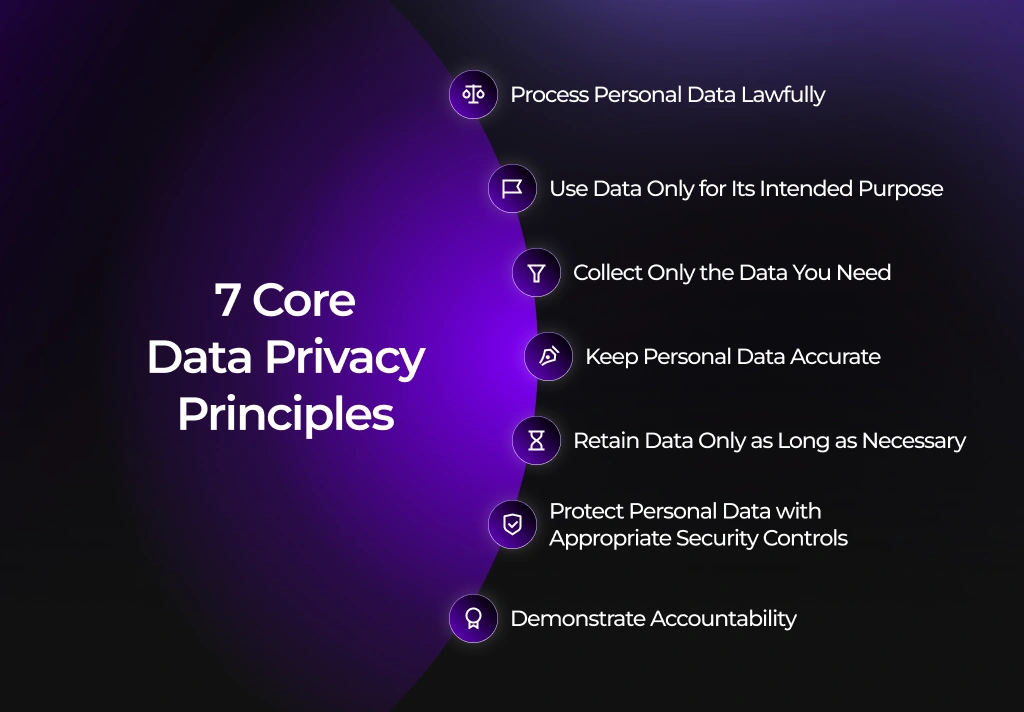
1. Process Personal Data Lawfully
Organizations should only collect and process personal data when they have a valid legal reason to do so. Depending on the applicable regulation, this may include obtaining consent, fulfilling a contract, complying with a legal obligation, or relying on another recognized legal basis.
Before collecting personal data, organizations should be able to answer a simple question: Why are we allowed to process this information? If that answer is unclear, the processing activity should be reviewed before it begins.
2. Use Data Only for Its Intended Purpose
Personal data should only be used for the purpose it was originally collected. If an organization wants to use that information for a different purpose, it should first determine whether the new use is compatible with the original purpose or whether a new legal basis is required.
For example, collecting a customer’s email address to process an order does not automatically allow that information to be used for marketing campaigns.
3. Collect Only the Data You Need
Organizations should avoid collecting personal data simply because it might become useful in the future. Instead, they should limit collection to the information necessary to achieve a clearly defined business purpose.
Collecting less data not only improves privacy compliance but also reduces the amount of sensitive information that could be exposed during a security incident.
4. Keep Personal Data Accurate
Personal data should remain accurate, complete, and up to date throughout its lifecycle. Organizations should establish processes that allow individuals to correct inaccurate information and ensure outdated records are updated or removed when appropriate.
Maintaining accurate data also improves business operations by reducing errors in customer service, decision-making, and reporting.
5. Retain Data Only as Long as Necessary
Personal data should not be stored indefinitely. Organizations should define retention periods based on legal, regulatory, and business requirements, then securely delete or anonymize data once it is no longer needed.
Regularly reviewing stored data helps reduce storage costs, minimize compliance risks, and limit the impact of potential data breaches.
6. Protect Personal Data with Appropriate Security Controls
Privacy depends on strong security. Organizations should implement technical and organizational measures that protect personal data from unauthorized access, loss, alteration, or disclosure.
Examples include encryption, multi-factor authentication, access controls, security monitoring, employee awareness training, and regular vulnerability assessments.
7. Demonstrate Accountability
Accountability means organizations should be able to demonstrate—not simply claim—that they comply with applicable privacy requirements. This includes maintaining documentation, assigning responsibilities, conducting privacy assessments, reviewing third-party vendors, and keeping records that support regulatory audits.
Among all the privacy principles, accountability is often the one that brings the others together. Organizations that document their decisions, monitor compliance, and continuously improve their privacy program are generally better prepared to meet regulatory expectations and respond to future changes.
The Business Case for Data Privacy in 2026
Data privacy is no longer viewed solely as a legal or compliance requirement. For many organizations, it has become a business capability that supports customer trust, operational resilience, and long-term growth. A well-managed privacy program helps organizations reduce regulatory risk while demonstrating that personal data is handled responsibly throughout its lifecycle.
As privacy expectations continue to rise, organizations that invest in privacy governance are finding that the benefits extend well beyond compliance.
1. Building Customer Trust
Customers increasingly want to know how their personal data is collected, used, and protected before they choose to do business with an organization. Clear privacy notices, transparent consent practices, and respect for individual privacy rights help build confidence and strengthen long-term customer relationships.
Organizations that make privacy part of their customer experience are often better positioned to earn trust and differentiate themselves in competitive markets.
2. Reducing Regulatory and Financial Risk
Privacy laws continue to expand across the world, bringing stricter enforcement and higher expectations for organizational accountability. Failing to comply can result in regulatory investigations, financial penalties, litigation, and reputational damage.
Investing in privacy governance helps organizations identify compliance gaps early, establish clear processes, and reduce the likelihood of costly violations or enforcement actions.
3. Strengthening Cybersecurity and Risk Management
Privacy and cybersecurity are closely connected. Organizations that understand what personal data they collect and where it is stored are better equipped to secure that information, respond to incidents, and limit the impact of data breaches.
Practices such as data minimization, access control, retention management, and vendor oversight improve both privacy compliance and overall cyber resilience.
4. Supporting Business Growth and Innovation
Privacy should not be viewed as a barrier to innovation. When organizations establish clear governance for collecting, sharing, and using personal data, they can adopt new technologies—including cloud services and AI—with greater confidence.
A mature privacy program enables business teams to innovate responsibly while ensuring new products and services are developed with privacy considerations built in from the beginning.
5. Creating Long-Term Business Value
Leading organizations increasingly view privacy as an investment rather than a cost. According to Cisco’s 2026 Data Privacy Benchmark Study, organizations with mature privacy programs reported an average return of $2.70 for every $1 invested in privacy. Benefits included reduced breach costs, improved operational efficiency, stronger customer trust, and better support for business growth.
As privacy regulations and customer expectations continue to evolve, organizations that embed privacy into governance, technology, and everyday business processes will be better positioned to manage risk and maintain a competitive advantage.
The 5 Biggest Data Privacy Risks Enterprises Face in 2026
As organizations collect more personal data and adopt cloud services, AI, and third-party platforms, managing privacy has become increasingly complex. Many privacy incidents today are not caused by a single technical failure but by gaps in governance, unclear responsibilities, or the misuse of personal data.
Understanding the most common privacy risks helps organizations strengthen their privacy programs before those risks become security incidents or regulatory violations.
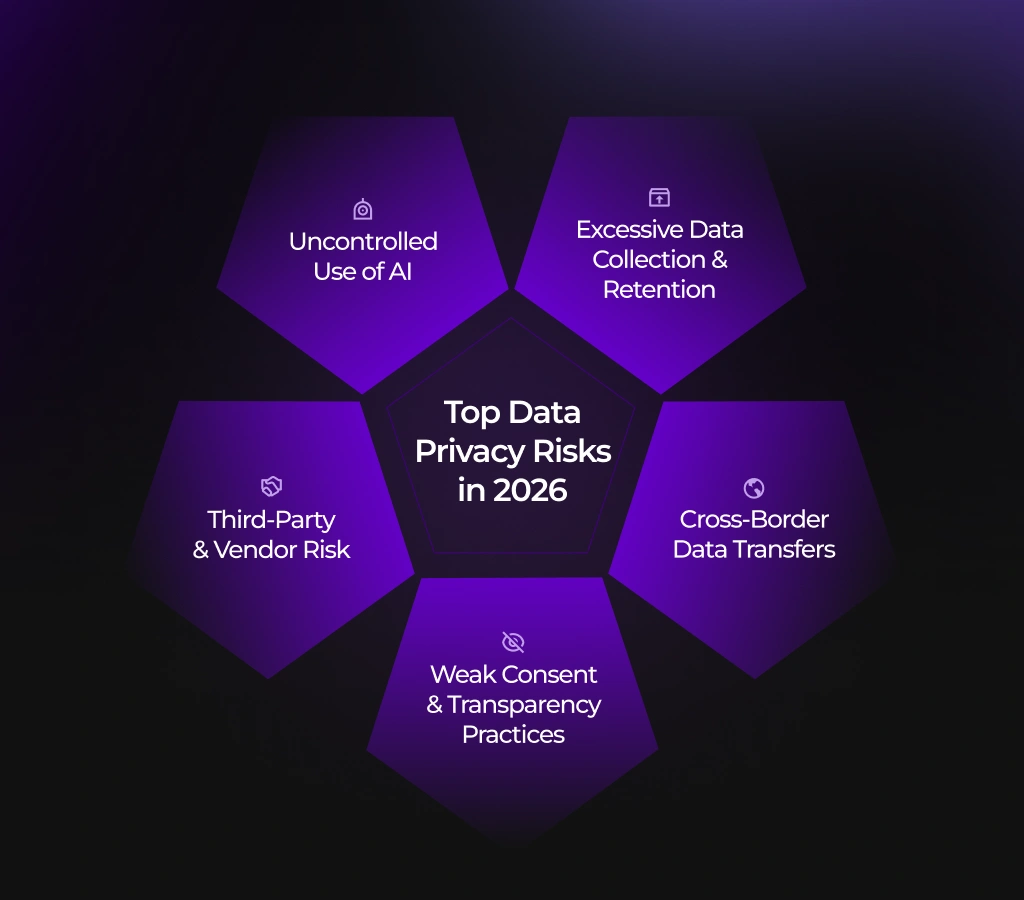
1. Uncontrolled Use of AI
AI tools are rapidly becoming part of everyday business operations, but they can also introduce new privacy risks. Employees may unintentionally upload confidential or personal information into public AI services, while organizations may use personal data to train AI models without a clear legal basis or appropriate governance.
To reduce these risks, organizations should establish AI governance policies, define acceptable use, and evaluate how AI systems collect, process, and retain personal data before they are deployed.
2. Third-Party and Vendor Risk
Many organizations rely on cloud providers, SaaS platforms, payroll services, marketing tools, and other vendors to process personal data. While these services improve efficiency, they also increase privacy risk because organizations remain responsible for how their vendors handle personal information.
Regular vendor assessments, Data Processing Agreements (DPAs), and ongoing monitoring help ensure third parties maintain appropriate privacy and security standards.
3. Cross-Border Data Transfers
Modern organizations frequently transfer personal data between countries through cloud services, global business operations, or international partners. These transfers may be subject to legal restrictions depending on where the data originates and where it is processed.
Organizations should understand applicable transfer requirements and ensure appropriate safeguards are in place before personal data is transferred across jurisdictions.
4. Weak Consent and Transparency Practices
Privacy notices, cookie banners, and consent forms are often the first interaction individuals have with an organization’s privacy program. If these mechanisms are unclear, misleading, or difficult to understand, organizations risk losing user trust and failing to meet regulatory expectations.
Providing transparent information and giving individuals meaningful choices about how their personal data is used are essential components of an effective privacy program.
5. Excessive Data Collection and Retention
Many organizations continue to collect more personal data than necessary and retain it long after its original purpose has been fulfilled. Over time, this increases storage costs, expands the organization’s attack surface, and creates unnecessary compliance obligations.
Regularly reviewing what data is collected, how long it is retained, and whether it is still needed helps reduce both privacy and cybersecurity risks while supporting compliance with modern privacy regulations.
Data Privacy Maturity: How Mature Is Your Privacy Program?
Building a data privacy program is a gradual process. Most organizations don’t achieve mature privacy governance overnight. Instead, they improve over time by establishing policies, documenting data processing activities, strengthening governance, and embedding privacy into everyday business operations.
Understanding your organization’s current level of privacy maturity can help identify gaps, prioritize improvements, and build a roadmap toward long-term compliance.
Level 1: Ad Hoc
Privacy activities are reactive rather than planned. The organization responds to privacy incidents or regulatory requests as they arise but has no formal privacy program, documented policies, or clear ownership of privacy responsibilities.
Organizations at this stage often struggle to understand what personal data they hold or where it is stored, making compliance difficult.
Level 2: Developing
Basic privacy practices have been introduced, such as privacy notices, consent mechanisms, and procedures for handling data subject requests. However, these activities are often managed manually and vary across departments.
While this level may satisfy some immediate compliance needs, the lack of consistent governance makes it difficult to scale as the organization grows.
Level 3: Defined
Privacy responsibilities, policies, and procedures are formally documented and applied consistently across the organization. Data inventories are maintained, vendor risk is managed, employee training is delivered regularly, and privacy assessments become part of normal business processes.
At this stage, organizations have established a structured privacy program rather than relying on individual teams or isolated compliance efforts.
Level 4: Managed
Privacy becomes integrated into business operations and technology projects. New products and services follow privacy-by-design principles, performance metrics are monitored, and privacy risks are reviewed regularly as part of governance and risk management activities.
Organizations at this level treat privacy as an ongoing business function rather than a regulatory requirement.
Level 5: Optimized
Privacy is embedded throughout the organization’s culture and decision-making processes. Compliance activities are continuously improved, many privacy processes are automated, and privacy becomes a competitive advantage that strengthens customer trust and supports responsible innovation.
Rather than reacting to new regulations, organizations continuously adapt their privacy program as business needs, technologies, and legal requirements evolve.
How to Build a Data Privacy Program: 7 Essential Steps
Building a data privacy program is about creating repeatable processes that protect personal data throughout its lifecycle. Rather than treating privacy as a one-time compliance project, organizations should establish governance practices that evolve alongside new business activities, technologies, and regulatory requirements.
The following seven steps provide a practical foundation for developing a privacy program that supports compliance, reduces risk, and strengthens customer trust.
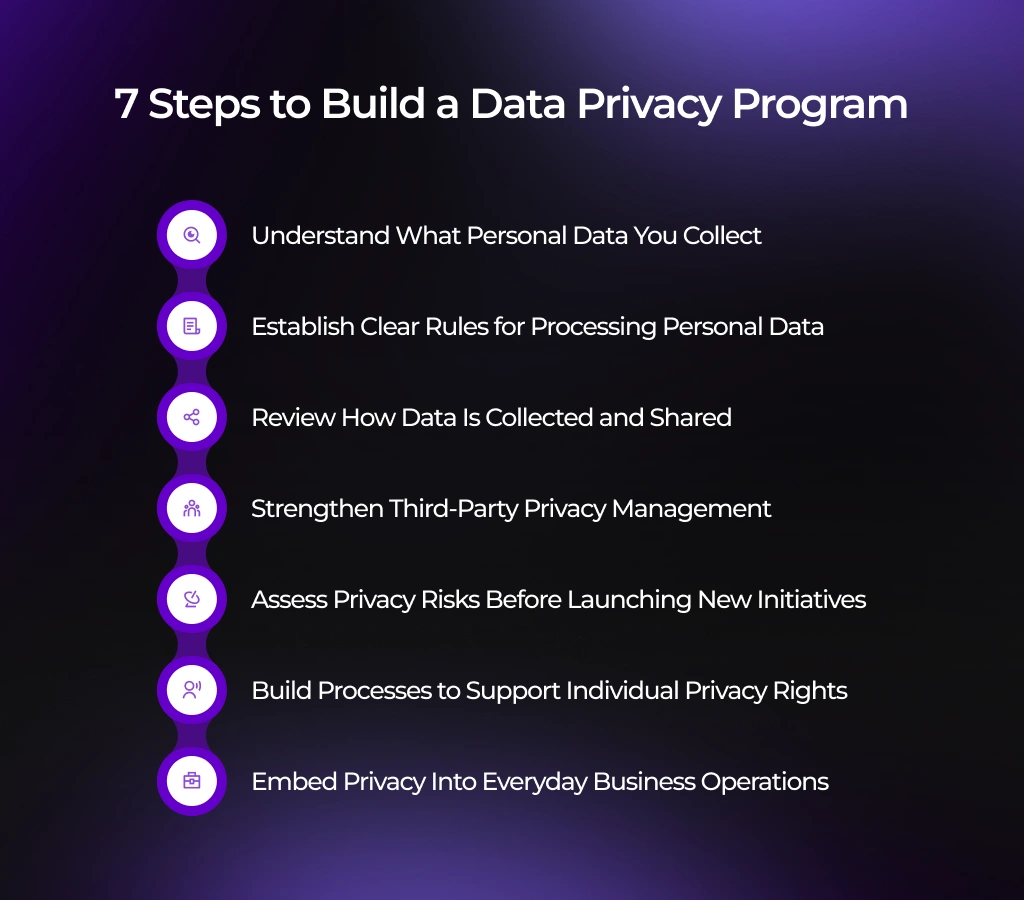
1. Understand What Personal Data You Collect
The first step is identifying what personal data your organization collects, where it comes from, why it is processed, who has access to it, and how long it is retained. This process, often called data mapping, creates a complete picture of how personal data flows across the organization.
Without this visibility, it becomes difficult to respond to data subject requests, assess privacy risks, or demonstrate compliance during an audit. Maintaining an accurate data inventory also provides the foundation for every other privacy activity.
2. Establish Clear Rules for Processing Personal Data
Once personal data has been identified, organizations should define how it can be collected, used, shared, retained, and deleted. Every processing activity should have a documented purpose and comply with applicable privacy regulations and internal policies.
Establishing clear governance rules helps ensure personal data is handled consistently across departments while reducing the risk of unauthorized or unnecessary processing.
3. Review How Data Is Collected and Shared
Organizations should regularly evaluate every point where personal data is collected, including websites, mobile applications, customer portals, marketing campaigns, and employee systems. Privacy notices, consent mechanisms, and cookie banners should clearly explain how personal data will be used and provide individuals with meaningful choices.
This review should also include how personal data is shared internally and with external partners to ensure those activities remain transparent and appropriate.
4. Strengthen Third-Party Privacy Management
Most organizations rely on external vendors to process or store personal data. Cloud providers, payroll services, CRM platforms, and marketing tools all introduce additional privacy risks that should be actively managed.
Vendor assessments, contractual agreements, and regular reviews help ensure third parties meet the organization’s privacy and security expectations throughout the relationship.
5. Assess Privacy Risks Before Launching New Initiatives
Privacy should be considered during the planning stage of new systems, products, and business processes rather than after deployment. Projects involving sensitive personal data, large-scale monitoring, or AI-powered decision-making should undergo structured privacy assessments before implementation.
Identifying potential risks early allows organizations to design appropriate safeguards before personal data is processed.
6. Build Processes to Support Individual Privacy Rights
Organizations should establish clear procedures for handling requests from individuals who want to access, correct, delete, or transfer their personal data. These processes should define responsibilities, response timelines, and verification steps so requests can be handled consistently and efficiently.
Well-defined workflows not only support regulatory compliance but also improve the customer experience by making privacy rights easier to exercise.
7. Embed Privacy Into Everyday Business Operations
A successful privacy program depends on people as much as technology. Employees should receive regular privacy training, business teams should understand their responsibilities when handling personal data, and privacy considerations should be integrated into system design, procurement, and project planning.
When privacy becomes part of everyday decision-making rather than a separate compliance activity, organizations are better prepared to adapt to new regulations, emerging technologies, and evolving customer expectations.
Conclusion
Data privacy has become a fundamental part of how modern organizations operate. As businesses collect more personal data, expand across jurisdictions, and adopt technologies such as cloud computing and AI, protecting personal information is no longer just a compliance exercise—it is a core element of responsible business governance.
Building an effective data privacy program requires more than implementing security controls or meeting regulatory requirements. Organizations need clear governance, well-defined processes, ongoing employee awareness, and a commitment to handling personal data transparently throughout its lifecycle. By embedding privacy into everyday operations, organizations can reduce risk, strengthen customer trust, and remain prepared for evolving regulatory expectations.
Need help building or strengthening your data privacy program? Terralogic’s cybersecurity experts help organizations establish privacy governance, assess privacy risks, implement privacy-by-design practices, and achieve compliance with regulations such as GDPR, PDPL, CCPA/CPRA, LGPD, and other global data privacy frameworks. Contact our team to learn how we can help your organization build a scalable, resilient, and compliance-ready data privacy program.
Frequently Asked Questions (FAQs)
1. What is data privacy?
Data privacy is the practice of governing how personal data is collected, used, stored, shared, and deleted. It gives individuals greater control over how their personal information is handled while requiring organizations to process that data lawfully, transparently, and only for legitimate purposes. A strong data privacy program combines governance, policies, and operational processes to ensure personal data is managed responsibly throughout its lifecycle.
2. What is the difference between data privacy and data security?
Data privacy focuses on how personal data should be collected and used, including who can access it, why it is processed, and how individuals can exercise their privacy rights. Data security focuses on how personal data is protected from unauthorized access, loss, theft, or cyberattacks through technical and organizational safeguards such as encryption, access controls, and monitoring. Organizations need both to effectively protect personal information and comply with modern privacy regulations.
3. What are the main data privacy laws in 2026?
Some of the most influential data privacy laws include the General Data Protection Regulation (GDPR) in the European Union, the UK GDPR, the California Consumer Privacy Act (CCPA) and California Privacy Rights Act (CPRA), Brazil’s Lei Geral de Proteção de Dados (LGPD), India’s Digital Personal Data Protection (DPDP) Act, Malaysia’s Personal Data Protection Act (PDPA), and Vietnam’s Personal Data Protection Law (PDPL). Organizations operating across multiple jurisdictions should understand which regulations apply to their business and build privacy programs that can support compliance across different legal frameworks.
4. Why is data privacy important for businesses?
Data privacy helps organizations protect personal information, comply with legal requirements, and strengthen customer trust. A well-designed privacy program also reduces regulatory and operational risks, improves data governance, and enables organizations to adopt new technologies such as cloud services and AI more responsibly. Beyond compliance, strong privacy practices can enhance brand reputation and provide a competitive advantage by demonstrating a commitment to responsible data management.