

Your organization may have strong cybersecurity controls, a mature compliance program, and a well-defined incident response plan. But if a critical vendor is breached, suffers an outage, or fails to meet regulatory requirements, your business could still face operational disruption, financial loss, and regulatory scrutiny.
This is why vendor risk management has become a board-level priority. Modern organizations rely on hundreds of third-party vendors, from cloud providers and payment processors to AI platforms and outsourced service providers. Each relationship introduces potential risks that must be identified, assessed, and monitored throughout the vendor lifecycle.
At the same time, regulations such as GDPR, DORA, NIS2, HIPAA, and the EU AI Act are placing greater responsibility on organizations to oversee the vendors they depend on. In many cases, organizations can be held accountable for compliance failures that originate within their third-party ecosystem.
A vendor risk management program provides a structured approach to managing these risks. It helps organizations evaluate vendors before onboarding, establish appropriate contractual safeguards, continuously monitor vendor performance, and respond effectively when issues arise.
In this guide, we’ll explain what a vendor risk management program is, why it matters in 2026, the key types of third-party risk, how to classify vendors by risk level, the 6 step vendor risk management lifecycle, and the regulations, tools, and best practices that support a successful program.
Key Takeaways
- A vendor risk management program helps organizations identify, assess, monitor, and mitigate risks introduced by third-party vendors throughout the vendor lifecycle.
- Third-party risk is expanding beyond cybersecurity to include operational, compliance, financial, reputational, concentration, and AI-related risks.
- Regulations such as GDPR, DORA, NIS2, HIPAA, and the EU AI Act are increasing the need for formal vendor oversight programs.
- Vendor tiering helps organizations apply the right level of due diligence and monitoring based on vendor criticality and risk exposure.
- Effective vendor risk management requires continuous monitoring, not just onboarding assessments or annual questionnaires.
What Is a Vendor Risk Management Program?
A Vendor Risk Management (VRM) program is a structured process for identifying, assessing, monitoring, and mitigating risks introduced by third-party vendors. It covers the entire vendor lifecycle, from due diligence before onboarding to ongoing monitoring, contract management, and eventual offboarding.
The goal of a VRM program is not to eliminate vendor relationships. Instead, it helps organizations understand which vendors create the greatest risk and ensure appropriate controls are in place before problems affect the business.
Why Vendor Risk Management Matters
Every vendor relationship introduces some level of risk to the organization. While cybersecurity often receives the most attention, vendor-related risks can also affect business operations, regulatory compliance, financial performance, legal obligations, and brand reputation.
As organizations become more dependent on cloud providers, SaaS platforms, outsourcing partners, and AI vendors, a single vendor failure can have far-reaching consequences. An effective vendor risk management program helps organizations identify these risks early, evaluate their potential impact, and implement controls before they become business disruptions.
Types of Risks Introduced by Vendors
Every vendor relationship introduces some level of risk. Depending on the services provided, a vendor may have access to sensitive data, critical systems, business operations, or customer information. As a result, organizations need to assess vendor risks from multiple perspectives rather than focusing solely on cybersecurity.
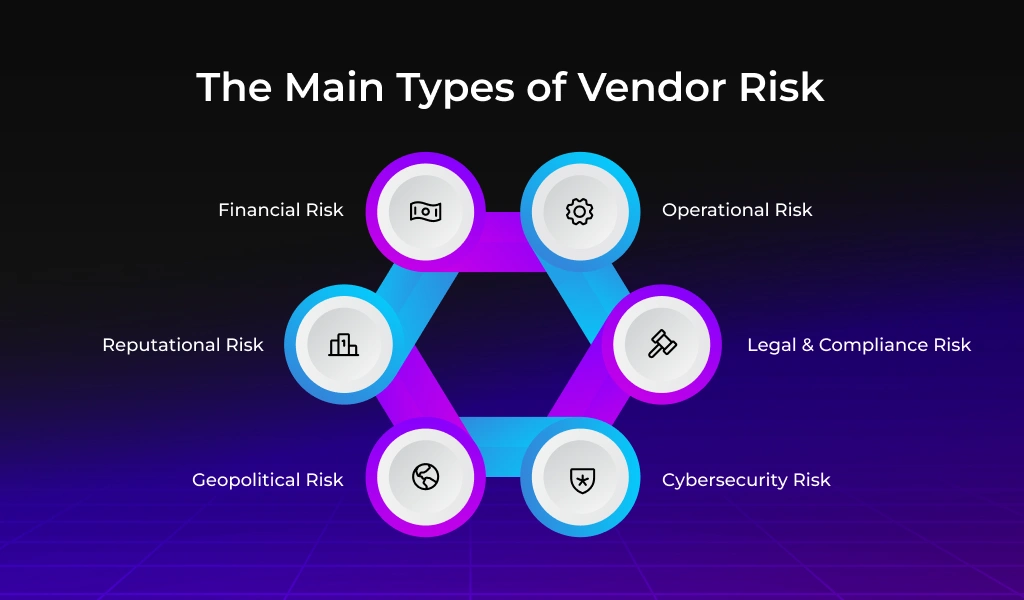
- Financial Risk – The vendor experiences financial difficulties, fraud, or bankruptcy that affects its ability to deliver services.
- Operational Risk – Service disruptions, supply chain failures, staffing shortages, or performance issues impact business operations.
- Legal and Compliance Risk – The vendor fails to meet regulatory requirements, creating potential liability for your organization.
- Cybersecurity Risk – Data breaches, ransomware attacks, insecure systems, or unauthorized access can compromise sensitive information.
- Reputational Risk – A vendor’s actions, public controversy, or security incident damages customer trust in your organization.
- Geopolitical Risk – Political instability, sanctions, trade restrictions, or regional conflicts affect the vendor’s ability to operate.
Why Vendor Risk Management Is a Board-Level Priority in 2026
Third-party risk is no longer just a cybersecurity or procurement issue. As organizations become increasingly dependent on cloud providers, SaaS platforms, outsourcing partners, AI vendors, and global supply chains, vendor-related incidents can directly impact business operations, regulatory compliance, financial performance, and customer trust.
At the same time, regulators and boards are demanding greater visibility into third-party risk exposure. Frameworks such as DORA, NIS2, GDPR, HIPAA, and the EU AI Act all place increasing responsibility on organizations to understand and manage risks introduced by their vendors.
Below are 5 reasons vendor risk management has become a board-level priority in 2026:
1. Third-Party Breaches Continue to Increase
Many of today’s most significant cybersecurity incidents originate through third parties rather than direct attacks on the organization itself. Vendors often have access to sensitive data, critical systems, and business processes, making them attractive targets for attackers.
As a result, boards are increasingly asking not only, “Are we secure?” but also, “Are our vendors secure?”
2. Regulatory Requirements Are Expanding
Regulations around the world are placing greater emphasis on third-party oversight. Organizations are now expected to assess vendor security, monitor compliance, maintain contractual controls, and demonstrate ongoing due diligence throughout the vendor relationship.
Failure to manage vendor risk can result in regulatory penalties even when the incident originates within a third party.
3. AI Vendors Introduce New Risk Categories
The rapid adoption of AI-powered solutions has expanded the scope of vendor risk management. Organizations must now evaluate risks related to model transparency, data usage, algorithmic bias, explainability, and compliance with emerging AI regulations.
Traditional vendor assessments designed for cybersecurity and privacy are often insufficient for evaluating AI-specific risks.
4. Supply Chain Dependencies Are Increasing
Modern organizations depend on complex ecosystems of vendors, subcontractors, and cloud providers. In many cases, critical business operations rely on a small number of external providers.
This creates concentration risk, where a disruption affecting a single vendor can impact multiple business functions simultaneously.
5. Boards Need Greater Visibility Into Organizational Risk
Vendor-related incidents can affect revenue, operations, compliance, customer trust, and shareholder value. As a result, vendor risk management has become an important component of enterprise risk management and board oversight.
Organizations that maintain a formal vendor risk management program are better positioned to identify emerging risks, demonstrate regulatory compliance, and make informed decisions about third-party relationships.
Vendor Risk Tiering: The 4-Tier Classification Model
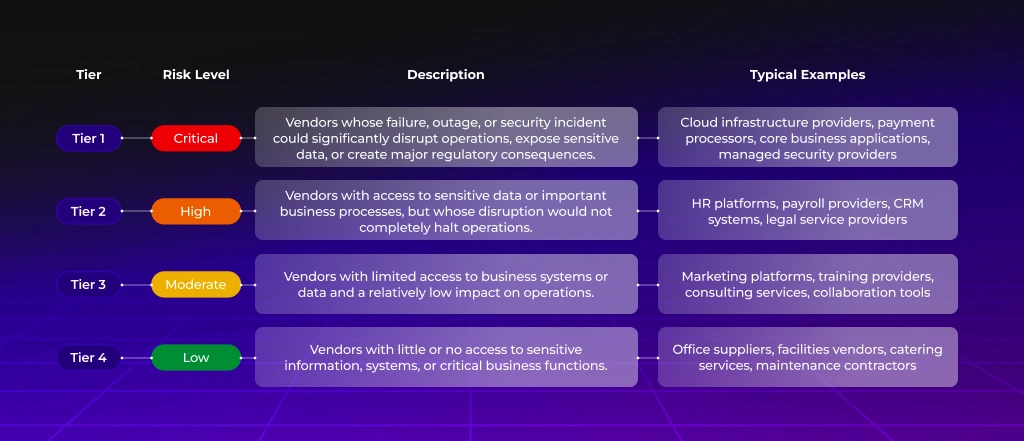
Not all vendors require the same level of oversight. A vendor that processes customer data or supports critical business operations presents a much higher level of risk than a supplier providing office equipment or facilities services.
Vendor tiering helps organizations prioritize resources by classifying vendors according to their potential impact on the business. The higher the risk tier, the more rigorous the due diligence, monitoring, and reassessment requirements.
The VRM Lifecycle: 6-Step Process
An effective vendor risk management (VRM) program is not a one-time assessment completed during procurement. Vendor risks evolve over time as vendors gain access to new systems, process additional data, expand their services, or experience security and operational changes.
For this reason, VRM should be treated as a continuous lifecycle that begins before a vendor is selected and continues until the relationship is formally terminated.
The following 6-step framework helps organizations consistently manage vendor risks while meeting growing regulatory expectations for third-party oversight, cybersecurity, data protection, operational resilience, and AI governance.
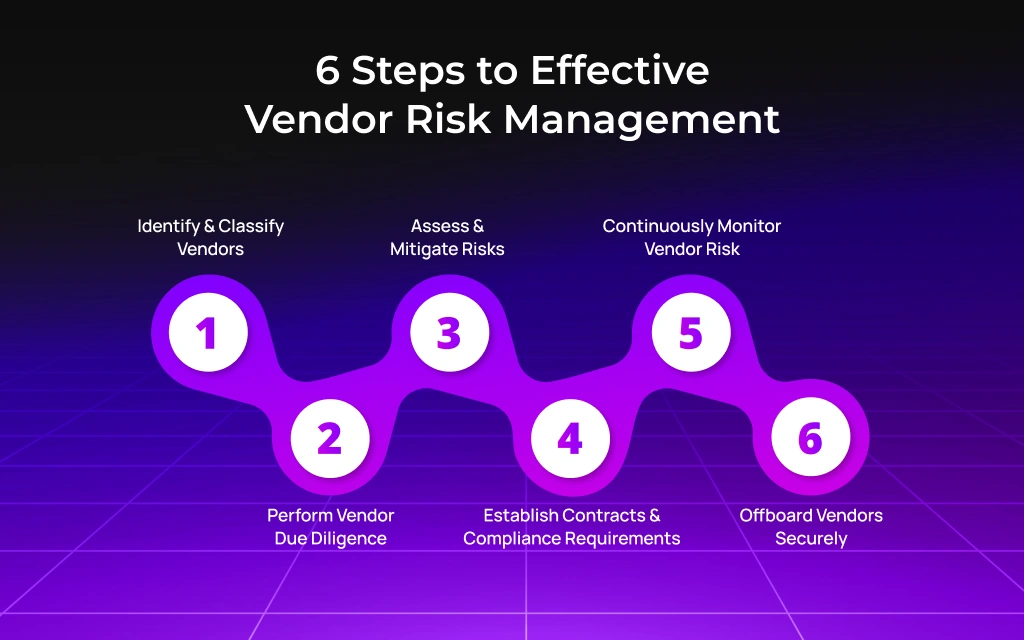
1. Identify and Classify Vendors
The first step is to create a complete inventory of all third-party vendors and determine how much risk each vendor poses to the organization.
Not every vendor requires the same level of scrutiny. A cloud provider that hosts customer data poses significantly more risk than a company that supplies office furniture. By classifying vendors into risk tiers, organizations can focus their resources on the vendors that matter most.
When assigning risk tiers, organizations typically evaluate:
- Access to sensitive or regulated data
- Access to internal systems and networks
- Impact on critical business operations
- Regulatory and compliance requirements
- Geographic location and data transfers
- Use of subcontractors or fourth parties
- Use of AI technologies
Example:
A payroll provider that stores employee personal information and salary data would likely be classified as a high-risk or Tier 1 vendor. In contrast, a catering company serving office events would typically be classified as a low-risk or Tier 4 vendor.
2. Perform Vendor Due Diligence
Once a vendor has been identified and classified, the next step is to evaluate whether the vendor can meet the organization’s security, compliance, operational, and business requirements.
Vendor due diligence helps organizations understand potential risks before signing a contract or granting access to systems and data.
Common due diligence activities include:
- Reviewing security questionnaires
- Evaluating compliance certifications such as ISO 27001 or SOC 2
- Assessing privacy and data protection practices
- Reviewing financial stability and business viability
- Examining incident response and disaster recovery capabilities
- Evaluating AI governance and data usage practices for AI vendors
Example:
Before selecting a cloud storage provider, a company may request a SOC 2 report, review the vendor’s encryption practices, and verify whether customer data is stored in approved geographic regions. If the vendor cannot demonstrate adequate security controls, the organization may choose another provider.
3. Assess and Mitigate Risks
After gathering information during due diligence, organizations must analyze the identified risks and determine whether they are acceptable.
Risk assessment involves evaluating both the likelihood of a risk occurring and the potential impact on the business if it does occur.
Once risks are identified, organizations can implement mitigation measures to reduce exposure.
Common mitigation strategies include:
- Requiring additional security controls
- Limiting vendor access to sensitive systems
- Implementing stronger contractual protections
- Requesting remediation plans
- Purchasing cyber insurance
- Selecting an alternative vendor if risks are too high
Example:
A software vendor may have strong security controls but lack multi-factor authentication (MFA) for administrator accounts. Rather than rejecting the vendor outright, the organization may require MFA implementation before onboarding can proceed.
4. Establish Contracts and Compliance Requirements
Contracts play a critical role in vendor risk management because they formally define each party’s responsibilities and expectations.
A well-structured contract should clearly outline security requirements, privacy obligations, performance expectations, and procedures for handling incidents.
Key contractual provisions often include:
- Data protection and privacy requirements
- Security control obligations
- Service-level agreements (SLAs)
- Audit and assessment rights
- Incident notification timelines
- Business continuity requirements
- Regulatory compliance obligations
- Vendor and subcontractor responsibilities
This step is particularly important for organizations subject to regulations such as GDPR, DORA, NIS2, HIPAA, PCI DSS, or industry-specific compliance frameworks.
Example:
A healthcare organization working with a patient data processor may require the vendor to notify them of any security incident within 24 hours and maintain HIPAA-compliant safeguards throughout the contract period.
5. Continuously Monitor Vendor Risk
Many organizations make the mistake of assessing vendors only during onboarding. However, vendor risk can change significantly over time.
A vendor that was considered low risk last year may experience a data breach, financial difficulties, regulatory violations, or operational disruptions that increase its risk profile.
Continuous monitoring helps organizations identify these changes before they become major problems.
Monitoring activities may include:
- Annual or quarterly risk reassessments
- Security ratings and external attack surface monitoring
- Compliance reviews and certification checks
- Financial health assessments
- Threat intelligence monitoring
- Vendor performance reviews
- Breach and incident tracking
Example:
A company may discover through continuous monitoring that one of its software vendors suffered a ransomware attack. This information allows the organization to assess potential exposure, request remediation updates, and implement additional safeguards if necessary.
6. Offboard Vendors Securely
Vendor risk does not disappear when a contract ends. Organizations must ensure that vendors no longer have access to systems, data, or business resources after the relationship is terminated.
A structured offboarding process helps prevent unauthorized access, data leakage, and compliance issues.
Typical offboarding activities include:
- Revoking user accounts and system access
- Disabling integrations and API connections
- Recovering company-owned assets
- Confirming data deletion or return
- Reviewing contractual obligations
- Documenting lessons learned from the engagement
Example:
When a company switches CRM providers, it should ensure that the previous vendor deletes all customer records, removes API connections, and provides written confirmation that no copies of the data remain in its environment.
How to Automate Vendor Risk Management
As vendor ecosystems grow and regulatory expectations increase, managing vendor risk through spreadsheets, emails, and manual reviews becomes increasingly difficult. Automation helps organizations reduce administrative workload, improve consistency, and gain better visibility into vendor risks throughout the lifecycle.
Below are several ways organizations can automate vendor risk management processes in 2026:
- Map your current vendor risk management workflow — Start by identifying where manual effort is slowing down the process. Common bottlenecks include vendor onboarding, questionnaire reviews, evidence collection, risk scoring, and remediation tracking.
- Centralize vendor information in a single platform — Maintaining vendor records across spreadsheets and email threads makes it difficult to track risk consistently. Centralized VRM, TPRM, or GRC platforms provide a single source of truth for vendor inventories, assessments, contracts, and monitoring activities.
- Automate due diligence and assessment workflows — Security questionnaires, document requests, compliance reviews, and approval workflows can often be automated. This reduces repetitive administrative work and helps ensure that assessments follow a consistent process.
- Implement continuous vendor monitoring — Vendor risks can change long after onboarding. Continuous monitoring tools can automatically track security ratings, compliance status, financial health, breach notifications, and external threat intelligence.
- Use AI to improve assessment efficiency — Organizations are increasingly using AI-powered capabilities to analyze questionnaire responses, identify potential risks, prioritize high-risk vendors, and surface emerging issues that require further investigation.
- Automate reporting and risk visibility — Dashboards and automated reports provide stakeholders with real-time insights into vendor inventories, assessment status, remediation activities, and overall third-party risk exposure.
- Integrate vendor risk management with business systems — Connecting VRM tools with procurement, contract management, security, and GRC systems helps eliminate duplicate data entry and improve visibility across the vendor lifecycle.
- Continuously refine and optimize the program — Automation is not a one-time project. Organizations should regularly review workflows, monitoring capabilities, and assessment criteria to ensure the program remains effective as vendor relationships, technologies, and regulatory requirements evolve.
Conclusion
Third-party vendors play a critical role in modern business operations, but they also introduce risks that organizations cannot afford to overlook. From cybersecurity incidents and compliance violations to operational disruptions and AI-related concerns, vendor-related risks have become more complex and more consequential than ever before.
A well-designed vendor risk management program helps organizations identify high-risk vendors, perform effective due diligence, maintain continuous oversight, and meet evolving regulatory requirements. By combining risk-based vendor tiering, ongoing monitoring, and automation, organizations can reduce third-party risk while improving operational resilience and regulatory compliance.
Need help strengthening your vendor risk management program? Terralogic helps organizations implement governance, risk, and compliance frameworks, improve risk visibility, assess security and compliance risks, and align with evolving regulatory requirements.