


It starts the same way every time. A company pours hundreds of thousands into AI, launches a promising pilot, and within months, it is collecting dust.
This story is common. Gartner recently reported that 85% of AI projects fail to deliver expected business value. McKinsey found that only 8% of companies have scaled AI beyond the pilot stage successfully.
Think about that for a second. Companies pour money into AI, see promising early results, and then hit a wall that burns their investment into expensive shelfware.
But here’s what nobody’s talking about: AI application failures aren’t technology problems. They’re strategy problems disguised as technology challenges.
The businesses succeeding with AI in 2025 aren’t necessarily the ones with the best engineers or biggest budgets. They’re the ones who figured out that implementing AI is fundamentally different from implementing traditional software.
Let’s see exactly why AI projects fail in business and, more importantly, how to avoid becoming another cautionary tale.
 Let’s cut through the noise and talk about the real challenges in implementing AI applications that we see repeatedly:
Let’s dive straight to the real challenges in implementing AI applications failures that happen repeatedly
Let’s cut through the noise and talk about the real challenges in implementing AI applications that we see repeatedly:
Let’s dive straight to the real challenges in implementing AI applications failures that happen repeatedly
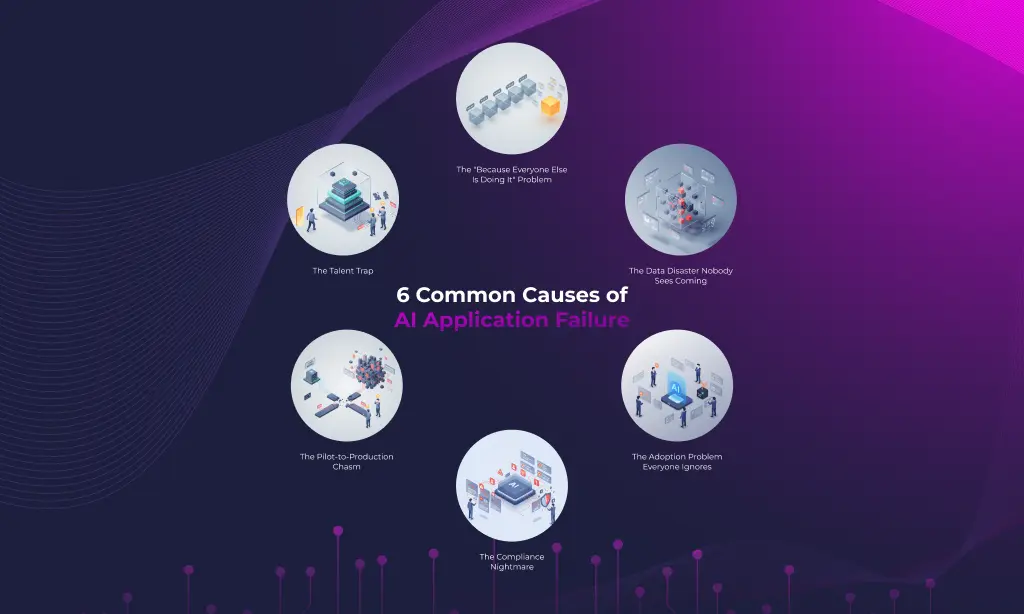
6 Common Causes of AI Application Failure
Let’s cut through the noise and talk about the real challenges in implementing AI applications that we see repeatedly:
Let’s dive straight to the real challenges in implementing AI applications failures that happen repeatedly
- The “Because Everyone Else Is Doing It” Problem
- The Data Disaster Nobody Sees Coming
- The Talent Trap
- The Pilot-to-Production Chasm
- The Adoption Problem Everyone Ignores
- The Compliance Nightmare
What Successful AI Leaders Do Differently
They Obsess Over Business Outcomes, Not Technology The best AI project success factors start with ruthless clarity on what success looks like in business terms.- They Design for Humans, Not Just Algorithms
- They Build Infrastructure Before Applications
- They Think in Phases, Not Projects
- They Partner Strategically
Practical Steps to Get AI Right in 2025
Here’s your playbook for how to ensure successful AI implementation: Define Success in metrics and sense. Before writing code, answer: What specific business metric improves? By how much? What’s that worth? If you can’t quantify the value, you’re not ready to build. Start Small, Win Big Pick high-impact, low-risk use cases for your first AI implementation. Customer service chatbots are before autonomous decision-making systems. Invoice processing before strategic forecasting. Quick wins fuel momentum, build capability, and boost organizational confidence. Invest in Your People Train your team not only on how to use AI tools but to think with AI. The companies succeeding with AI are building AI literacy across their organization, not just in IT, allowing them to scale easily. Make Security and Compliance Non-Negotiable Create a solid foundation for privacy, security, and auditability in your AI from the start. Retrofitting compliance is exponentially harder and more expensive than designing for it up front. Plan for Maintenance, Not Just Launch AI models need fine-tuning over time as patterns change. Your initial implementation is just the beginning; you need more budget for ongoing monitoring, retraining, and refinement.The Role of Trusted AI Partners
Here’s what I’ve learned watching hundreds of AI implementations: the companies that try to figure everything out alone are the ones most likely to fail. Why Does Going Solo Fail? To build production-grade AI, one requires expertise in machine learning, data engineering, UX design, security, compliance, and change management. Few companies have all these skills in-house. Many businesses spend years and millions trying to build AI capabilities from scratch, only to end up with systems that don’t deliver business value. What the Right Partner Provides Strategic partners help you avoid AI application design mistakes companies make by bringing:- Strategy clarity: helping you identify where AI creates the most value
- Design expertise: building AI that people actually want to use
- Technical depth: implementing AI that works reliably at scale
- Ongoing support: maintaining and improving AI as your business evolves