


Many modern data breaches stem from gaps in governance, risk, and compliance rather than failures in security tools. Organizations often struggle with fragmented governance, limited risk visibility, and compliance processes that cannot keep pace with expanding digital operations.
In 2026, governance, risk, and compliance cybersecurity are no longer just a compliance exercise. It has become the foundation for managing cyber risk, regulatory pressure, operational resilience, and board-level accountability.
As regulations such as GDPR, NIS2, DORA, PCI DSS 4.0, and the EU AI Act continue to expand, organizations are under growing pressure to strengthen governance and demonstrate continuous compliance. At the same time, boards increasingly expect security leaders to report cyber risk in clear business terms.
A modern governance risk and compliance framework helps organizations connect governance policies, risk management, compliance controls, and incident response into one operational strategy.
In this guide, we will explain what governance risk and compliance mean in cybersecurity, why it matters in 2026, and how organizations can build a stronger and more scalable GRC program.
Key Takeaways
- Governance risk and compliance in cybersecurity combines governance, risk management, and compliance into one integrated framework. Together, these functions help organizations improve accountability, reduce cyber risk, and meet regulatory requirements more effectively.
- In 2026, GRC programs are becoming more automated and operationally embedded. Organizations are shifting from reactive compliance management to proactive risk leadership and continuous monitoring.
- Key governance risk and compliance regulations shaping 2026 include GDPR, HIPAA, PCI DSS 4.0, NIS2, DORA, the EU AI Act, SEC cybersecurity disclosure rules, and NIST CSF 2.0.
- Modern governance risk and compliance software helps organizations automate workflows, centralize documentation, improve audit readiness, and generate real-time risk reporting.
- Organizations that fail to integrate GRC effectively face regulatory penalties, reputational damage, operational disruption, and increased business risk. In 2026, GRC is no longer just a compliance requirement — it is a business resilience strategy.
What Is Governance, Risk & Compliance (GRC)?
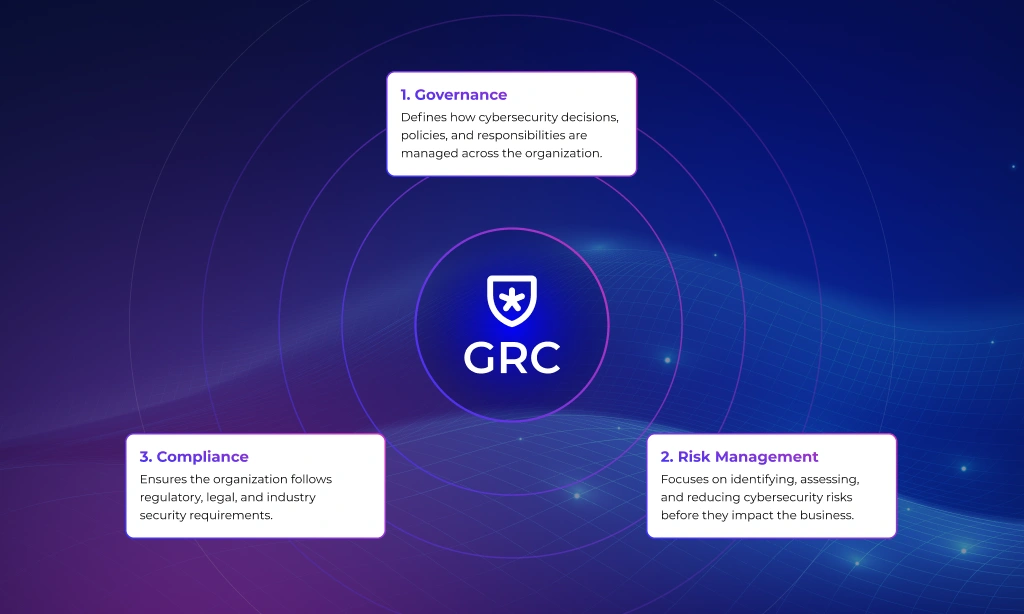
Governance, risk and compliance (GRC) is an integrated approach to managing an organization’s security, legal, operational, and regulatory responsibilities. Instead of handling governance, risk, and compliance separately, GRC connects them into one structured framework that supports better decision-making and stronger organizational resilience. A modern governance risk and compliance framework is built around 3 core pillars:
1. Governance
Governance focuses on how cybersecurity decisions are directed and managed across the organization. It defines roles, responsibilities, security policies, and accountability structures that align cybersecurity with the overall business strategy. Strong governance helps organizations:- Establish clear security ownership
- Improve oversight and accountability
- Align security priorities with business goals
- Standardize cybersecurity policies across teams
2. Risk Management
Risk management is the process of identifying, assessing, and reducing cybersecurity risks before they become larger business problems. The goal is to turn unknown threats into prioritized and manageable action plans. This includes:- Identifying vulnerabilities and security gaps
- Assessing operational and financial impact
- Prioritizing risks based on severity
- Implementing mitigation and monitoring strategies
3. Compliance
Compliance ensures the organization follows relevant legal, regulatory, and industry requirements. This may include standards such as GDPR, HIPAA, PCI DSS 4.0, NIS2, or ISO 27001. An effective compliance strategy helps organizations:-
- Reduce the risk of regulatory penalties
- Improve audit readiness
- Build customer and stakeholder trust
- Access regulated or high-value markets
Why GRC Is Critical in Cybersecurity in 2026
In 2026, organizations are facing growing pressure to manage cyber risk in a more structured and measurable way. Regulatory enforcement is increasing rapidly. At the same time, expanding digital operations, AI adoption, and board-level accountability are making integrated governance, risk, and compliance cybersecurity programs a business necessity, not just a compliance exercise. Here are 5 major factors driving GRC adoption in 2026:1. Regulatory Enforcement Is Accelerating
Many cybersecurity regulations are now moving from guidance to active enforcement. Organizations are expected to demonstrate continuous compliance, faster reporting, and stronger governance oversight. Key regulations shaping 2026 include:- DORA for EU financial entities
- NIS2 across critical infrastructure sectors
- PCI DSS 4.0 for payment security
- The EU AI Act for AI governance
- SEC cybersecurity disclosure rules
2. Boards Expect Business-Level Risk Reporting
Cybersecurity is no longer discussed only within IT or security teams. In 2026, boards and investors increasingly expect CISOs to explain cyber risk in business terms, not just technical metrics. This includes:- Financial impact of cyber incidents
- Operational resilience risks
- Regulatory exposure
- Third-party and supply chain risks
- Business continuity readiness
3. AI Is Creating New Governance Challenges
AI adoption is expanding faster than most organizations can govern it. Employees are increasingly using AI tools across daily workflows, while many organizations still lack formal AI governance policies. This creates new challenges around:- Data privacy and security
- AI-generated decision-making
- Regulatory compliance
- Model transparency and accountability
- Shadow AI usage across teams
4. Cybersecurity Is Becoming Part of ESG Strategy
Cybersecurity is now closely connected to ESG reporting and corporate governance. Investors and regulators increasingly evaluate organizations based on how they manage cyber risk and protect sensitive data. Poor cybersecurity governance can impact:- Investor confidence
- ESG ratings
- Brand reputation
- Customer trust
- Access to regulated markets
5. Supply Chain Risk Continues to Expand
Modern organizations rely heavily on vendors, cloud providers, SaaS platforms, and third-party service providers. As a result, cyber risk now extends far beyond internal systems and networks. A strong governance risk and compliance framework helps organizations:- Assess third-party security risks
- Standardize vendor compliance reviews
- Monitor supply chain exposure
- Improve incident response coordination
- Maintain operational resilience across partners
The GRC Framework — Structure, Components & Key Standards
A governance risk and compliance framework defines how governance, risk, and compliance activities are organized, managed, and measured across an organization. It helps businesses align cybersecurity operations with regulatory requirements, risk management priorities, and overall business objectives.Core Components of a GRC Framework
An effective GRC framework is typically built around 5 operational components that support governance, risk visibility, compliance management, and incident response across the organization.1. Policy Management
Policy management focuses on creating, updating, distributing, and tracking organizational security and compliance policies. It helps ensure employees follow consistent security standards across teams, departments, and business operations. A strong policy management process also improves version control, approval workflows, employee acknowledgment tracking, and audit readiness.2. Risk Assessment
Risk assessment is the process of identifying, analyzing, and prioritizing cybersecurity risks that could affect the organization. The goal is to understand which threats create the highest operational, financial, or regulatory impact. This process often includes vulnerability assessments, threat intelligence analysis, risk scoring, and ongoing monitoring of critical systems and assets.3. Control Mapping
Control mapping links security controls to internal policies, business processes, systems, and regulatory requirements. It helps organizations understand which controls support specific compliance obligations and risk management objectives. This reduces duplicated compliance work and allows the same controls to be reused across multiple frameworks, audits, and reporting requirements.4. Compliance Monitoring
Compliance monitoring focuses on continuously tracking whether security controls, policies, and operational processes meet regulatory and industry requirements. Instead of preparing only for annual audits, organizations now need ongoing visibility into compliance performance. Modern GRC programs use continuous monitoring to identify gaps earlier, respond to regulatory changes faster, and maintain stronger audit readiness throughout the year.5. Incident Management
Incident management focuses on how organizations detect, respond to, document, and recover from cybersecurity incidents. It connects security events directly to governance, compliance, and risk management workflows. This includes incident tracking, response coordination, post-incident analysis, reporting processes, and updates to the organization’s risk register and security policies.Key GRC Frameworks & Standards in 2026
Several frameworks and regulations are shaping modern governance, risk and compliance cybersecurity programs in 2026. These standards help organizations strengthen governance structures, improve risk management processes, and maintain compliance across increasingly complex digital environments.1. NIST CSF 2.0
NIST CSF 2.0 is a cybersecurity framework developed by the U.S. National Institute of Standards and Technology. What it does:- Helps organizations manage and reduce cybersecurity risks
- Provides guidance for governance, risk management, and security operations
- Improves visibility into cybersecurity responsibilities and accountability
2. ISO 27001
ISO 27001 is an international standard for information security management systems (ISMS). What it does:- Helps organizations protect sensitive business and customer data
- Establishes structured security and risk management processes
- Improves audit readiness and compliance management
3. DORA
The Digital Operational Resilience Act (DORA) is a European Union regulation focused on cybersecurity and operational resilience for financial institutions. What it does:- Strengthens ICT risk management and operational resilience
- Requires faster incident reporting and response processes
- Improves third-party and supply chain risk oversight
4. EU AI Act
The EU AI Act is a regulation designed to govern how organizations develop and use AI systems. What it does:- Introduces governance requirements for AI systems
- Improves transparency and accountability for AI usage
- Establishes compliance requirements for high-risk AI applications
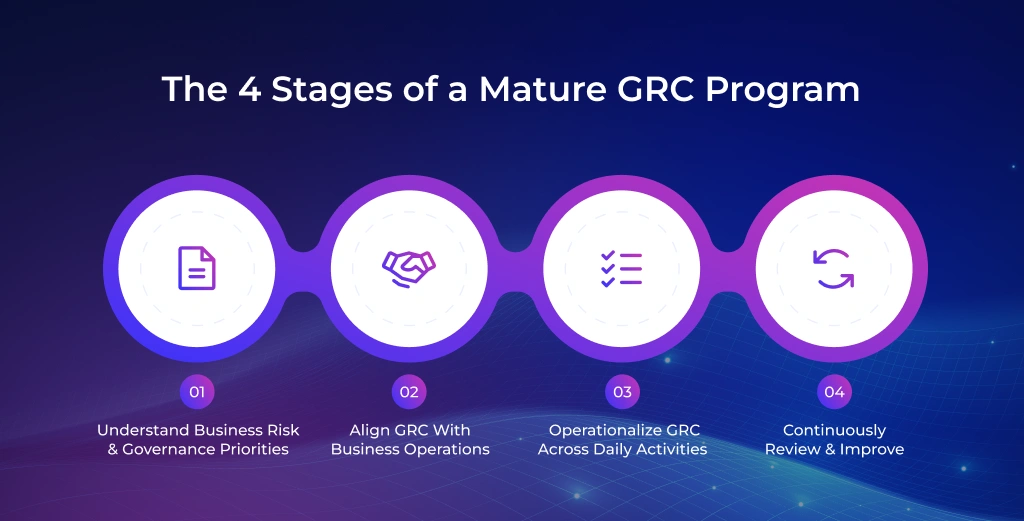
How Mature GRC Programs Operate in 2026
Modern governance risk and compliance programs are no longer managed through isolated audits and manual compliance tracking. In 2026, organizations are building integrated GRC operating models that continuously connect governance, risk management, compliance, and security operations.
1. Understand Business Risk & Governance Priorities
Mature GRC programs begin by understanding the organization’s business environment, regulatory obligations, operational risks, and governance priorities. At this stage, organizations define their risk appetite, identify compliance requirements, and evaluate how cyber risks could affect business operations and strategic goals.2. Align GRC With Business Operations
Once governance priorities are established, organizations align security policies, compliance processes, and risk management activities with broader business objectives. The goal is to ensure governance and cybersecurity decisions support operational efficiency, resilience, and long-term business growth rather than operating as disconnected compliance functions.3. Operationalize GRC Across Daily Activities
At this stage, GRC becomes part of day-to-day operations. Organizations implement security controls, monitor cyber risks continuously, manage compliance activities, coordinate incident response, and automate reporting processes. Instead of relying on annual assessments alone, mature GRC programs use continuous monitoring and real-time visibility to identify issues earlier and respond faster.4. Continuously Review & Improve
Mature GRC programs continuously evolve based on audit findings, security incidents, regulatory changes, and emerging threats. Organizations regularly review governance processes, update policies, improve controls, and refine risk management strategies to strengthen operational resilience over time.Best Practices for Building a Strong GRC Program
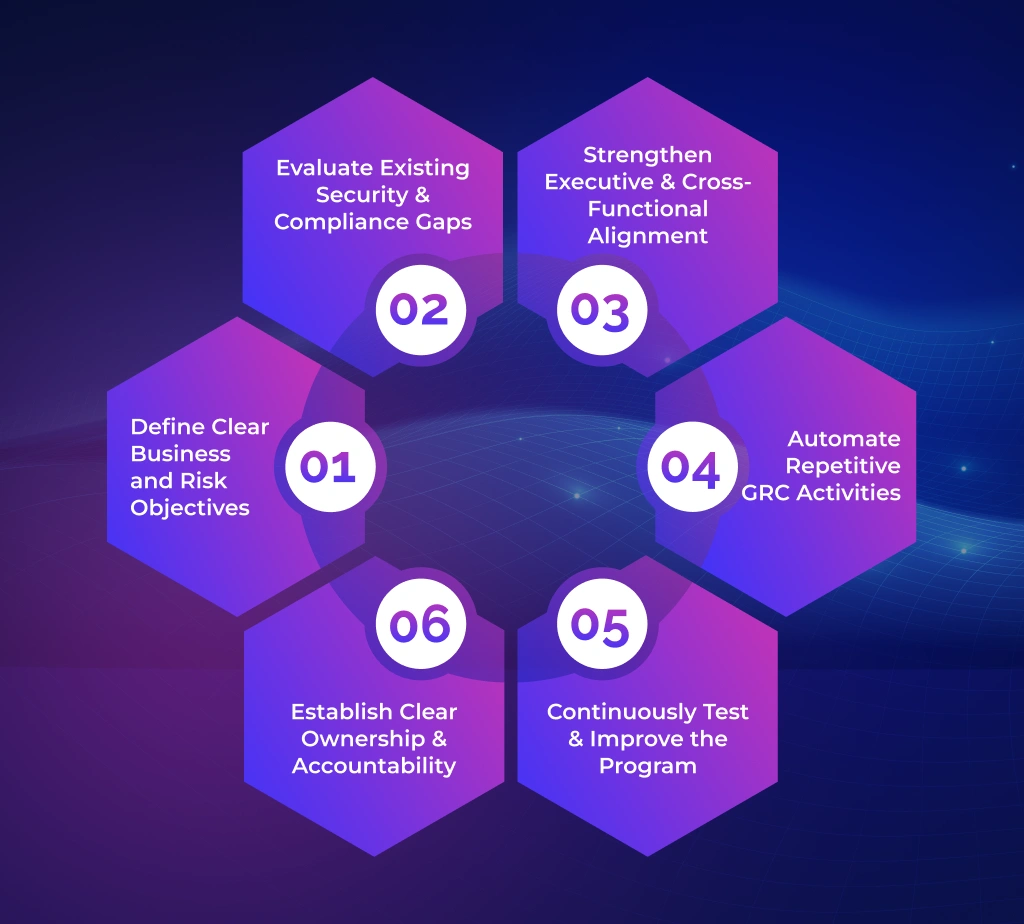
Building an effective governance risk and compliance program requires more than implementing policies or preparing for audits. In 2026, organizations need operational GRC strategies that improve visibility, strengthen accountability, and support long-term business resilience.